

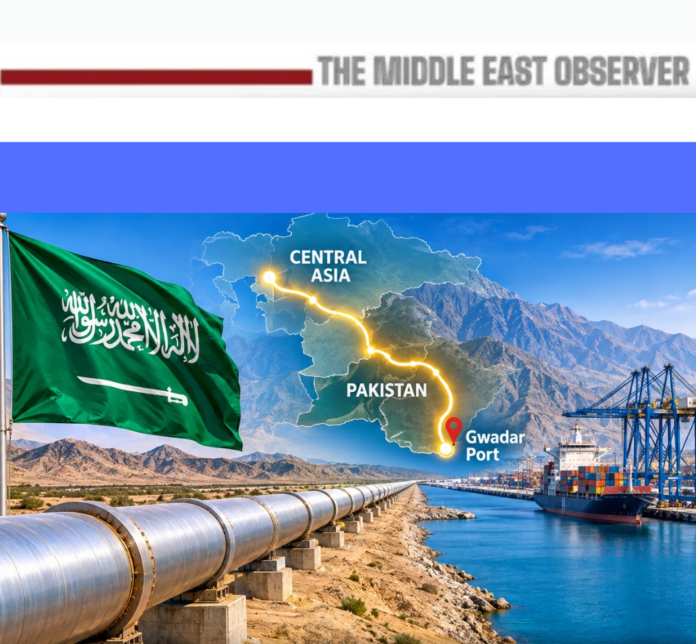
Saudi Arabia’s Delta Energy Saudi and Pakistan’s state-owned Inter State Gas Systems signed an agreement on November 17 to explore a $25 billion–$30 billion gas infrastructure programme that could connect Central Asia and Afghanistan to the Arabian Sea port of Gwadar, with potential extensions towards India, as Islamabad seeks to diversify energy supplies and strengthen regional trade links.
The memorandum of understanding (MoU), signed under the auspices of Pakistan’s Special Investment Facilitation Council (SIFC), establishes a framework for assessing a network of gas pipelines, liquefied natural gas (LNG) facilities, processing plants, storage infrastructure and export terminals. It does not represent a final investment decision or a commitment to finance construction.
According to Pakistan’s Petroleum Division, the proposed pipeline would originate in Turkmenistan, cross Afghanistan and enter Pakistan near Chaman before running through Balochistan to Gwadar, where an LNG terminal is planned.
The programme also envisages expanding the network towards Pakistan’s eastern border, potentially establishing a gas transportation corridor linking Afghanistan with markets further east.
One proposed route would extend from Chaman across Pakistan towards Fazilka, near the Indian border. Delta Energy described the corridor as a strategic priority, although implementation would require formal engagement and agreements with Pakistani and Indian authorities, according to Reuters.
Afghanistan’s Kashk gas concession and other Afghan resources have been identified as potential supply sources. However, no binding gas supply agreements, confirmed transportation volumes or construction schedules have been announced.
The proposed supply arrangements also contain an unresolved distinction. While Pakistan’s official announcement identifies Turkmenistan as the starting point, Delta Energy said the programme was separate from the long-delayed Turkmenistan-Afghanistan-Pakistan-India (TAPI) pipeline and would not depend on Turkmen gas supplies, Reuters reported.
Delta Energy’s ambitions extend beyond the newly announced Pakistan agreement. Its CENTGAZ initiative envisages a regional gas transmission network connecting resources in Iran and Central Asia through Afghanistan to Pakistan, with proposed routes passing through Herat, Helmand, Kandahar and Spin Boldak.
The company’s broader Afghan midstream infrastructure programme carries projected capital expenditure of $13 billion to $18 billion, covering three export corridors, four domestic transmission routes and associated gas infrastructure, including a proposed LNG terminal at Gwadar.
These plans illustrate Delta Energy’s wider regional ambitions, although the company has not established whether the Afghan projects and the new Pakistan programme would share financing arrangements or development schedules.
Delta International Energy, part of the privately held Saudi Delta International Group, also lists exploration and development interests in Algeria, Uganda and Venezuela.
The latest agreement comes as Pakistan and Turkmenistan seek to revive progress on TAPI, a separate project designed to transport gas from Turkmenistan’s Galkynysh field through Afghanistan and Pakistan towards India.
The approximately 1,800-kilometre pipeline has a designed annual transportation capacity of 33 billion cubic metres, but its development has faced prolonged delays involving financing, security and cross-border arrangements.
On November 17, Pakistan’s Deputy Prime Minister and Foreign Minister Ishaq Dar discussed the project’s progress with Turkmenistan’s Foreign Minister Rashid Meredov during bilateral meetings in Islamabad. The two sides agreed to convene a steering committee to address outstanding technical and commercial issues.
The parallel discussions highlight renewed efforts to develop regional gas corridors, although the Delta Energy proposal and TAPI remain separate initiatives with different commercial arrangements.
Pakistan’s domestic energy requirements provide an important economic backdrop to the proposed investment. According to the Pakistan Economic Survey 2025–26, indigenous natural gas accounted for approximately 29.3% of the country’s primary energy supply mix.
The country operates more than 13,700 kilometres of gas transmission pipelines, supported by extensive distribution networks serving over 10.9 million consumers.
Average natural gas consumption, including regasified LNG, stood at approximately 2,929 million cubic feet per day during July 2025–March 2026, underscoring the scale of the market and the importance of maintaining reliable gas supplies.
The proposed development would also add an energy infrastructure dimension to expanding Saudi–Pakistan cooperation, which has included closer defence ties and efforts to deepen bilateral investment.
If implemented, the network could diversify Pakistan’s access to regional gas resources, support new processing and storage capacity at Gwadar, and create additional cross-border energy connections. Its commercial prospects, however, will depend on securing reliable gas supplies, financing and the necessary government approvals.
For now, the $25 billion–$30 billion figure represents the estimated scale of projects under consideration, rather than committed Saudi investment. Final financing arrangements, construction contracts, supply volumes and implementation schedules remain subject to feasibility assessments and further negotiations.
Related News:
Saudi Aramco Studies New Oil Export Routes, Eyes 10m-Bpd Pipeline Capacity
Saudi Arabia Targets Stake in Pakistan’s $6.5bn Reko Diq Mining Project
Read Also:
How Gulf Energy Logistics Could Evolve After the Hormuz Crisis
Egypt–Saudi Energy Pact Targets Petrochemicals, Industrial Investment and Supply Security
