

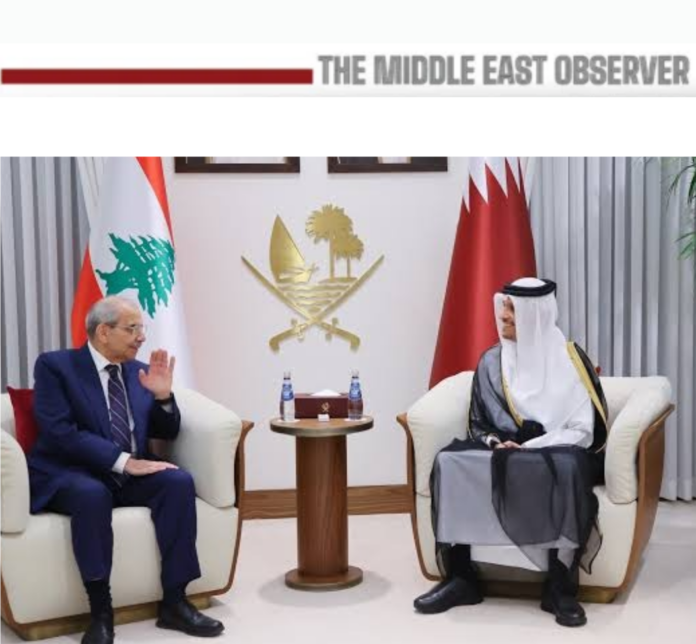
Lebanese Prime Minister Nawaf Salam said Qatar and Lebanon had made significant progress towards a proposed 20-year liquefied natural gas (LNG) supply agreement following talks in Doha on November 15, 2026, advancing a broader plan to rebuild Lebanon’s electricity sector through Qatari-backed power generation and gas infrastructure projects.
Salam announced the progress after meeting his Qatari counterpart, Sheikh Mohammed bin Abdulrahman bin Jassim Al Thani, alongside Lebanese Energy Minister Joe Saddi and Qatar’s Minister of State for Energy Affairs Saad bin Sherida Al Kaabi.
A Lebanese technical team also arrived in Doha to continue discussions on electricity generation, gas supplies and related infrastructure, according to Salam.
The latest talks followed the Lebanese cabinet’s November 13 approval of the main elements of the electricity plan, authorising Saddi to continue negotiations with Qatar on financial arrangements, electricity tariffs and guarantees before submitting the outcome for further government consideration.
The negotiations build on Qatar’s October 16 commitment to help modernise Lebanon’s electricity sector through a comprehensive programme intended to increase generation capacity and improve the reliability of power supplies.
An October proposal prepared with Lebanese and Qatari government involvement envisages building two combined-cycle gas-fired power plants at Deir Ammar in northern Lebanon and Zahrani in the south, each with a planned capacity of 825 megawatts, according to a document reviewed by Reuters.
The two plants, with a combined proposed capacity of 1,650 megawatts, are targeted for construction over three years under the preliminary plan. The timetable and final project specifications remain subject to agreement.
The proposal also includes a 20-year LNG supply arrangement involving QatarEnergy, a floating storage and regasification unit to receive imported gas, and potential use of the Arab Gas Pipeline through Syria.
The wider programme incorporates 800 megawatts of solar generation, 440 megawatts of wind power, battery storage and potential electricity imports from Syria initially estimated at 300 megawatts.
Financing is expected to involve private investment and a build-operate-transfer model, under which project developers would finance, construct and operate facilities before transferring ownership. The proposed arrangement would avoid upfront capital expenditure by the Lebanese government but could still entail future electricity payments, contractual commitments and financial guarantees.
Lebanon’s state utility, Électricité du Liban, continues to supply households with only a few hours of electricity daily, leaving many dependent on costly private diesel generators. The utility’s financial difficulties have also led to disputes over unpaid electricity bills from public institutions.
Although the proposed agreement could establish a long-term framework for gas supplies to support new electricity generation, no final LNG contract has been announced. Gas purchase volumes, pricing, financing guarantees and implementation schedules remain subject to negotiation and further government approvals.
Related News:
1- Golden Pass Startup Gives Qatar Strategic Buffer Amid Gulf LNG Disruptions
2- Middle East Crude Nears Pre-War Levels, but Energy Crisis Shifts Downstream
Read Also:
1- Cairo and Doha in Talks for Long-Term Gas Pact
2- Gulf Investors Build Sectoral Clusters Across Syria’s Reconstruction
