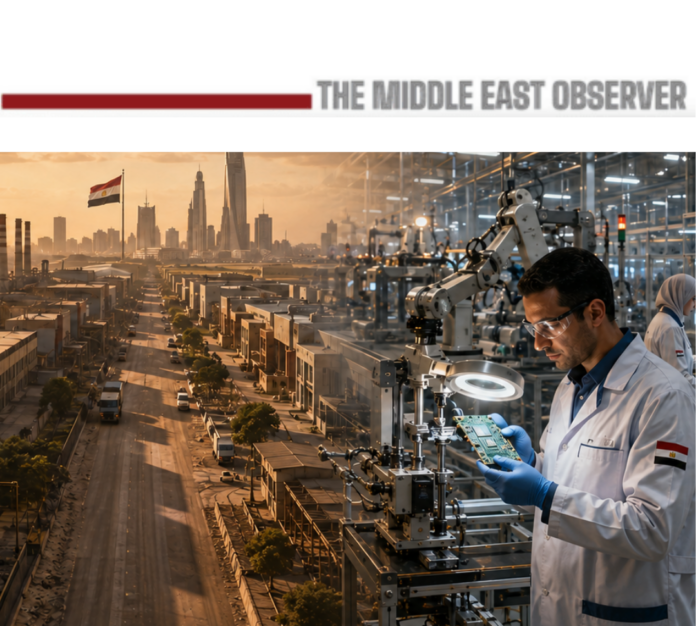
Egypt’s next industrial phase will increasingly be judged by the value investments create — through exports, technology, productivity, local supply chains and skilled employment — rather than by factory numbers alone.
A new study of Egypt’s investment regimes has found striking disparities between industrial locations operating under the same regulatory frameworks, strengthening the case for Cairo to focus less on headline incentives and more on infrastructure, logistics and the quality of investment attracted.
The findings from the Egyptian Center for Economic Studies (ECES) come as Egypt targets $100bn in non-oil exports by 2030, sharpening the question of whether its next phase of industrialisation should be driven primarily by investment volume or by the economic value and productivity those investments generate.
Quality, in this context, means investment capable of generating higher value added, stronger exports, greater productivity, technology transfer, deeper local sourcing and skilled employment.
That does not diminish the importance of labour-intensive manufacturing in an economy that must generate jobs at scale, nor industries needed to reduce import dependence. Rather, it argues for a broader scorecard in which project numbers and capital commitments are assessed alongside their wider contribution to the economy.
Same Regime, Vastly Different Results
ECES provides striking evidence.
Nasr City Public Free Zone hosts about 206 projects representing $6.8bn of investment, while Qift Public Free Zone has only seven projects worth $15.4mn — despite both operating under the public free-zone regime.
ECES attributes much of the disparity to Nasr City’s access to labour, banking and logistics, while Qift is further from major markets and ports and has weaker supporting services.
The pattern is repeated inside the Suez Canal Economic Zone.
Ain Sokhna has 547 projects worth $33.1bn, more than 133,000 direct jobs and 88 supporting service activities. Qantara West has 52 projects worth $1.5bn. Sokhna benefits from port proximity, integrated infrastructure and a deeper industrial and logistics ecosystem.
The disparities matter because incentives alone cannot explain them. ECES finds that Egypt’s investment regimes offer many broadly comparable advantages, while infrastructure readiness, logistics, labour, raw materials and administrative efficiency can ultimately determine where investment succeeds.
From Industrial Land to Industrial Ecosystems
The findings strengthen the economic case for specialised industrial clusters rather than simply adding generic industrial acreage.
ECES cites MOPCO in Damietta, where fertiliser production benefits from natural-gas supplies and port access; dairy operations in Nubaria, where proximity to raw milk reduces transport costs; and Robbiki Leather City, where tanning is integrated with feeder industries and finished-product manufacturing.
Applied more broadly, the findings support clustering automotive manufacturing around component suppliers; pharmaceuticals around research, testing and certification; electronics around engineering skills and technology providers; food processing near agricultural production; and export manufacturing around ports and logistics.
ECES also recommends expanding the industrial-developer model, under which serviced, investment-ready land reduces the infrastructure and site-development burden investors otherwise face after committing capital.
Egypt’s Strategy Is Moving Towards Value
Government policy is increasingly moving in the same direction. The 2026–30 industrial strategy targets $100bn in non-oil exports by 2030 and prioritises sectors including garments and textiles, food, pharmaceuticals, automotive, electrical and engineering industries and electronics. The government has also emphasised localisation, technological development, competitiveness and deeper integration into global production chains.
Quality standards are becoming part of that push. Egypt has allocated EGP557mn to support about 200 industrial companies in obtaining quality, conformity, sustainability and environmental certifications, with authorities estimating that beneficiary companies could increase exports by 20–25% as compliance with international standards improves. (Goeic)
The shift extends beyond factories. Egypt’s digital exports doubled from $2.4bn in 2022 to $4.8bn in 2025, while the country is increasingly targeting higher-value activities including IT services, engineering R&D, AI, embedded software and electronic design.
Premium tradable services can therefore form part of the same transition towards higher-value exports.
A Broader Measure of Investment
The ECES findings do not argue against attracting more investment. They suggest that greater returns can be extracted from industrial land, infrastructure and incentives by considering what type of investment is attracted, where it is located and what economic value it generates.
Different regimes already serve different purposes. ECES identifies free zones as particularly suited to exporters, the SCZone to industries dependent on ports and logistics, and inland and investment zones to businesses primarily serving the domestic market while retaining export potential.
Infrastructure must also be matched by predictability. ECES calls for clearer criteria governing non-tax privileges and argues that fundamental investment conditions should remain reasonably stable for five to 10 years, reducing administrative discretion and giving investors greater certainty over long-duration projects.
Egypt still needs more production, particularly industries that create employment, deepen local manufacturing and reduce import dependence. But the next phase of its investment strategy will increasingly be judged by what those projects add: exports, technology, productivity, local supply chains and skilled employment.
The challenge is no longer simply to build more factories, but to extract more economic value from every factory — and every premium service — Egypt develops.
Related news:
Egypt Launches Digital Licensing Service for Commercial Premises
Egypt Opens 9 Industrial Projects in Suez Canal Economic Zone with $182.5mn Investments
Read also:
Egypt Adjusts Gas Pricing for Heavy Industries as Oil Prices Rise
Alpha Smart Invests $100mn in Integrated Sokhna Industrial Complex