

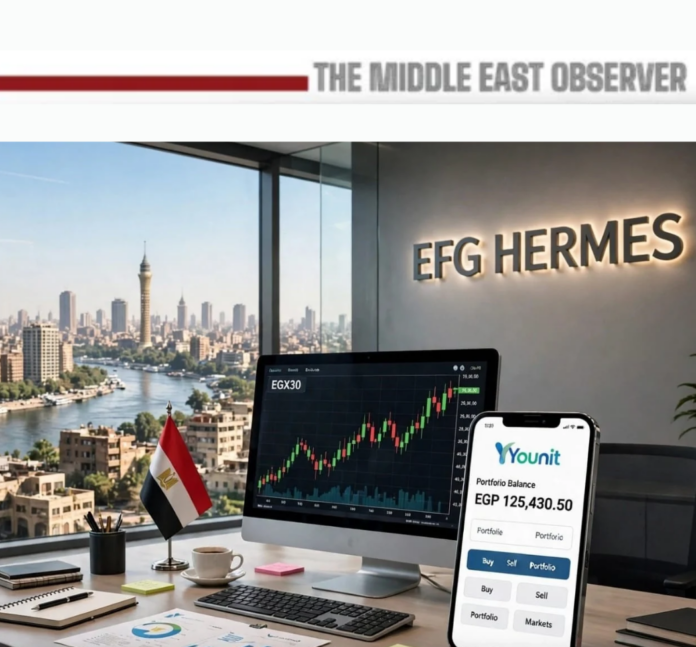
CAIRO, EFG Hermes has launched Egypt’s first retail algorithmic trading API platform, targeting a stock market where individual investors account for nearly three-quarters of trading activity but equity turnover fell 20.9% in October amid sustained institutional selling.
Announced on 1 November, Younit allows retail investors, developers and students to build automated trading strategies through EFG Hermes ONE. The platform offers commission-free trading during its first month, followed by a 0.1% commission on orders, with no monthly subscription fee, according to EgyptInnovate.
The launch follows a difficult month for Egyptian equities. Listed-stock turnover, including small and medium enterprises, declined to EGP211 billion in October from EGP266.7 billion in September, while the benchmark EGX30 lost 4.43%, according to the Egyptian Exchange’s monthly report.
Retail investors accounted for 74.9% of ordinary equity trading value during October, excluding block transactions, and purchased EGP4.14 billion net. Institutions sold an equivalent amount, while foreign investors recorded net sales of EGP2.3 billion and Arab investors sold EGP588.9 million.
The figures highlight the commercial opportunity facing EFG Hermes. Individual investors already generate most stock-market transactions, but greater retail activity has not prevented declining turnover or persistent institutional outflows.
Competition is also intensifying. Thndr led Egypt’s brokerage market in October with a 17.4% share, followed by Commercial International Brokerage at 15.9% and EFG Hermes’ combined brokerage operations at 14.3%, according to the exchange’s brokerage rankings.
Younit gives EFG Hermes a potential way to compete beyond conventional trading applications by allowing customers to develop their own execution systems, analytical dashboards and portfolio-management tools using the bank’s infrastructure.
The initiative originated in January 2026, when EFG Holding began developing a system to extend trading technology previously associated mainly with institutional clients to a wider audience, according to the group’s technology chief, Mohamed El Sayed Fathy.
Through application programming interfaces and software development kits, users can connect applications to trading systems, automate orders based on predefined rules and test strategies against historical market data before deploying capital.
The pricing model could encourage experimentation, although its economics will depend on trading frequency. At the announced 0.1% commission, an EGP100,000 purchase would incur EGP100 in brokerage fees after the promotional period. Buying and subsequently selling the same position at that value would cost approximately EGP200 before other applicable charges.
For EFG Hermes, higher transaction volumes could support brokerage revenue and customer retention. The company has not disclosed Younit’s development costs, initial registrations, expected trading volumes or projected financial contribution.
The broader market benefit is less straightforward. Retail investors accounted for 72.7% of gross listed-stock trading during the first half of 2026, according to calculations published by EnterpriseAM using exchange data, but their net purchases were only EGP3.74 billion against approximately EGP1.4 trillion in combined buying and selling activity.
That distinction matters for Younit. Faster execution could increase turnover without attracting equivalent new investment capital, particularly if automated strategies encourage existing investors to trade more frequently.
Algorithmic trading also introduces execution and risk-management challenges. Strategies that perform well against historical prices can fail during volatile sessions, while transaction costs and limited liquidity in smaller stocks may erode returns. Automated orders remain subject to applicable market rules and risk controls.
EFG Hermes plans to expand Younit through university competitions, hackathons and internships, potentially creating opportunities for Egyptian developers to build financial applications without establishing their own brokerage operations.
The first commercial test will come after the commission-free period, when paying-user retention and transaction volumes begin to reveal demand. For the wider market, the more important indicators will be new investor participation, sustained equity turnover and whether trading activity spreads beyond the most liquid shares.
Younit could strengthen EFG Hermes’ position in Egypt’s increasingly competitive retail brokerage market. Its contribution to capital-market development, however, will depend on whether automation attracts additional investment and improves market depth rather than simply accelerating transactions among existing investors.
Related News:
Egypt Stocks Struggle to Recover as High Yields Challenge Equity Demand
Egypt’s Equity Rebound Masks Continued Institutional Selling
Read Also:
EGX Attracts 550,000 New Investors as Foreign Selling Deepens
Egypt Stocks Rebound as Foreign Institutions Return, but Weak Liquidity Tests Recovery