

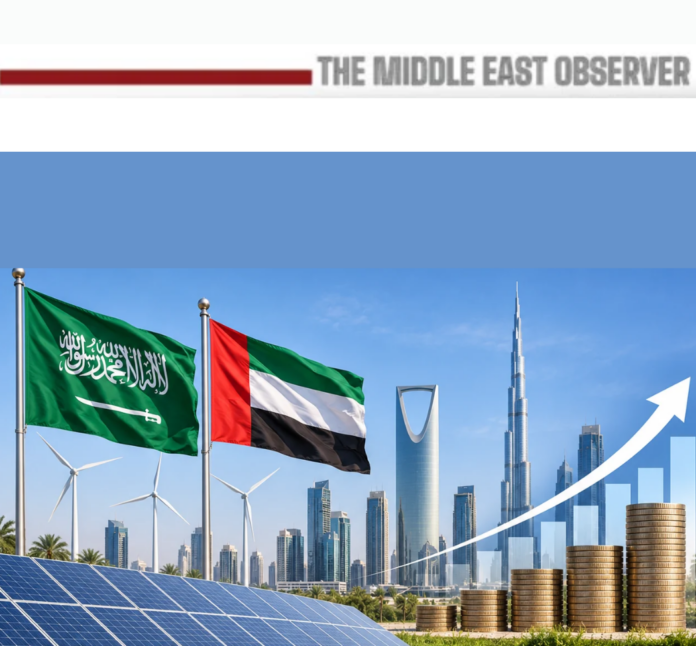
Greenpeace MENA research finds that faster diversification could strengthen public finances, but projected gains depend on higher non-oil revenues and tighter government spending.
Saudi Arabia and the United Arab Emirates could improve their combined annual budget balances by $25.9 billion by 2040 under a faster energy-transition strategy, according to a Greenpeace Middle East and North Africa study whose projections depend heavily on higher non-oil revenues and tighter government spending.
The report, Rethinking Long-Term Economic Development, published on November 2, compares continued hydrocarbon expansion with two managed-transition pathways across seven economic scenarios.
By 2040, the faster transition produces stronger annual fiscal balances in six of the seven scenarios in both countries. Continued expansion retains a narrow advantage only under sustained high oil prices.
Under the reference scenario, Saudi Arabia’s annual fiscal position improves by $17.1 billion relative to continued expansion, while the UAE gains $8.8 billion. These are modelled improvements in budget balances, not additional government revenues or guaranteed savings.
Fiscal reform drives the projected gains. Saudi Arabia’s faster-transition scenario assumes $107.7 billion less annual hydrocarbon revenue by 2040, offset by $70.2 billion in additional non-oil receipts and $54.9 billion in lower primary expenditure, before higher interest costs.
The improvement would nevertheless leave Saudi Arabia with a fiscal deficit of 11.3% of GDP, compared with 12.2% under continued expansion. The UAE’s projected surplus rises to 2.0% of GDP from 1.0%.
The transition also carries near-term costs. Continued hydrocarbon expansion delivers stronger annual fiscal balances in every scenario tested for 2030, reflecting higher initial oil revenues and the financing requirements of diversification.
Longer-term improvements do not eliminate earlier borrowing. The UAE’s modelled public debt reaches 20.3% of GDP in 2040 under the faster transition, against 17.6% under expansion.
The study identifies renewable electricity as a competitive investment opportunity. By 2030, new utility-scale solar generation is projected to cost approximately $34 per megawatt-hour in Saudi Arabia and $31 in the UAE, compared with $41 for new gas-fired generation in both countries. Further investment in grids, storage and system flexibility remains necessary.
Greenpeace MENA argues that both economies should redirect investment from additional fossil-fuel capacity towards renewable energy, electrification and sustainable non-oil income.
Related news:
Saudi Arabia Grants ACWA Power Exclusive Green Hydrogen Export Mandate
Gulf-Backed Green Sky Expands North African Aviation-Fuel Plans With $239m Morocco Project
Read also:
Riyadh Energy Congress Exposes the Rising Cost of Securing Global Oil
Lebanon Advances Tripoli Rail Design as Gulf–Turkey Corridor Remains Under Study
