
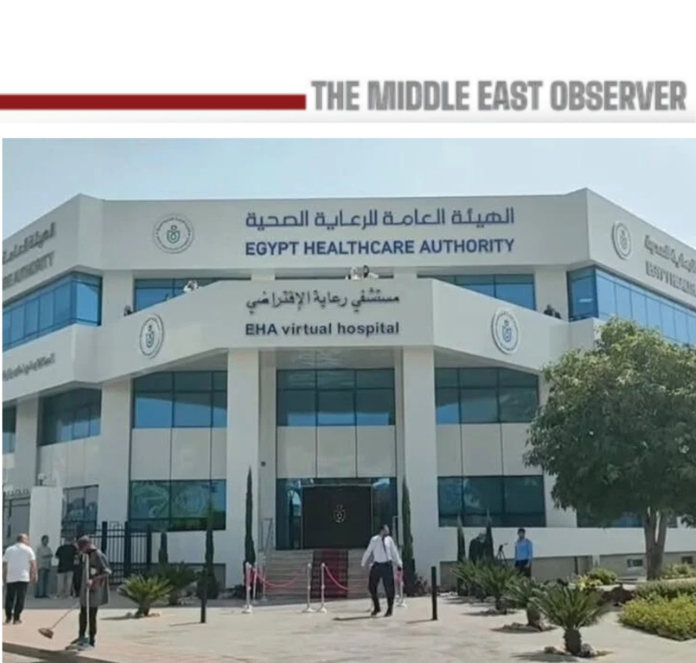
Egypt is preparing to launch its first virtual hospital in Ismailia as part of a broader drive to expand digital healthcare, telemedicine and artificial intelligence within the country’s Universal Health Insurance System.
Ahmed El-Sobky, Chairman of the General Authority for Healthcare, inspected the facility’s final preparations and reviewed its technical and operational readiness ahead of its official opening. Authorities are completing system testing and integrating the hospital with the healthcare authority’s wider digital infrastructure.
Unlike a conventional hospital, the Ismailia facility will operate as a central digital hub connecting hospitals and healthcare centres through secure telecommunications and information systems. The platform will allow specialists to review electronic medical records and diagnostic imaging, provide remote consultations, monitor intensive-care patients and support emergency teams at connected facilities in real time.
The model is intended to extend specialist expertise beyond major hospitals, particularly to patients in areas where advanced medical services are less readily available. By enabling doctors to consult remotely, it could reduce unnecessary patient transfers, improve the utilisation of specialised medical personnel and support faster clinical decision-making across the healthcare network.
The hospital system will rely on secure digital infrastructure
The hospital will comprise 119 digital and operational units, including electronic triage facilities, telecardiology and teleradiology units, virtual outpatient clinics, remote emergency services, command-and-control centres and virtual intensive-care units. It will also incorporate artificial intelligence tools to support clinical decision-making, while diagnosis and treatment will remain under the supervision of qualified medical professionals. The system is expected to rely on secure digital infrastructure and protected electronic health records to safeguard patient information and support the secure exchange of clinical data.
The project forms part of Egypt’s wider healthcare reform programme and the phased rollout of the Universal Health Insurance System. Launched in Port Said in 2019, the scheme has since expanded to Ismailia, Luxor, South Sinai, Suez and Aswan.
Healthcare facilities operating under the programme have delivered around 68 million medical services through 157 facilities across the Canal Region, according to the General Authority for Healthcare. Nearly three million citizens have registered with the system, while all family medicine facilities and approximately 95% of hospitals in the region have completed digital transformation. The government has allocated more than EGP115 billion for the second phase of the programme, which is expected to extend coverage to Minya, Matrouh, Damietta, Kafr El-Sheikh and North Sinai, serving more than 12 million additional citizens.
The World Bank has identified digital healthcare as an important component of Egypt’s ongoing health-sector reform and recently sent a delegation to Ismailia to review progress under the Universal Health Insurance System and discuss the next phase of cooperation with Egyptian authorities. The discussions focused on strengthening primary healthcare, expanding digital health services and supporting institutional capacity-building.
The adoption of telemedicine accelerated worldwide following the COVID-19 pandemic, prompting healthcare systems to invest more heavily in remote consultations, digital patient monitoring and virtual specialist services. While these technologies have the potential to improve access to healthcare and ease pressure on conventional hospitals, their long-term effectiveness depends on reliable digital infrastructure, interoperable health records, cybersecurity and continuous training for healthcare professionals.
If successfully implemented, the Ismailia facility could serve as a blueprint for similar digital healthcare projects as Egypt expands universal health insurance nationwide. Its long-term success, however, will ultimately be measured by tangible improvements in patient outcomes, access to specialist care, operational efficiency and the effective use of healthcare resources rather than by technological sophistication alone.
Related news:
Egypt Signs $3.38m Agreement with WHO and Japan to Strengthen Emergency Healthcare
China Leads the Way with its First AI-Powered Hospital: Revolutionizing Healthcare for the Future
Read also:
Egypt Attracts More Than $1.1bn in New Hospitality Investment for Sharm El Sheikh
DP World Opens Egypt’s First Integrated Logistics Distribution Centre at Sokhna