

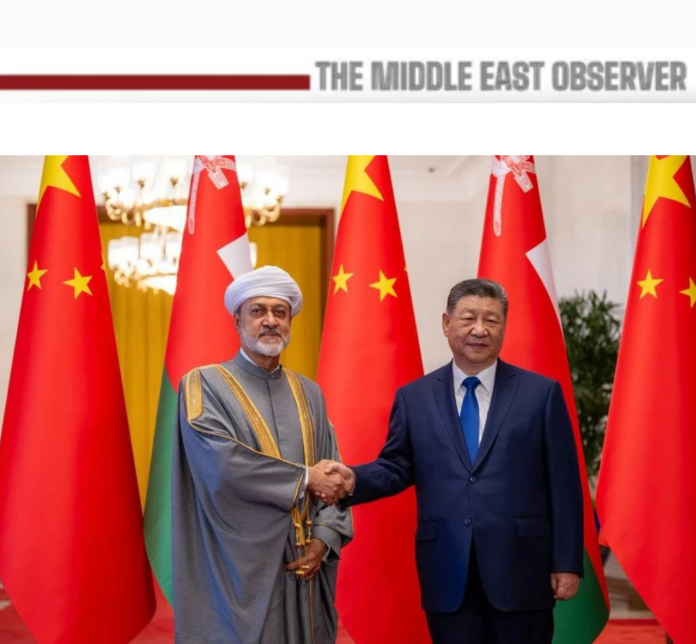
Historic Beijing summit brings 23 commercial arrangements and 16 government-level instruments, but previously announced funds and preliminary agreements complicate the calculation of new investment.
Oman and China announced 23 commercial and investment arrangements worth several billion dollars on Monday, 2 November 2026, during Sultan Haitham bin Tarik’s first state visit to Beijing, seeking to transform an established energy-trading relationship into a broader partnership in manufacturing, technology, finance and regional logistics.
The package includes proposals for an $800 million joint investment fund and a second $300 million fund, a $418.7 million mining-services contract, and partnerships covering renewable energy, battery storage, artificial intelligence, satellite technology and industrial manufacturing.
However, several investment vehicles included in the announcements were established before the summit, while others remain subject to final agreements. The amount of genuinely new capital cannot therefore be determined from the headline figures.
Sultan Haitham and Chinese President Xi Jinping also witnessed the signing of 16 government-level instruments at Beijing’s Great Hall of the People, including a central-bank currency-swap agreement, 14 memoranda of understanding and an agricultural trade protocol.
The 1–2 November visit marked the first by an Omani Sultan since diplomatic relations were established in 1978. The two countries formed a strategic partnership in 2018.
An established $25bn trading relationship
China is already Oman’s largest trading partner, accounting for 23.8% of its merchandise trade in 2025.
Bilateral trade reached OMR 9.6 billion, approximately $25 billion, comprising Omani exports of OMR 7.7 billion and imports of OMR 1.9 billion, according to Commerce Minister Anwar Al Jabri.
The relationship remains heavily weighted towards Omani exports of crude oil, liquefied natural gas and petroleum-related products, while Chinese shipments include machinery, electrical equipment, batteries, vehicles and industrial materials.
Preliminary figures show bilateral trade of OMR 5.4 billion during the first seven months of 2026.
Chinese direct investment stock in Oman reached OMR 903.8 million by the end of June 2026, according to Omani national statistics, up from OMR 866.2 million at the end of 2025.
Separately, Sultan Haitham told Xi that investments by Chinese companies in partnership with the Oman Investment Authority (OIA) had exceeded RMB 33 billion over recent years. The two figures have different reported scopes and periods and should not be treated as directly comparable.
The Sultan subsequently told Chinese Premier Li Qiang that Oman wanted to move beyond increasing trade and investment volumes towards building more diverse and sustainable productive capabilities.
That objective is central to Oman Vision 2040, which seeks to diversify the economy, expand private-sector activity and reduce dependence on hydrocarbons.
New sovereign funds lead the financing proposals
The largest proposed new investment vehicle is an $800 million joint fund between OIA and China’s Silk Road Fund.
A preliminary term sheet provides for most of the capital to be invested in Oman, with the remainder directed towards China and other emerging markets. The precise contribution of each partner, investment timetable and portfolio of projects were not disclosed.
OIA also signed preliminary terms with China Merchants Bank for a second $300 million investment fund, financed equally by the two institutions.
The arrangement extends an existing relationship established in 2019 through an earlier $300 million fund focused on Chinese technology businesses.
Together, the two proposed funds have target sizes of $1.1 billion, although neither figure represents capital already deployed.
Additional agreements with China Investment Corporation, Bank of China, China International Capital Corporation and HongShan establish frameworks for identifying investment opportunities, mobilising capital and expanding venture-capital cooperation.
Earlier investment funds reappear in the Beijing package
A closer examination of the announced investments reveals that three substantial funds predate the summit.
Oman’s Foreign Ministry reported in July 2025 that Future Fund Oman had already established the $200 million IDG Oman Fund and the $250 million EWTP Oman Fund, both targeting investment in Oman.
The IDG fund was designed to support information technology, renewable energy and electric vehicles. The EWTP fund targeted sectors including technology, energy, tourism and agriculture.
OIA’s November announcement described the broader eWTP partnership as worth approximately $275 million, including the previously established fund and an additional regional investment allocation.
Similarly, Templewater and Future Fund Oman launched a $200 million Energy Transition Fund in July 2025, with equal contributions from both partners.
The November summit announcement reported an overall Templewater partnership of approximately $260 million, including a $60 million component associated with the Templewater Innovation Fund.
That innovation partnership also had an earlier foundation. In September 2026, Templewater announced that OIA had received in-principle approval to invest up to HK$250 million in a Hong Kong technology fund, subject to final documentation. The September proposal and November’s reported $60 million component have not been fully reconciled in the published disclosures.
The IDG, EWTP and Templewater funds alone had previously announced sizes totalling $650 million.
Their inclusion in the Beijing package demonstrates the development of an existing investment network, but the full value cannot be presented as new capital committed during the visit.
It is also important to distinguish fund sizes from Chinese foreign direct investment. Several vehicles are jointly financed by Omani institutions, while some capital may be invested outside Oman.
Renewable energy partnerships move towards manufacturing
Energy cooperation extends beyond oil and gas into solar manufacturing, wind power and electricity storage.
OIA announced preliminary terms for a $100 million partnership covering solar projects and the manufacture of solar electrical equipment in Oman for Middle Eastern and North African markets.
Omani accounts differ over the names of the Chinese counterparties and whether the planned facility would manufacture transformers or inverters. The precise legal entities and industrial scope remain subject to confirmation.
Nama Holding separately signed a framework agreement with State Grid International Development to assess two battery energy storage installations of 500 megawatts each, at Duqm and the Al Subeikhi–Ibri Solar 3 substations.
The proposed combined capacity is 1 gigawatt. The systems would connect to Oman’s 400-kilovolt electricity transmission network and could help integrate more renewable generation.
Their storage duration, financing structure and construction schedules were not disclosed, making it premature to assign a definitive investment value.
In another visit-related announcement, O-GREEN’s Mawarid Turbine and Shanghai Electric Wind Power Group agreed to deepen cooperation in wind-turbine manufacturing, research, testing, component localisation and workforce development at Duqm.
The companies are pursuing local industrial capacity alongside technology transfer and specialist training. However, the agreement’s inclusion in OIA’s official count of 23 commercial instruments has not been established.
Mining delivers a defined $419mn contract
One of the more concrete commercial commitments concerns the Mazoon Copper and Gold Project in Yanqul.
Minerals Development Oman signed a ten-year integrated mining-services contract worth OMR 161 million ($418.7 million) with Hongda International.
The agreement covers open-pit mining, drilling, loading, ore transport, waste handling, roads and operational facilities.
Unlike the preliminary investment funds, the contract has a defined project, service scope, value and duration.
Nevertheless, its $418.7 million value represents contracted services over ten years, not an equivalent amount of new foreign direct investment or immediate capital expenditure.
Its economic contribution will depend on mining output, domestic procurement, employment, infrastructure development and the project’s commercial performance.
Chinese logistics networks target Gulf and African markets
Asyad Group signed a cooperation agreement with Chinese e-commerce company JD.com to develop warehousing and distribution facilities in Oman.
The initial programme targets three locations: Muscat International Airport Free Zone, Khazaen Economic City and Sohar Free Zone.
The partners also plan to integrate logistics networks, introduce digital systems and automation, and improve distribution links to Gulf and East African markets.
Separately, OIA signed a memorandum with China International Marine Containers to explore opportunities in transport equipment, logistics and supply chains.
The projects could strengthen Oman’s position as a regional distribution platform, but their profitability will depend on competitive freight costs, warehouse utilisation, customs efficiency and sustained demand.
Investment values and operational schedules were not disclosed.
AI and space agreements broaden the technology relationship
Oman also secured cooperation arrangements in government digital transformation, advanced computing and satellite technology.
The Ministry of Transport, Communications and Information Technology and Omantel signed memoranda involving WPS and Huawei.
One concerns government digital transformation. The other covers Huawei Ascend neural processing units, specialised accelerators used in artificial-intelligence computing.
The announcements did not specify the computing capacity, procurement value or implementation timetable.
Oman Lens and Star Vision Aerospace concluded two agreements covering space technology and specialist training.
The first provides for 30 Omani postgraduate scholarships in China, training for 1,000 Omani specialists and a joint space-AI laboratory over five years.
The second covers satellite development, launch and operation, beginning with seven satellites. A subsequent constellation would be assessed after the initial phase.
Plans also include a satellite assembly, integration and testing facility in Oman.
These arrangements could support domestic technical capabilities, although investment values and binding delivery schedules remain undisclosed.
Banking agreements broaden financial links
Sohar International signed agreements with Shanghai Pudong Development Bank and two Chinese-linked asset-management institutions.
They cover syndicated financing, debt capital markets, investment-fund distribution and institutional portfolio management, including potential access to gold-backed exchange-traded products.
Individual financial transactions remain subject to approvals and applicable regulations.
At government level, the Central Bank of Oman and the People’s Bank of China concluded a local-currency swap agreement intended to facilitate trade and financial cooperation.
A separate memorandum covers central-bank digital currencies.
The published announcements did not disclose the currency-swap facility’s size or duration. Nor did they establish an agreement to replace the US dollar as the principal currency used in bilateral trade.
Sixteen state-level instruments and regional diplomacy
The government agreements span green investment, media and information exchange, scientific innovation, securities regulation, digital technologies, artificial intelligence, peaceful space applications, BeiDou satellite navigation, industrial supply chains, competition regulation, environmental management and archives.
A separate agricultural protocol establishes inspection, quarantine and sanitary requirements for dried Omani dates exported to China.
The agreements accompanied a 20-point joint statement linking China’s Belt and Road Initiative with Oman Vision 2040.
Sultan Haitham expressed openness to negotiating a bilateral preferential trade and investment agreement, while the two governments supported accelerating China–Gulf Cooperation Council free-trade negotiations. Neither agreement was concluded during the visit.
The statement also reaffirmed Oman’s support for the One-China principle and addressed regional security, including renewed diplomatic efforts involving Iran and the United States, safe navigation through the Strait of Hormuz and a political settlement in Yemen.
For China, deeper cooperation provides access to an established energy partner, regional logistics infrastructure and an investment platform connecting Asian businesses to Gulf and African markets.
For Oman, the potential gains lie in productive investment, local manufacturing, technology transfer, skilled employment and more diversified exports.
The decisive test: Capital must create production
The Beijing summit strengthens an established economic partnership, but its significance cannot be measured simply by adding together the financial values of its announcements.
Several investment funds were established before the visit. Others remain preliminary. Contracted services, sovereign-fund target sizes and prospective industrial projects represent different financial commitments.
Oman’s investment authority must also balance commercial returns against the objective of developing domestic industry.
The programme’s success will depend on how much genuinely additional capital reaches operating businesses, whether local suppliers and skilled workers participate, and whether new facilities produce competitive goods and services for export.
Oman’s opportunity is to convert Chinese capital, technology and industrial experience into sustainable productive capacity. The decisive measure will not be the billions announced or the agreements signed, but the factories established, jobs created, exports generated and lasting economic value retained within the country.
Related articles:
1. Oman Partners with China’s Temple Water to Launch $200 Million Green Energy Fund
2. Oman Leads $500 Million Fund Targeting Central Asia
Read Also:
1. Oman’s $4bn AI Data Center Push Puts Salalah’s Power and Connectivity to the Test
2. Oman’s Economic Upswing Deepens as Duqm Emerges as Regional Investment Magnet