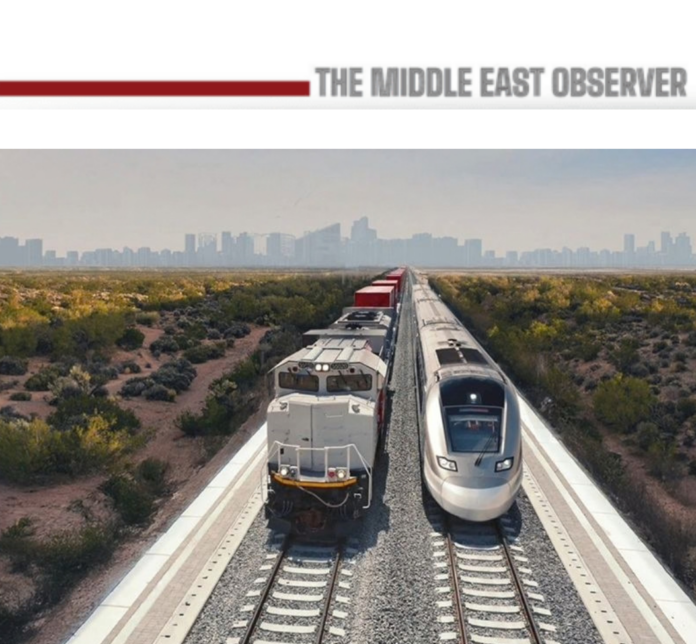
The UAE has opened a new rail freight corridor linking Fujairah Terminals with Abu Dhabi’s industrial base, expanding the country’s ability to move cargo from an east-coast maritime gateway directly into major manufacturing and logistics zones.
Etihad Rail Freight and AD Ports Group launched the roughly 200-kilometre service on September 20. Trains will operate three times a week between Fujairah and the Industrial City of Abu Dhabi, or ICAD, reducing dependence on long-haul trucking for containers serving factories, warehouses and distribution centres in the capital.
Fujairah’s location gives the project wider strategic significance. The port sits on the Gulf of Oman, outside the Strait of Hormuz, providing direct maritime access to Indian Ocean trade routes before vessels enter the Gulf.
ICAD has meanwhile received the UN/LOCODE AECAD, allowing shipping lines and freight forwarders to book cargo directly to the industrial hub. Customs, inspection and cargo-release facilities at ICAD can bring clearance closer to end-users rather than concentrating those processes solely at the coastal gateway.
The arrangement effectively creates an inland-port model linking maritime entry, rail transport, customs processing and industrial distribution within one logistics chain.
For Fujairah, the corridor expands its industrial hinterland deeper into Abu Dhabi. For ICAD, it strengthens its role as an internationally connected logistics and manufacturing hub.
The service also deepens Etihad Rail’s role in the UAE’s trade infrastructure as the national network scales towards freight capacity of up to 60mn tonnes annually by 2030.
The significance extends beyond transport efficiency. By connecting an east-coast port outside the Strait of Hormuz with rail, inland clearance and Abu Dhabi’s manufacturing base, the UAE is widening the routes through which industrial cargo can enter, clear and move across the country.
Related news:
Egypt Approves Fujairah-Alamein Oil Storage and Trading Free Zone
Cairo–Fujairah Pact Bridges Gulf and Mediterranean Energy Routes
Read also:
Rebuilding Khartoum’s industrial base takes first step
Trump Welcomes Chinese Carmakers, but Market Access remains a puzzle