
If Spain’s triumph represented the tournament’s greatest footballing achievement, Africa’s collective performance became its most significant strategic story.
For decades, African football has been recognised for producing gifted individuals, passionate supporters and occasional giant-killing performances. Yet success at the World Cup had often proved elusive. Apart from Morocco’s historic semi-final appearance in Qatar in 2022, African teams had struggled to consistently translate continental dominance into sustained success on football’s biggest stage.
North America 2026 suggested that this narrative is changing.
The first 48-team FIFA World Cup not only expanded participation but also revealed how rapidly the competitive gap between football’s traditional powers and emerging nations is narrowing. African representatives entered the tournament better organised, tactically disciplined and psychologically prepared than ever before, demonstrating that the continent’s football development has reached a new level.
Rather than relying primarily on athleticism and individual brilliance, African teams increasingly matched Europe and South America in tactical intelligence, defensive organisation and technical execution. Their performances were not isolated surprises but evidence of a broader structural evolution taking place across the continent.
By the end of the tournament, Africa had firmly established itself as one of international football’s fastest-rising forces.
Morocco Confirms Its Place Among the Elite
Morocco entered the competition carrying the weight of expectation created by its remarkable run to the semi-finals in Qatar four years earlier.
Many questioned whether that achievement had been an exceptional generation or the beginning of a longer-term transformation.
The Atlas Lions answered convincingly.
Once again displaying defensive discipline, tactical maturity and composure under pressure, Morocco reached the knockout stages and reinforced its reputation as Africa’s benchmark on the global stage. Although it did not repeat its semi-final finish, the team’s consistency confirmed that its success in 2022 was no anomaly.
Equally important was Morocco’s growing influence beyond the field.
As one of the principal hosts of the 2030 FIFA World Cup alongside Spain and Portugal, Morocco demonstrated both the footballing quality and organisational credibility expected of a future host nation. Continued investment in stadiums, transport infrastructure and youth development has positioned the country not only as Africa’s leading football power but also as one of FIFA’s most important strategic partners for the coming decade.
A Continent Growing in Confidence
Morocco’s achievements were supported by strong performances across the continent.
Senegal once again demonstrated why it remains one of Africa’s most respected football nations. Combining physical strength with tactical organisation, the Lions of Teranga continued the consistency that has characterised their recent international campaigns.
Ivory Coast, rejuvenated following its Africa Cup of Nations success, displayed impressive technical quality and attacking ambition, confirming that another talented generation has emerged in West African football.
South Africa also attracted attention with disciplined performances against higher-ranked opponents, illustrating the steady progress made by a national programme that has quietly rebuilt over recent years.
One of the tournament’s most inspiring stories came from Cape Verde.
Representing a nation of fewer than one million people, Cape Verde reached the knockout stages through organisation, teamwork and tactical discipline rather than individual star power. Their campaign served as another reminder that modern football increasingly rewards collective preparation over historical reputation.
Collectively, these performances painted a clear picture.
African football is no longer defined by occasional surprises. It is becoming consistently competitive.
The continent’s players now populate Europe’s leading leagues, while coaching standards, sports science, youth academies and tactical preparation have improved significantly across many national federations. The expanded World Cup undoubtedly provided more qualification opportunities, but African teams justified those additional places through the quality of their performances rather than merely their participation.
Egypt Becomes the Tournament’s Dark Horse
Among Africa’s representatives, however, no team captured international attention more dramatically than Egypt.
The Pharaohs arrived with relatively modest expectations. Although historically the continent’s most successful nation in the Africa Cup of Nations, Egypt had struggled for decades to convert regional success into deep World Cup runs.
Few observers predicted that the team would become one of the tournament’s most compelling stories.
Yet from the opening group-stage matches, Egypt displayed a level of organisation and tactical maturity that surprised even experienced analysts.
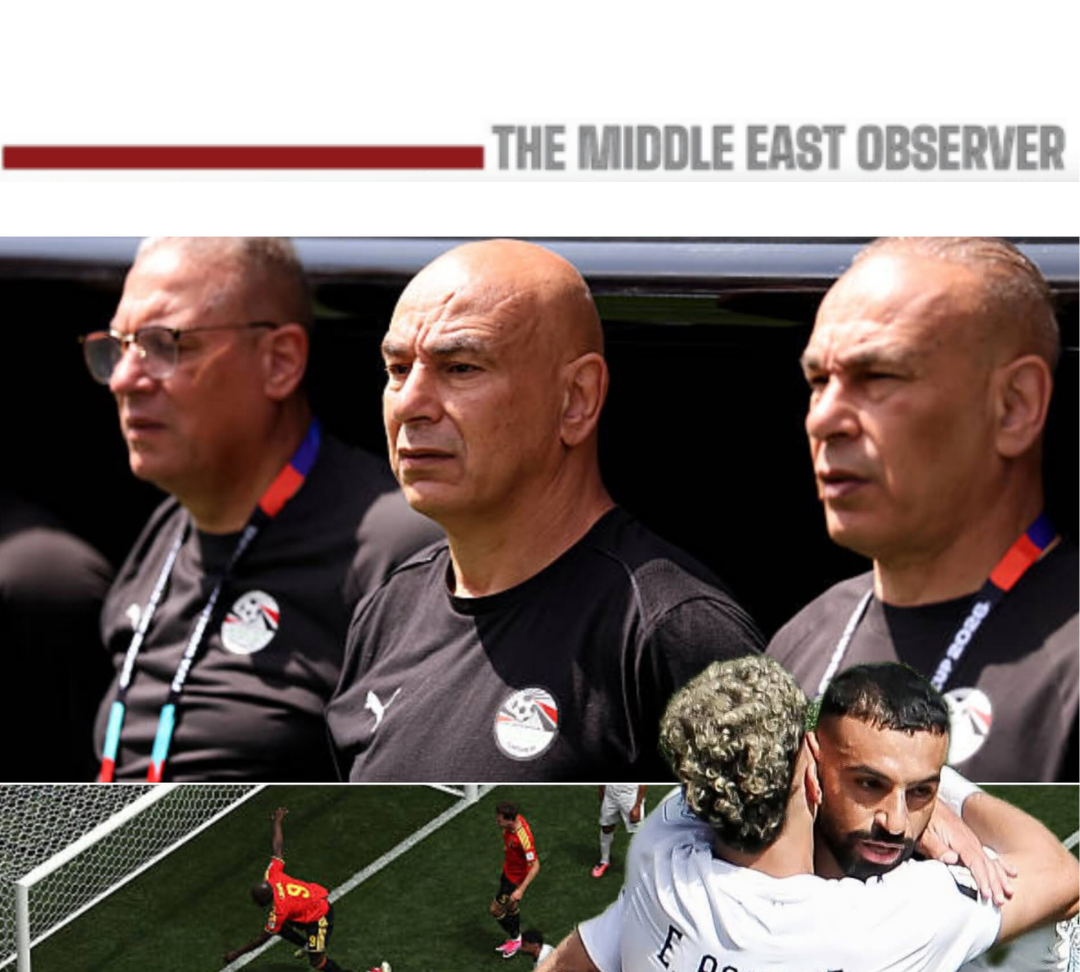
The team defended with discipline, pressed intelligently and counterattacked with speed and precision. Rather than relying solely on Mohamed Salah’s individual brilliance, Egypt functioned as a cohesive collective capable of adapting its approach according to the opponent.
Its midfield maintained excellent defensive shape, while the back line consistently frustrated technically superior opponents through intelligent positioning rather than physicality alone.
Each match strengthened the belief that Egypt possessed something increasingly valuable in tournament football: balance.
Unlike teams dependent on spectacular attacking football, Egypt understood how to manage difficult periods, absorb pressure and exploit transitional moments. Those qualities repeatedly proved decisive as the tournament progressed.
A Historic Breakthrough
Egypt’s campaign reached a historic milestone in the Round of 32 against Australia.
The match proved exactly as demanding as anticipated. Australia combined physical intensity with disciplined defending, making scoring opportunities scarce throughout normal and extra time.
After 120 exhausting minutes, the contest was decided by penalties.
Egypt held its nerve.
Displaying remarkable composure under immense pressure, the Pharaohs converted their spot kicks with confidence before securing victory in the shootout. The result carried significance far beyond qualification.
It represented Egypt’s first-ever victory in a World Cup knockout match.
For a nation with one of football’s richest histories outside Europe and South America, the breakthrough marked an important psychological barrier finally being overcome.
The celebrations reflected more than simply reaching the Round of 16.
Players, coaching staff and supporters recognised that Egyptian football had entered unfamiliar territory. The team was no longer merely participating in the World Cup—it was genuinely competing.
Belief Begins to Grow
Momentum is one of football’s most powerful forces, and Egypt appeared to gather it at precisely the right moment.
Confidence spread throughout the squad as each disciplined performance reinforced belief that they could challenge even the tournament favourites.
International media increasingly described Egypt as the competition’s “dark horse”—a team capable of upsetting established powers through organisation, resilience and tactical intelligence.
The next challenge, however, would be the most difficult of all.
Standing between Egypt and an historic quarter-final appearance was defending world champion Argentina, led by Lionel Messi in what many expected to be his final World Cup campaign.
For Egypt, the match represented an opportunity to produce one of the greatest victories in its football history.
Few realised that it would also become one of the tournament’s most fiercely debated encounters.
The Match That Captivated the Football World
Egypt’s Round of 16 encounter against defending champions Argentina quickly developed into one of the most compelling matches of the tournament.
Few expected the Pharaohs to compete on equal terms with the reigning world champions, yet from the opening minutes Egypt demonstrated remarkable tactical discipline. Rather than retreating into a purely defensive shape, the team pressed intelligently, disrupted Argentina’s midfield rhythm and launched quick transitions whenever possession was regained.
Mohamed Salah’s movement consistently stretched Argentina’s defence, while Egypt’s midfield successfully limited the influence of Lionel Messi for long periods. The African champions looked organised, composed and increasingly confident as the match progressed.
That confidence was rewarded when Egypt took the lead, stunning both Argentina and the neutral supporters. For much of the first half, the defending champions appeared unusually vulnerable against an Egyptian side playing with growing belief.
The momentum appeared to swing even further in Egypt’s favour during the second half.
The Turning Point
In the 62nd minute, Mostafa Zico found the net after a well-constructed Egyptian attack, apparently giving the Pharaohs a two-goal advantage against the defending world champions.
Celebrations were short-lived.
Following an extended VAR review, the goal was disallowed after officials identified an earlier infringement in the attacking phase. Under the Laws of the Game, VAR is entitled to review the attacking possession phase leading directly to a goal, and the officials concluded that a foul had occurred before the finish.
The decision dramatically altered the course of the match.
Instead of facing a two-goal deficit with less than half an hour remaining, Argentina remained within touching distance. The psychological impact was immediate. Egypt’s celebrations gave way to frustration, while Argentina regained both belief and momentum.
The defending champions gradually increased their pressure and eventually drew level, transforming what had seemed a controlled Egyptian performance into an increasingly tense contest.
The Incidents That Sparked Debate
The controversy deepened during the closing stages.
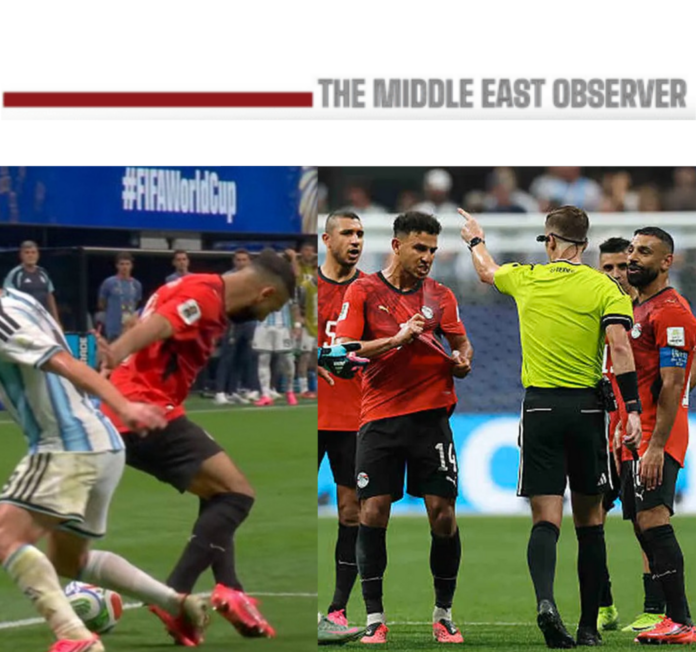
With the score level, Hamdy Fathy went down inside the Argentine penalty area following a challenge. As play stopped, Fathy approached the referee and visibly showed that his shirt had been torn during the incident, appealing for a penalty. Despite the apparent physical evidence of contact, the referee allowed play to continue and did not conduct an on-field review. VAR also chose not to recommend intervention.
Moments later came the sequence that would dominate post-match discussion.
During the attacking phase immediately preceding Argentina’s decisive third goal, Mohamed Salah appeared to be brought down inside the penalty area while attempting to create another Egyptian opportunity. Once again, play continued without a whistle, and VAR did not intervene.
Argentina immediately launched a counterattack and scored what proved to be the winning goal.
Within only a few minutes, Egypt had experienced three defining moments: a disallowed goal after detailed VAR scrutiny, a rejected penalty appeal involving Hamdy Fathy and a second disputed penalty incident involving Mohamed Salah before conceding the decisive goal.
The sequence fundamentally changed the narrative of the match.
Why the Debate Intensified
The controversy surrounding Egypt’s elimination was not driven solely by the individual decisions themselves.
Football has always accepted that referees will make difficult judgments and that not every contentious incident will produce universal agreement.
The central issue became one of consistency.
VAR had examined Egypt’s attacking move in sufficient detail to identify an earlier infringement and overturn Zico’s goal. Yet during two separate penalty appeals involving Egypt, the technology was not used in a visibly similar manner.
For many observers, the question therefore shifted from whether each individual decision could be defended under the Laws of the Game to whether the same intervention threshold had been applied throughout the match.
That distinction proved significant.
Supporters, former players and television analysts debated not simply the correctness of the rulings but whether comparable incidents had received comparable levels of review.
The Egyptian Football Association subsequently criticised the officiating and called for greater transparency and consistency in the application of VAR during the tournament.
While disappointment naturally shaped many reactions, the wider discussion quickly expanded beyond Egypt itself.
The match became a case study in football’s broader challenge: ensuring that technology designed to reduce controversy is applied according to clear, predictable and universally understood standards.
No publicly available evidence has established that the match was manipulated or deliberately influenced. Nevertheless, FIFA’s inability to provide immediate, detailed explanations of the review process allowed speculation to flourish, reinforcing demands for greater openness regarding how decisive VAR decisions are reached.
Egypt Leaves with Respect
Despite the painful manner of their elimination, Egypt emerged from North America with its international reputation significantly enhanced.
The Pharaohs had demonstrated that African football continues to evolve beyond isolated success stories into a consistently competitive force. Their tactical organisation, defensive discipline and composure under pressure earned admiration throughout the tournament.
Equally important, Egypt showed that it could compete with the world’s elite over ninety—and even one hundred and twenty—minutes.
The campaign also reflected the growing maturity of African football as a whole. Rather than relying exclusively on individual brilliance or physical superiority, Egypt displayed sophisticated tactical preparation comparable to many established European and South American nations.
The Round of 16 defeat therefore represented both an ending and a beginning.
It ended Egypt’s finest World Cup campaign in modern history.
It also established a platform upon which future generations can realistically aspire to progress even further.
A Defining Legacy
History is likely to remember Egypt’s 2026 World Cup for two parallel reasons.
The first was footballing achievement.
The Pharaohs became one of the tournament’s genuine surprise packages, recorded their first World Cup knockout victory and demonstrated that they belonged among the competition’s emerging powers.
The second was institutional.
Their elimination became one of the defining examples in the global debate over how VAR should be implemented in elite football. Whether or not every individual decision can be justified within the Laws of the Game, the perception of unequal intervention illustrated the importance of transparency, consistency and public confidence in modern officiating.
For Egypt, the tournament ended in disappointment.
For African football, however, it represented another significant step forward.
The continent had not merely participated in football’s greatest event.
It had announced, with increasing authority, that it intends to shape its future.
Related news:
Egypt Earns Global Respect After Holding Belgium in World Cup Opener
Read also:
El-Sisi Accelerates Suez Canal Shipbuilding Strategy as Exports Reach Europe
Elsewedy Electric Invests $200m to Build an Integrated Metals Manufacturing Hub