
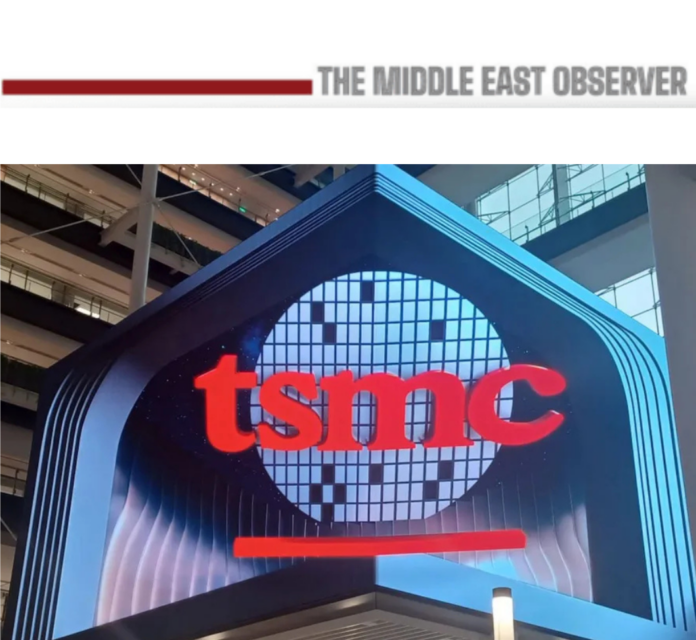
Record AI-driven exports underline Taiwan’s semiconductor dominance as $265 billion in planned US investment tests whether advanced manufacturing expertise can be reproduced abroad.
Taiwan’s exports surged 60.9% to a record $87.22 billion in September, exposing a growing contradiction in the global semiconductor industry: the stronger demand for Taiwan’s advanced technology becomes, the greater the incentive for its largest customers to diversify production beyond the island.
The increase, reported by Taiwan’s Finance Ministry on October 8, surpassed August’s previous record of $82.4 billion and generated a $23.63 billion trade surplus. Exports to the United States more than doubled to $27.46 billion, reflecting accelerating investment in artificial intelligence, data centres and advanced computing.
Information and communications technology exports reached $39.1 billion, up 103%, while electronic components rose 45.3% to $31.1 billion. Together, the categories accounted for more than 80% of September’s merchandise exports, although they include products unrelated to AI.
The figures demonstrate how Taiwan has become indispensable to an expanding global technology industry, while raising questions about whether its manufacturing capabilities can be replicated elsewhere.
Where Taiwan’s Technological Advantage Lies
Taiwan’s dominance extends beyond semiconductor fabrication. It rests on a closely integrated industrial network connecting chip designers, specialised manufacturers, advanced packaging facilities, equipment suppliers and electronics assemblers.
Taiwan Semiconductor Manufacturing Company (TSMC) produces advanced processors designed by customers including Nvidia and Apple. MediaTek develops processors and customised semiconductor technology, while Foxconn plays a major role in assembling servers and other computing equipment.
Nvidia occupies a different position in this ecosystem, generating value through chip architecture, software and computing platforms while relying on manufacturing partners to produce its most advanced processors.
The crucial competitive advantage is not simply the ownership of sophisticated equipment. Advanced semiconductor manufacturing depends on technical expertise, production yields, engineering collaboration and the ability to manufacture increasingly complex chips reliably at commercial scale.
Taiwan has developed these capabilities over decades. Reproducing them requires much more than building factories.
The $265 Billion American Expansion
The geographical shift accelerated on July 16, when TSMC announced an additional $100 billion investment in Arizona, increasing its planned US commitment to $265 billion.
The latest expansion includes four additional advanced semiconductor fabrication plants, intended to produce chips using 2-nanometre and more advanced technologies, alongside the development of advanced packaging capacity.
The broader programme is designed to establish an integrated American manufacturing cluster. Arizona authorities expect around 30% of TSMC’s capacity for 2-nanometre and more advanced chips to be located in the state once the planned expansion is completed.
Nevertheless, the investment represents a long-term commitment rather than productive capacity already operating. TSMC Chairman C.C. Wei has declined to establish a fixed timetable for the latest expansion, indicating that construction and investment decisions will depend on market conditions and customer demand.
American production is also demonstrating technical progress. TSMC has reported competitive manufacturing yields at its Arizona operations, challenging assumptions that advanced processes cannot operate successfully outside Taiwan.
The remaining difficulties concern construction costs, specialised labour, infrastructure and the development of nearby suppliers. Taiwan’s established industrial concentration continues to offer advantages in coordination, production flexibility and operating efficiency.
Nvidia Strengthens Taiwan’s Design Ecosystem
A different form of industrial consolidation emerged on August 31, when Nvidia announced a $3.5 billion investment in convertible bonds issued by MediaTek.
The transaction deepens cooperation in custom AI infrastructure, personal computing and automotive technology.
MediaTek will participate in Nvidia’s NVLink Fusion ecosystem, helping customers develop specialised processors that can operate within Nvidia’s larger AI computing architecture.
Unlike TSMC’s American investment, the Nvidia–MediaTek transaction does not primarily relocate manufacturing. Instead, it strengthens the relationships between companies controlling chip design, intellectual property and computing infrastructure.
Together, the investments reveal two complementary trends: geographical diversification of manufacturing and deeper integration of technological capabilities.
Strong Demand Brings Rising Financial Exposure
The AI boom continues to underpin extraordinary growth among semiconductor manufacturers.
TSMC reported third-quarter revenue of approximately $46.7 billion, up 50% year on year, supported by demand for advanced processors and packaging technologies.
Yet expanding manufacturing capacity brings substantial financial exposure. Semiconductor factories require large upfront investment, specialised infrastructure and continuing expenditure on equipment upgrades.
Their commercial success depends on maintaining high utilisation, competitive production yields and sufficient customer demand over many years.
For governments, domestic semiconductor capacity offers strategic benefits, including greater supply-chain resilience and reduced exposure to geopolitical disruption. Those gains, however, do not automatically translate into lower production costs.
For manufacturers, expanding across several countries could improve access to customers and reduce concentration risk, while increasing capital requirements and operational complexity.
A sustained slowdown in AI infrastructure spending would make the economics of these investments more difficult, particularly where factories are developed ahead of confirmed long-term demand.
Who Will Control Semiconductor Manufacturing by 2036?
Over the next decade, three outcomes could reshape the industry.
Under the first, semiconductor production becomes more geographically diversified while Taiwanese companies retain control of the most sophisticated manufacturing processes and engineering expertise.
Under the second, American investment successfully develops an integrated network of fabrication plants, packaging operations and domestic suppliers, reducing reliance on Taiwan for critical stages of advanced semiconductor production.
Under the third, weaker-than-expected returns on AI infrastructure investment delay factory expansion and reinforce the advantage of established manufacturing centres.
These outcomes are not mutually exclusive. Taiwan could remain technologically dominant even as the United States becomes a major location for advanced semiconductor production.
The distinction matters for governments seeking technological independence. Manufacturing security depends not merely on where factories are located, but on who controls the processes, specialist knowledge, supply networks and intellectual property required to operate them.
By 2036, the success of today’s investment programmes will be measured in competitive manufacturing capacity, dependable supply and sustainable financial returns.
Taiwan’s $87.22 billion export record demonstrates the commercial strength of its existing ecosystem. The $265 billion American expansion will test how much of that strength can be reproduced overseas without sacrificing the efficiency that made Taiwan indispensable.
Related news:
Huawei Eyes Expansion into AI Chip Market in Middle East and Southeast Asia
Uber and Baidu Partner to Launch Self-Driving Fleet in Asia and Middle East
Read also:
El-Sisi’s Malaysia Visit Opens New Industrial Investment Prospects as Bilateral Trade Surges 75%