
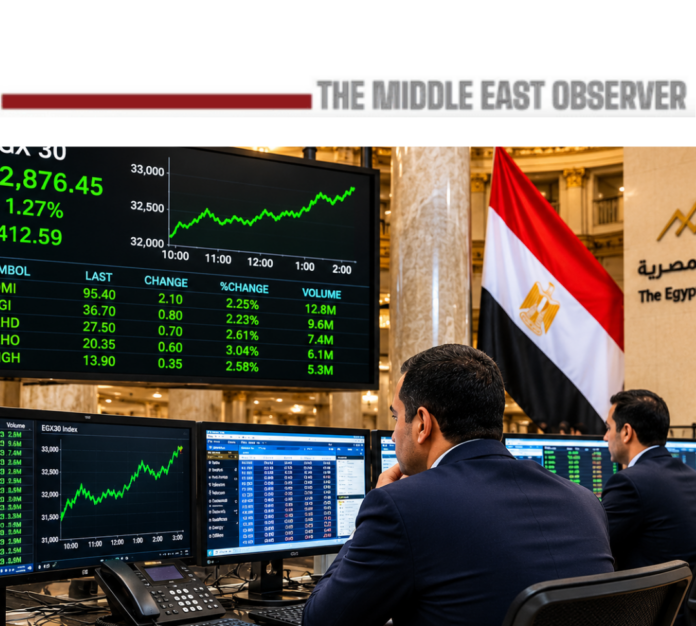
The Egyptian Exchange (EGX) ended the trading week on a broadly positive note on Wednesday, 22 July, as renewed buying by non-Arab foreign investors helped lift overall market capitalisation despite a marginal decline in the benchmark EGX30. The session underscored two themes that shaped the week: resilient participation beyond the market’s largest stocks and increasingly differentiated investor positioning between Egyptian equities and government debt.
The EGX30 slipped 0.11% to close at 53,931.92 points, following two consecutive sessions of gains that had carried the benchmark close to the 54,000-point level. By contrast, the broader market remained firmly positive, with the EGX70 Equal Weight Index rising 0.69% to 17,706.12 points, the EGX100 Equal Weight Index gaining 0.49% to 23,597.48 points, the EGX35-LV advancing 0.23%, and the EGX33 Shariah Index edging 0.09% higher.
Total market capitalisation increased to EGP3.951 trillion, adding approximately EGP4.6 billion during the session and extending the week’s cumulative gains.
Equity turnover exceeded EGP12.6 billion, around 36% above the exchange’s 90-day average, indicating that investor participation remained elevated even as the benchmark paused after its recent advance. Market breadth was also marginally positive, with 101 shares advancing, 99 declining and 20 closing unchanged, reflecting continued activity across the wider market rather than a rally confined to a handful of large-cap stocks.
Broader Market Continues to Outperform
Wednesday’s trading suggested that market momentum remained intact despite modest profit-taking in blue-chip shares.
While the EGX30 consolidated after approaching the 54,000-point level, the stronger performance of the EGX70 and EGX100 indicated that buying interest continued to extend beyond heavyweight constituents. The combination of a marginal decline in the benchmark, gains across the broader indices and above-average turnover was consistent with market consolidation rather than a deterioration in investor sentiment.
Although Commercial International Bank’s first-half results helped drive Tuesday’s advance in blue-chip stocks, the broader pattern throughout the week continued to favour small- and mid-cap companies, illustrating sustained investor appetite across multiple segments of the market.
Non-Arab Foreign Investors Remained Net Buyers
Egyptian Exchange nationality statistics for Wednesday’s session showed non-Arab foreign investors as net buyers of approximately EGP4.65 billion, while Egyptian investors recorded net sales of around EGP725.8 million and Arab investors were net sellers of approximately EGP3.92 billion.
The figures marked the second consecutive session in which the Egyptian Exchange’s nationality statistics showed net buying by non-Arab foreign investors. However, these reported totals should be distinguished from figures covering ordinary listed-share trading alone, as published market reports may apply different transaction classifications and reporting scopes.
The renewed foreign participation follows a period during which overseas investors had generally reduced exposure to Egyptian equities earlier in July, suggesting a more selective approach centred on individual companies rather than broad market positioning.
Equities and Government Debt Continue to Diverge
Investor behaviour in equities continued to contrast with positioning in Egypt’s government debt market.
The Central Bank of Egypt was scheduled to auction EGP120 billion of Treasury bills on 26 July, comprising EGP50 billion of 182-day securities and EGP70 billion of 364-day securities on behalf of the Ministry of Finance.
The auction will provide an important indication of domestic and foreign demand for Egyptian short-term government debt. Bid volumes, coverage ratios and accepted yields are expected to offer further evidence of investors’ required returns for maintaining exposure to local-currency fixed-income securities.
The distinction between the two asset classes remains significant. Recently reported corporate earnings may continue to support demand for selected listed companies, while Treasury-bill investment decisions remain more directly influenced by interest-rate expectations, exchange-rate developments, monetary policy and broader global portfolio allocation.
Healthcare Shares Featured Prominently
Among the session’s strongest performers, Catalyst Partners Middle East (CPME) rose 18.54%, followed by Alexandria New Medical Center, which gained 12.10%, and GlaxoSmithKline Egypt, which advanced 9.94%.
Healthcare shares therefore featured prominently among the day’s leading gainers, although the session’s results alone are insufficient to conclude that investors were rotating into the healthcare sector more broadly.
On the downside, Naeem Real Estate Holding Group, Arab Polvara Spinning & Weaving and Rubex International for Plastic and Acrylic Manufacturing recorded the largest declines, with losses remaining relatively modest compared with the strongest advances.
Weekly Performance
The week’s trading demonstrated improving market resilience despite intermittent profit-taking in blue-chip stocks.
From last Thursday’s close through Wednesday’s session:
- EGX30 gained approximately 1.9%
- EGX70 advanced about 3.9%
- EGX100 rose roughly 3.1%
Market capitalization expanded by approximately EGP64.6 billion over the four trading sessions.
The figures indicate that while heavyweight stocks continued to influence the benchmark index, smaller and medium-sized companies remained the principal drivers of the week’s overall market performance.
Market Themes
Three themes emerged over the course of the week.
First, second-quarter corporate earnings continued to influence investor positioning, particularly within large-cap financial stocks.
Second, market participation remained broad, with the wider indices outperforming the benchmark and turnover remaining comfortably above recent averages.
Third, investors increasingly differentiated between asset classes. Demand for selected listed companies contrasted with a more cautious approach towards Egyptian government debt, reflecting differing assessments of corporate fundamentals and macroeconomic conditions.
Outlook
Attention will now turn to the next round of second-quarter corporate earnings, particularly from banks, industrial companies, real estate developers, telecommunications operators and consumer businesses, alongside the results of the Central Bank’s Treasury-bill auction.
The interaction between corporate earnings, sustained domestic liquidity, foreign portfolio activity and funding conditions in the government debt market will remain central to near-term market direction.
If corporate results continue to meet investors’ expectations and foreign participation remains supportive, the EGX30 could make another attempt to establish a sustained position above the 54,000-point level. However, investors are likely to remain attentive to developments in interest rates, government debt demand and external financial conditions, which will continue to shape cross-border capital flows into Egyptian assets.