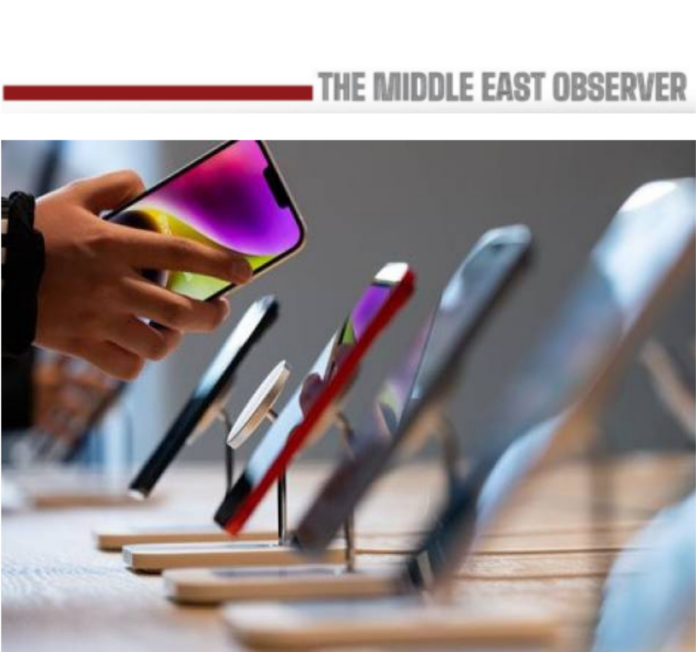
Egypt expects to manufacture more than 15 million mobile phones in 2026, roughly five times its 2024 output. Yet much of the value inside those devices — from advanced chips and displays to specialised electronic components — still comes from abroad.
That gap will determine whether Egypt is building an electronics industry or primarily a large assembly base.
From 3 Million Phones to 15 Million
Egypt’s smartphone-manufacturing expansion has been rapid. Local production rose from roughly 3 million units in 2024 to 10 million in 2025, while the government expects output to exceed 15 million this year. Installed annual capacity stands at about 20 million units, with officials targeting 30 million by 2028.
Fifteen international brands now manufacture mobile phones and accessories locally, backed by roughly $200 million in investment, according to government figures.
The expansion is part of Egypt Makes Electronics, a state strategy intended to move the country from electronics consumption towards manufacturing, design and exports. The OECD said in its 2026 review of Egypt’s innovation policy that the programme aims to position the country as a manufacturing and design base serving Arab, African and European markets.
The first stage — attracting global manufacturers and establishing production scale — is taking shape. The harder question is how much of the value inside those devices Egypt can capture.
What Does “Made in Egypt” Mean?
The distinction matters because assembling a smartphone locally is not the same as producing its most valuable components.
Vivo opened its 10th of Ramadan City plant in 2022 with investment of about $20 million. ITIDA says the facility can produce as many as 500,000 units a month, employs about 1,200 people directly and indirectly, and has achieved local value added of around 42%.
More significant for Egypt’s industrial ambitions is what happens before final assembly. Vivo has manufactured smartphone motherboards locally and exported them to its operation in Turkey — evidence that Egyptian production can participate in cross-border electronics supply chains rather than merely serve domestic consumers.
Samsung provides a different measure of scale. The company says investment in its Beni Suef manufacturing complex has exceeded $700 million, including $85 million invested between 2022 and 2024 in mobile-phone and tablet production. Its operations include board manufacturing as well as final assembly.
OPPO is another major entrant. Its 24,000-square-metre plant was operating 17 production lines when inaugurated in October 2025, producing around 400,000 phones a month. Its investment programme was put at about $50 million, while local value added exceeded 42%. The company has also identified Arab markets as future export destinations.
Such local-content figures are important, but they require careful interpretation. A handset can generate substantial domestic value through labour, assembly, testing, packaging, plastics and electronics processing while still relying on imported semiconductors, displays and other high-value components.
The industrial question is therefore not simply how much of a phone is produced locally, but which parts of its value chain Egypt controls.
Moving Up the Value Chain
Egypt does not need to manufacture advanced semiconductors to develop a competitive electronics industry.
A more realistic next step is deeper participation in electronics manufacturing services and intermediate production: printed circuit boards, power systems, testing and certification, embedded software, product engineering and selected components.
That would also broaden the economic impact. Assembly creates jobs and replaces some imports of finished handsets. A domestic supplier network can create additional industrial employment, engineering capabilities and technology transfer while allowing more of the value of each device to remain inside the economy.
This is where industrial incentives become critical.
If support primarily rewards factory capacity and finished-unit output, manufacturers can meet production targets while continuing to import most sophisticated inputs. Incentives tied more closely to supplier development, progressively higher-value local content, engineering functions and exports would create stronger pressure to deepen production.
Vivo’s motherboard operations offer an early indication of what such upgrading can look like. The challenge is turning individual examples into a broader supplier ecosystem.
The Foreign-Currency Test
The economics ultimately extend beyond the number of phones carrying a “Made in Egypt” label.
Local assembly can reduce imports of finished handsets, but factories still require foreign currency to purchase imported components. Exchange-rate volatility and the cost and availability of foreign currency can therefore affect production costs even when final assembly takes place domestically.
Egypt’s wider trade structure illustrates the challenge. Electronics and engineering products have become an important source of non-petroleum exports, but the sector also accounts for a substantially larger share of non-petroleum imports, reflecting continued dependence on foreign machinery, components and intermediate goods.
The relevant measure is therefore not simply how many phones Egypt manufactures, but how much net foreign exchange each locally produced handset saves or earns after imported inputs are accounted for.
That makes exports particularly important.
Selling Egyptian-made devices and components abroad can generate foreign currency, improve utilisation of existing factories and give manufacturers a reason to expand beyond the limits of the domestic market. Vivo’s component exports to Turkey demonstrate one route; OPPO’s planned expansion into Arab markets could provide another.
A successful export industry would also subject Egyptian production to a more demanding test than import substitution alone: whether products manufactured locally can compete internationally on cost, quality and reliability.
Why Egypt — and What Could Hold It Back?
Egypt has several advantages in trying to establish itself as a regional electronics manufacturing base: a large domestic consumer market, relatively competitive labour costs, a substantial pool of engineering graduates and geographic proximity to markets in Europe, Africa and the Middle East.
Its trade relationships and location around the Suez Canal also offer potential access to multiple export markets.
But geography and labour costs alone do not create an electronics cluster. Manufacturers also require reliable logistics, predictable access to imported inputs and foreign currency, efficient customs procedures, skilled suppliers and a stable investment framework.
Egypt is competing not only for handset factories but for investment that could otherwise flow to established Asian manufacturing centres or emerging lower-cost production bases elsewhere.
Its advantage will therefore depend increasingly on whether manufacturers see the country as an efficient export platform, rather than simply a protected domestic market worth assembling products inside.
Beyond Assembly
Egypt has already crossed an important industrial threshold. It has demonstrated that major global brands are willing to manufacture smartphones locally and that production can be scaled rapidly.
The next stage is harder.
Success should increasingly be measured not by whether Egypt produces 15 million, 20 million or eventually 30 million devices, but by how much domestic value, technology and foreign currency those factories generate.
If investment moves upstream into suppliers, electronics engineering and export-oriented production, today’s smartphone plants could become the foundation of a broader electronics manufacturing ecosystem.
If it does not, Egypt could achieve impressive assembly volumes while remaining dependent on imported technology at the most valuable points in the chain.
The difference between those outcomes is the difference between assembling hardware in Egypt and building an Egyptian electronics industry.
Related news:
Egypt’s Mobile Manufacturing Sector Raises Local Content Amid Rising Costs
From Field Visits to Smartphones: Egypt Tests the Digital Future of Insurance
Read also:
CMA CGM Plans to Step Up Suez Transits as Canal Traffic Recovers
The 50°C Test: Is MENA Building Real Estate for the Climate of Tomorrow?