

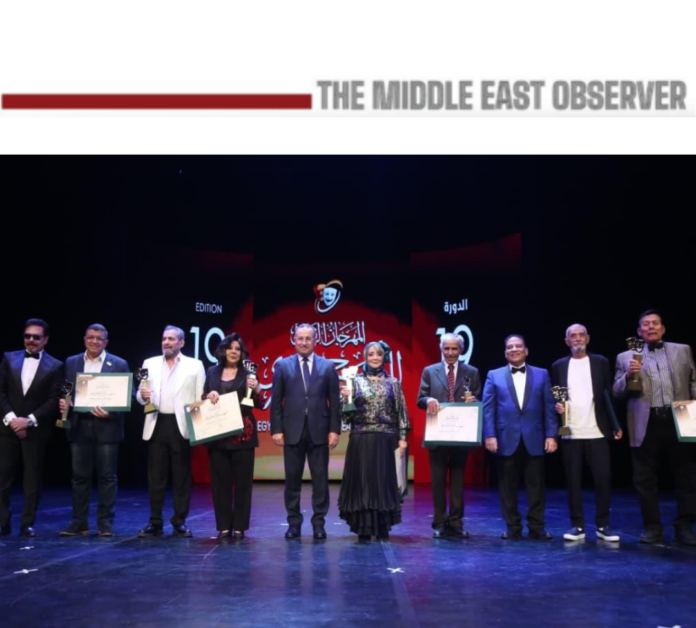
CAIRO — Egypt’s Acting Minister of Culture Abdel Aziz Konsowa on Sunday inaugurated the 19th National Festival for Egyptian Theatre, launching the first edition of the country’s flagship theatre event to extend beyond Cairo as part of a broader government strategy to decentralise cultural activities and widen public access to the arts.
The festival, which runs until 11 August, is being held under the slogan “The National Festival for Egyptian Theatre Across Egypt” and, for the first time since its establishment in 2006, includes a parallel programme in Mansoura, reflecting the government’s policy of expanding cultural services beyond the capital.
The opening ceremony at the Cairo Opera House was attended by senior government officials, artists, academics and members of Egypt’s theatre community.
Konsowa, who also serves as Minister of Higher Education and Scientific Research, described theatre as an investment in people and one of the state’s principal instruments for strengthening national identity, encouraging creativity and promoting public awareness.
“Theatre is an investment in people before it is an investment in art,” he said, adding that the Ministry of Culture is expanding programmes to identify emerging talent while reinforcing Egypt’s cultural identity and confronting extremist ideologies through artistic engagement.
The decision to extend the festival beyond Cairo also revives a tradition of regional cultural festivals that once played an important role in Egypt’s artistic life. Soad Moawad, a retired teacher from Port Said, recalled that before the city’s wartime disruption, Port Said hosted an annual festival that attracted many of Egypt’s leading actors and theatre personalities.
“People across the city looked forward to the festival every year,” Moawad said. “It was one of the highlights of Port Said’s cultural calendar and gave audiences outside Cairo the opportunity to experience performances by Egypt’s biggest stars.”
Moawad said the atmosphere surrounding those annual celebrations is reflected in the classic Egyptian film Eshaet Hob (A Rumour of Love), starring Youssef Wahbi, Soad Hosny and Omar Sharif, which, in her view, captures the excitement and social significance of the city’s festival during that period.
Her recollection underscores how the government’s decision to expand the National Festival for Egyptian Theatre into Mansoura not only advances its policy of cultural decentralisation but also revives a longstanding tradition of bringing major artistic events to Egypt’s governorates, reinforcing the role of regional cities in the country’s cultural landscape.
The festival’s expansion forms part of Egypt’s wider cultural decentralisation strategy, which seeks to achieve what the government describes as “cultural justice” by treating access to artistic and intellectual life as a constitutional right rather than a privilege concentrated in Cairo. The policy prioritises governorates that have historically received fewer cultural services and aligns with the state’s broader human development agenda.
According to official Ministry of Culture and State Information Service (SIS) briefings, the strategy includes modernising regional cultural infrastructure, expanding theatre and artistic programming in underserved communities, deploying mobile cultural units to remote areas and integrating cultural initiatives with the presidential Hayah Karima (Decent Life) rural development programme.
Egypt’s General Authority for Cultural Palaces currently oversees a nationwide network of approximately 347 cultural palaces and cultural houses, while the Ministry of Culture operates six mobile theatre units serving Greater Cairo, Upper Egypt, the Delta, Canal cities and Sinai. The ministry is also implementing a programme to modernise 30 regional cultural palaces, transforming them into multi-purpose centres equipped with theatres, digital libraries, educational facilities and community arts spaces.
Officials argue that broadening access to theatre and cultural activities strengthens social cohesion, promotes dialogue among young people and reinforces Egypt’s long-standing position as one of the Arab world’s leading centres of cultural production.
Festival President Mohamed Riad said the event has evolved into Egypt’s principal platform for recognising theatrical achievement while supporting emerging artists.
“Theatre is the memory of a nation and the conscience of society,” he said. “It remains one of Egypt’s most enduring instruments of soft power.”
Festival Director Adel Abdo described this year’s edition as the largest in the event’s history.
He said Mansoura alone hosted 72 cultural events, including theatrical performances, dramatic readings, seminars, masterclasses, workshops for persons with disabilities and community outreach programmes.
The festival received 126 theatrical productions, with 35 selected for the official competition and three additional performances presented outside competition. Organisers also reported 216 playwriting submissions, 40 critical essays, 22 academic research papers, 23 intellectual seminars and 11 artistic workshops. Nearly 20,000 students applied to participate in workshops held in Cairo and Mansoura, reflecting growing youth engagement with the performing arts.
The opening ceremony, presented by Reham Ibrahim, featured Safar (“Journey”), a choreographed performance directed by Walid Aouni that symbolically traced the movement of Egyptian theatre from Cairo to the country’s governorates, reinforcing the festival’s expanded national identity.
Seven prominent figures were honoured for their lifetime contributions to Egyptian theatre and the arts, including Essad Younis, Shahira, Ahmed Abdel Aziz, Ahmed Maher, theatre critic Hamdy El-Gabry, and directors Magdy Megahed and Ahmed El-Banhawy.
The official competition jury is chaired by director Khaled Galal, while the festival’s performance selection committee is headed by Hassan El-Wazir.
Konsowa thanked Dakahlia Governor Tarek Marzouk and Mansoura University President Sherif Khater for supporting the festival’s regional expansion, which also places greater emphasis on Egyptian playwrights and professional training programmes for young theatre practitioners.
The decision to stage part of the festival outside Cairo marks one of the clearest examples to date of Egypt’s efforts to decentralise cultural policy. By shifting major national events into regional governorates and investing in local cultural infrastructure, officials hope to strengthen participation in the creative industries, broaden access to the arts and reinforce Egypt’s cultural influence across all parts of the country. The initiative also reflects a broader recognition that Egypt’s cultural heritage has historically flourished not only in Cairo but across regional cities whose artistic traditions continue to shape the country’s national identity.