Benchmark edges higher while small- and mid-cap shares continue to outperform amid ongoing capital-market reforms
CAIRO — Egypt’s stock market extended its gains on Tuesday, with the benchmark index closing modestly higher as domestic investors absorbed profit-taking by regional and international investors. The session reinforced a broader trend that has characterized July trading, with smaller companies continuing to outperform blue-chip shares despite increasingly selective investor positioning.
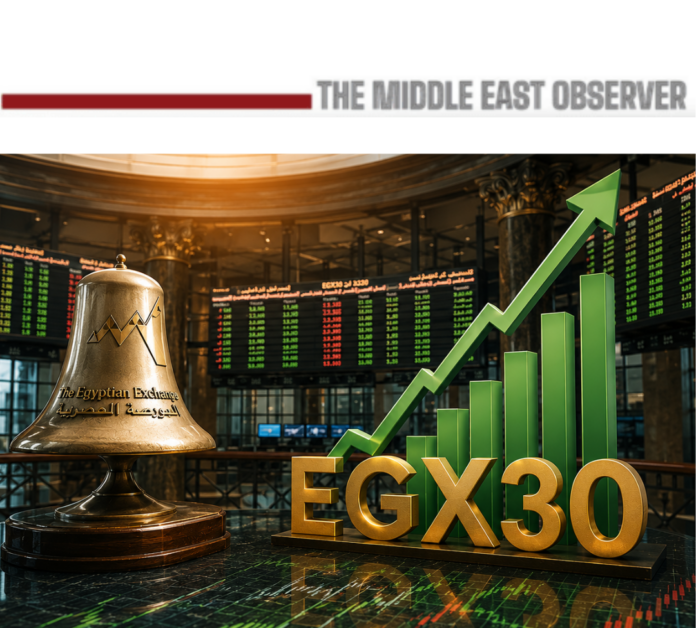
The EGX30 advanced 0.18% to close at 53,729.97 points, marking its second consecutive daily gain. The broader market again outperformed, with the EGX70 Equal Weight Index rising 0.97% to 18,300.85 points, while the EGX100 Equal Weight Index gained 0.62% to 24,133.04 points. The EGX33 Shariah Index added 0.16%, whereas the EGX35-LV slipped 0.39%, reflecting selective profit-taking in some lower-volatility large-cap shares.
Total market capitalization increased by approximately EGP4 billion to EGP3.959 trillion, leaving listed companies roughly EGP22 billion more valuable than at the beginning of the trading week.
Domestic Investors Continue to Underpin the Market
Official Egyptian Exchange data showed Egyptian investors finishing the session as significant net buyers, offsetting net selling by Arab and non-Arab foreign investors.
The trading pattern suggests that local institutional and retail investors continued to provide the market’s principal source of liquidity, allowing the benchmark indices to advance despite foreign profit-taking following recent gains.
While overseas participation fluctuated during the session, the overall balance of trading indicated that domestic demand remained sufficiently resilient to sustain the market’s upward trajectory.
Selective Rally Rather Than Broad-Based Buying
Although the principal indices ended higher, the advance was not uniform across the market.
Official trading statistics showed that declining shares outnumbered advancing issues, indicating that investor demand remained concentrated in selected sectors and companies rather than extending across the entire market.
This divergence between headline indices and overall market breadth suggests investors are becoming increasingly selective, favouring companies supported by stronger earnings expectations, liquidity and sector-specific fundamentals.
Turnover Holds Above Recent Levels
Trading activity remained firm, with turnover of approximately EGP11.2 billion, broadly in line with the stronger trading volumes recorded in recent sessions.
Institutions accounted for roughly one-fifth of total trading activity, while retail investors continued to dominate overall market turnover, highlighting the important role of domestic individual investors in supporting market liquidity.
Healthcare and Industrials Lead Individual Movers
Healthcare shares continued to attract investor interest, with GlaxoSmithKline Egypt climbing 16.6% to lead the market’s gainers.
Arab Moltaka Investments advanced 7.6%, while Sinai Cement gained 6.9%, reflecting continued interest in selected industrial and construction-related companies.
Among the day’s weakest performers, Crest Mark for Contracting and Real Estate Development fell 6.53%, El Saeed Contracting and Real Estate Investment (SCCD) declined 5.86%, and El Nasr Clothes & Textiles (Kabo) lost 4.87%.
Pound Strengthens While Debt-Market Flows Diverge
The Egyptian pound continued to strengthen against the US dollar, with the Central Bank of Egypt reporting reference rates of approximately EGP 50.48 for buying and EGP 50.58 for selling.
Separate data from Egypt’s secondary market for government securities showed Arab and foreign investors recording combined net sales of approximately US$219.7 million. These transactions relate to fixed-income instruments rather than equities, illustrating that portfolio positioning differed between the debt and stock markets during the session.
For equity investors, the relatively stable exchange rate continues to provide a more predictable macroeconomic backdrop when assessing Egyptian assets.
Capital-Market Reforms Remain a Medium-Term Driver
Beyond daily trading activity, investor attention remains focused on Egypt’s programme to deepen domestic capital markets.
The Financial Regulatory Authority (FRA) continues preparing additional state-owned enterprises for eventual public offerings while advancing reforms covering securities borrowing, short selling, disclosure standards and corporate governance.
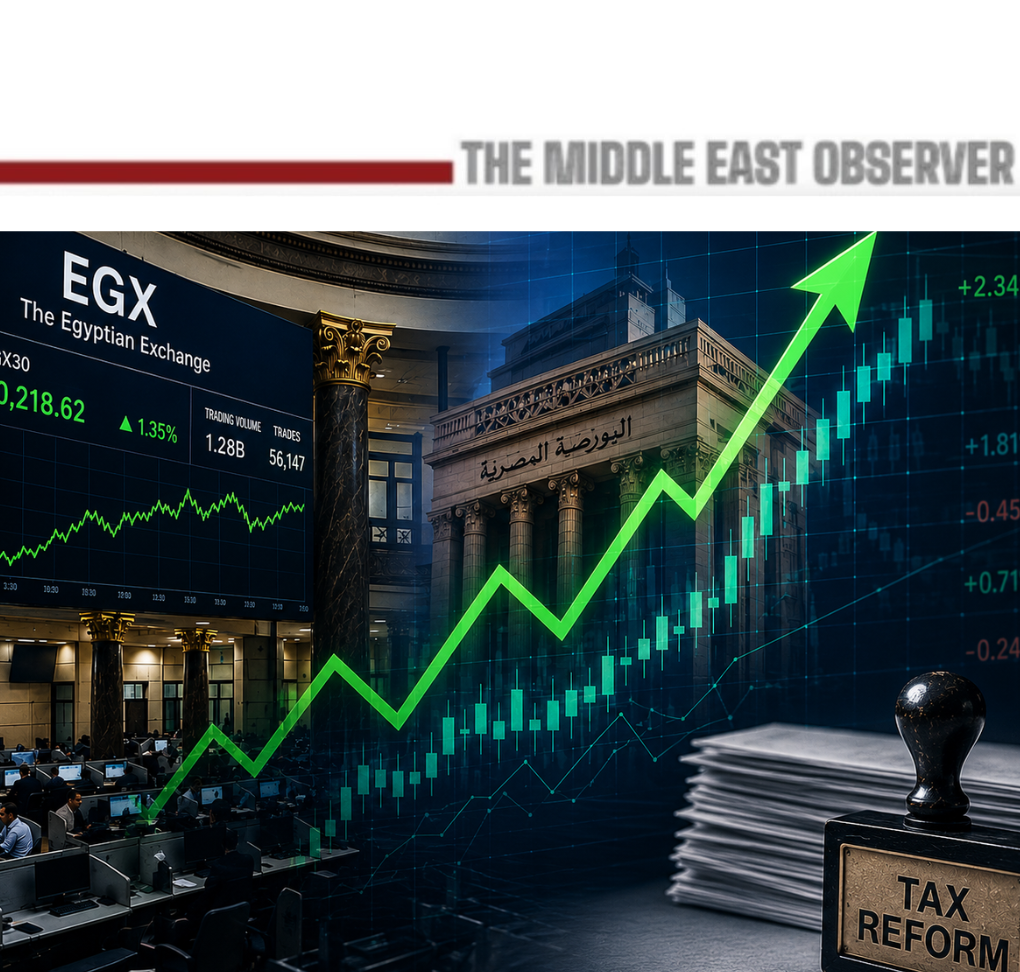
Recent tax reforms simplifying the treatment of listed securities are also intended to improve market accessibility and support new listings. Together, these initiatives aim to enhance market depth and strengthen the Egyptian Exchange’s role as a long-term source of corporate financing.
Analysts at leading Egyptian investment banks have generally argued that sustained improvements in market liquidity and a credible pipeline of new listings will be more important for attracting long-term institutional capital than short-term fluctuations in daily index performance.
Weekly Perspective
Tuesday’s session extended the constructive tone established earlier in the week.
Since Monday’s rebound, the EGX30 has gained almost 0.6%, while the EGX70 has advanced nearly 2.5%, reinforcing investors’ continued preference for smaller and mid-cap companies over many of the exchange’s largest constituents.
The divergence reflects improving opportunities beyond traditional blue-chip stocks, although sustained momentum will ultimately depend on stronger corporate earnings, continued economic stability and successful execution of the government’s capital-market reform agenda.
Outlook
Attention now shifts to second-quarter earnings announcements, monetary policy expectations and progress on Egypt’s state-owned company listing programme.
Tuesday’s session demonstrated that domestic liquidity continues to underpin Egypt’s equity market even as foreign participation fluctuates. Sustaining the recent rally, however, will depend less on retail-driven momentum than on stronger corporate earnings, continued progress in capital-market reforms and renewed long-term institutional investment.
Related news:
Egypt’s Fund Boom Signals Deeper Shift in Capital Markets Architecture
CBE, Internal Trade Development Authority Sign Agreement to Expand Digital Access to Corporate Data
Read also:
How Digital Money Can Strengthen Monetary Policy Across the MENA Region
Parliament Seeks Stronger Institutional Role for National Investment Bank