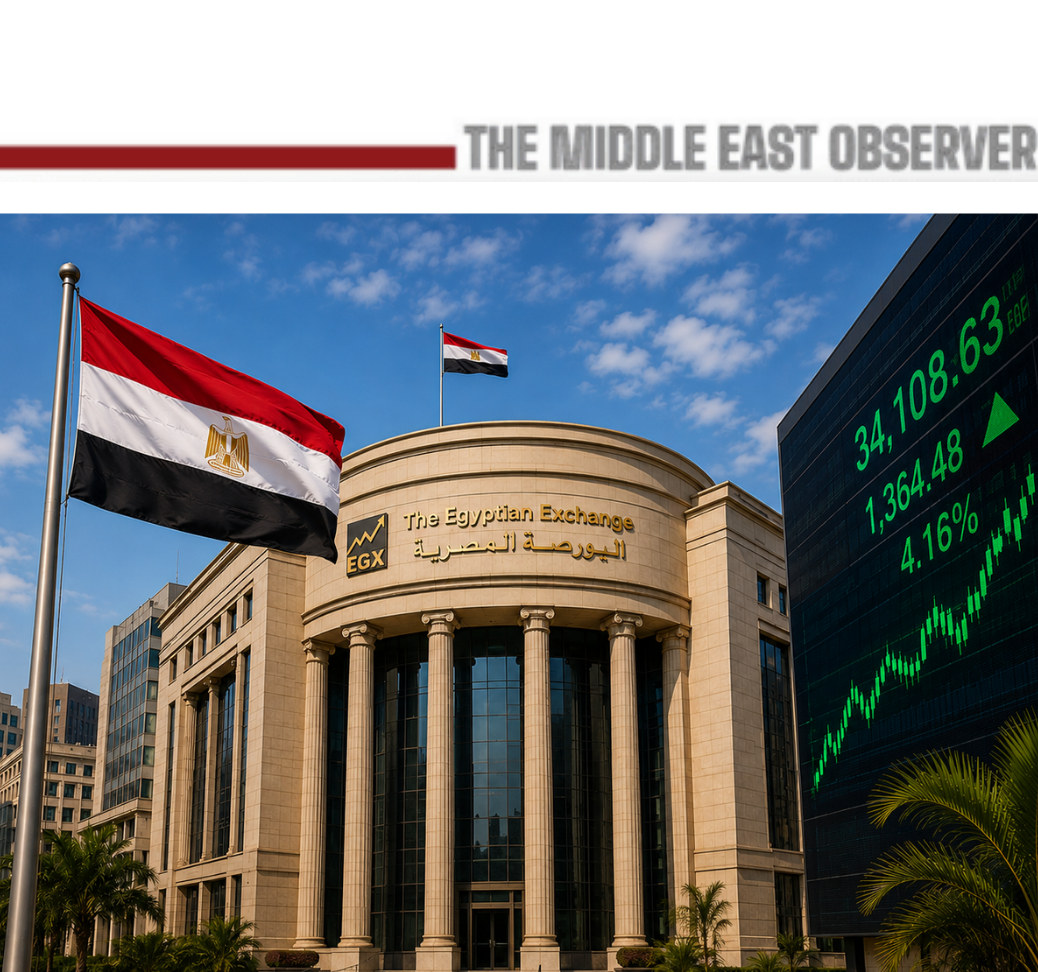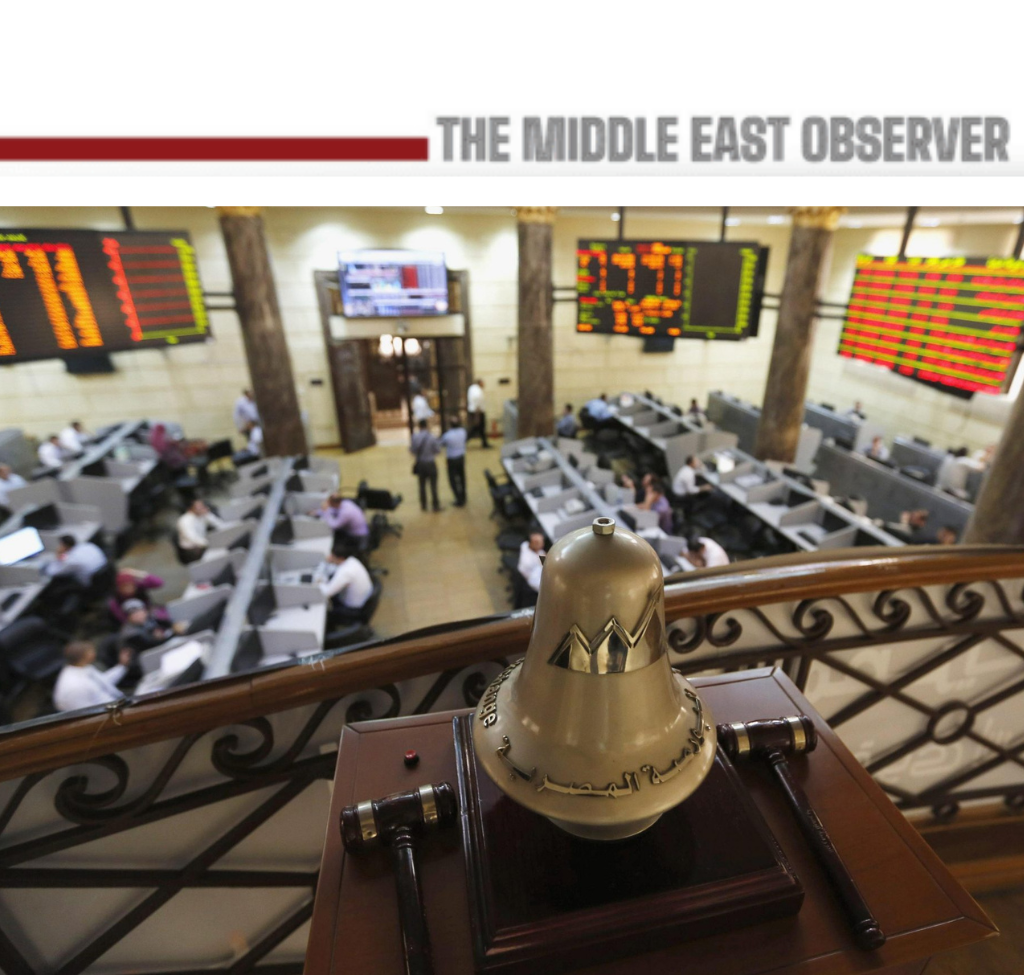
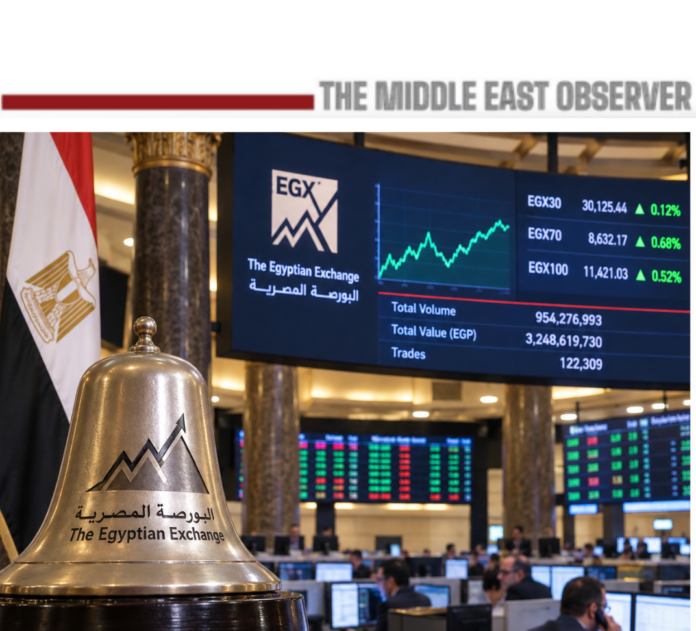
Egyptian equities ended a volatile week almost exactly where they began, but the flat headline concealed a meaningful shift beneath the EGX30. Smaller stocks outperformed large caps, domestic investors remained the market’s principal liquidity base, and international capital continued to favor Egyptian sovereign yield over listed equities.
The EGX30 fell 0.39% on Thursday to 56,280.17 points, leaving the benchmark up just 0.02% for the week and roughly 34.6% since the start of 2026.
The broader market moved differently. EGX70 rose 0.32% on Thursday to 21,403.27 and EGX100 gained 0.17% to 27,997.27, while turnover reached about EGP12.1bn. Market capitalization fell roughly EGP18bn on the day to EGP4.408tn.
Egyptians were net buyers of EGP518.8mn, while Arabs sold EGP329.5mn and non-Arab foreigners EGP 189.3mn.
The session therefore repeated the week’s defining pattern: blue-chip weakness did not translate into equivalent pressure across the wider market.
A Flat Week, but Not a Flat Market
The path was considerably more volatile than the final weekly change suggests.
EGX30 opened the week at a record 56,676.16 on Sunday, slipped on Monday, fell 0.80% Tuesday, recovered 0.58% Wednesday and declined again Thursday.
It ended just 9.85 points above the previous Thursday.
Smaller shares performed better. For the week, EGX70 gained about 0.47% and EGX100 0.35%, while EGX33 Shariah advanced 1.77%.
The market has therefore moved from a straight-line record rally into rotation and consolidation.
After a roughly 35% EGX30 advance this year, a period in which smaller companies outperform while large caps digest gains can be a more constructive configuration than another narrow index surge.
Foreign Equity Flows Remain Weak
Foreign investors remained net sellers of listed equities during the week, recording roughly EGP1.04bn of net sales.
Arab investors showed about EGP4.51bn of weekly net buying, but that headline requires qualification. Monday alone included approximately EGP5.04bn of Arab institutional buying, almost matched by heavy Egyptian institutional selling.
The concentration means the weekly Arab figure should not be interpreted as evidence of a broad regional rush into Egyptian shares.
The more durable feature is that Egyptian investors continue to provide the bulk of equity-market liquidity, reducing the market’s immediate dependence on foreign flows.
That resilience is useful, but it does not remove the need for stronger institutional participation.
Foreign Capital Still Prefers Sovereign Yield
The government-debt market sent a different signal.
Published daily EGX figures imply that foreign and Arab investors were net buyers of roughly $420mn of secondary-market government securities over the week.
The strongest inflows came on Tuesday and Wednesday, when combined net purchases reached about $380mn and $144mn, respectively. Thursday reversed part of that with around $110mn of net selling.
The broader conclusion remains clear:
international and regional investors were net buyers of Egyptian sovereign debt even as foreigners remained net sellers of Egyptian equities.
That is the central asset-allocation divide confronting the EGX.
High domestic yields continue to attract short-term portfolio capital, while equities must offer sufficiently strong earnings growth to compensate investors for corporate, liquidity and currency risk.
Pound Weakness Raises the Equity Hurdle
The pound also weakened during the week.
The CBE’s average dollar buying rate moved from EGP50.8871 on September 3 to EGP51.2709 on September 10, a depreciation of about 0.75%.
For foreign investors, that reduces part of the EGX’s local-currency return when translated into dollars.
It also increases the importance of company-level FX exposure, particularly for exporters, import-intensive businesses and firms carrying foreign-currency debt.
Banque du Caire Moves Another Step Towards Market
The state IPO programme provided a more constructive structural signal.
The government committee overseeing state-company valuations approved the methodology for Banque du Caire’s updated fair-value study, advancing preparations for a potential EGX offering.
The stage matters: this is progress towards an offering, not an IPO launch or final transaction approval.
Its significance lies in market supply. With investor participation and trading liquidity substantially higher in 2026, the EGX increasingly needs new investable assets rather than simply higher prices for the existing stock universe.
A successful Banque du Caire offering, alongside other state and private-sector listings, could help convert trading liquidity into genuine market depth.
Flat Index, More Important Changes Beneath It
The EGX30’s 0.02% weekly gain understates what changed.
Smaller shares outperformed large caps. Foreign equity investors remained cautious, while sovereign-debt investors were net buyers. The pound weakened, raising the hurdle for hard-currency equity returns. And the state IPO pipeline continued moving forward.
The market is therefore consolidating, not clearly reversing.
The next advance will depend less on another attempt at 57,000 than on three harder tests: broader earnings support, sustained institutional equity demand and successful new listings capable of converting abundant liquidity into deeper market structure.
Egypt has already shown that domestic liquidity can sustain the EGX near record levels. The next test is whether that liquidity can build a market deep enough to attract long-term foreign capital from sovereign yield into corporate equity.
Related news:
EGX30 Holds Near Records as Broader Market Loses Momentum
EGX Nears 56,000 as Blue Chips Extend Rally Ahead of Index Reshuffle
Read also:
Foreign Buying Helps EGX30 Recover as Small-Caps Extend Rally
EGX Falls While Dollar IPO Strategy Broadens Egypt’s Market Appeal