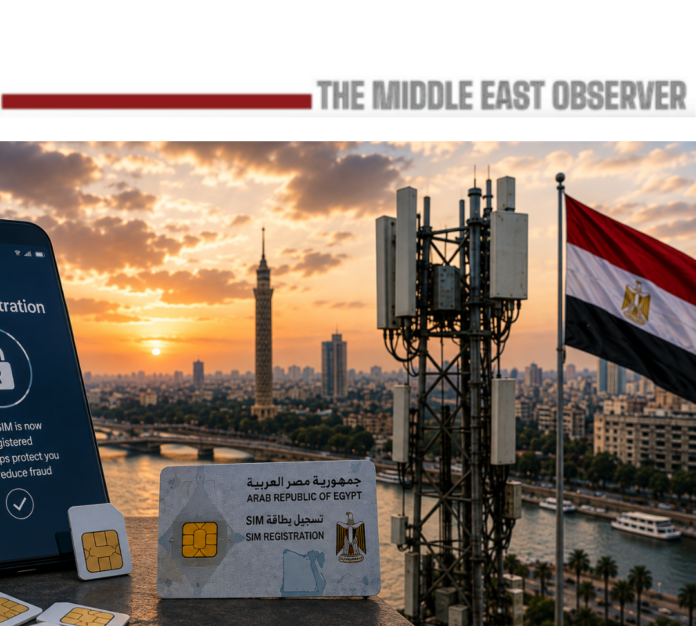
A disputed SIM linked to a drug-trafficking prosecution has triggered thousands of complaints, scrutiny of all four mobile operators and a push towards facial verification.
Egypt is tightening mobile-phone registration after a SIM registered to a university student was cited in a drug-trafficking case, triggering thousands of complaints over unfamiliar numbers and scrutiny of all four mobile operators.
The National Telecommunications Regulatory Authority, or NTRA, has referred Vodafone Egypt, Orange Egypt, e& Egypt and Telecom Egypt’s WE to the Public Prosecution, suspended new bulk corporate-line activation and ordered operators to accelerate biometric identity verification.
The referrals open prosecutorial investigations and do not constitute findings of criminal wrongdoing. The cases will determine whether disputed registrations resulted from individual misconduct, weaknesses at branches or distributors, or broader failures in operator controls.
The case that triggered scrutiny
The issue gained national attention through the case of Amr Emara, a university student from Sharqia, who was convicted in connection with a drug-trafficking case involving a shipment intercepted near the Ahmed Hamdi Tunnel.
A mobile number cited in the investigation was registered in Emara’s name. His family maintains that he neither possessed nor controlled the SIM and that his identification had been used to obtain mobile lines for another person.
According to the family’s account, Emara provided his national ID and signature believing he was helping secure one line. His relatives later alleged that additional SIMs were activated under his identity without his knowledge and that one subsequently surfaced in the criminal investigation.
Emara was initially convicted in absentia and later surrendered for retrial. A life sentence was subsequently upheld, according to local reporting, while his family has said it will continue pursuing legal remedies.
The family’s account remains disputed, and the full judgment has not been publicly reviewed by MEO, making it impossible to determine the precise weight the court gave the SIM-registration evidence.
The case nevertheless exposed a wider vulnerability: a telephone number can establish an investigative link to the subscriber recorded in an operator’s database even when possession and actual usage are contested.
NTRA subsequently clarified that registration of a mobile line under a person’s identity does not by itself establish legal responsibility for activity conducted through it. Liability depends on evidence establishing possession, control and actual use.
Thousands check subscriber records
Public attention surrounding the case prompted Egyptians to review their own records through NTRA’s My Numbers service.
The regulator restored the service on August 6 after a temporary technical suspension, allowing users to identify mobile numbers associated with their national IDs.
NTRA spokesperson Mohamed Ibrahim said the authority had received about 4,000 complaints concerning lines that citizens said had been registered without their knowledge.
Ahmed Badawy, chairman of parliament’s Communications and Information Technology Committee, said more than 1.5mn people had accessed the service to review numbers associated with their identities.
The checks far exceeded confirmed complaints, but their scale showed how rapidly an individual criminal case had become a broader test of confidence in subscriber records.
Egypt already requires customers purchasing individual mobile lines to present valid national identification and complete contractual registration procedures. The emerging issue is therefore not the absence of know-your-customer rules, but whether those controls were applied consistently and whether customer information could be reused without effective authorisation.
The stakes extend beyond telecommunications. Mobile numbers increasingly underpin authentication for banking, digital payments, online accounts and government services, making incorrect subscriber records a wider digital-identity risk.
Four operators face investigation
NTRA escalated its response on August 10 by referring all four mobile operators to prosecutors after reviewing complaints and collecting documentation related to registration and activation practices.
The authority also imposed immediate restrictions while the investigations proceeded.
New bulk sales and activations through systems used for companies and institutions have been suspended, covering both private-sector and government entities.
Existing corporate lines are to be reviewed, with actual users required to regularise ownership and conclude contracts under their own names. Lines that are not corrected within the required period may ultimately be cancelled.
The suspension puts corporate and bulk-registration channels at the centre of the regulatory review, where the legal subscriber and the person actually using a line can more easily become separated.
NTRA has warned that further breaches could lead to administrative and legal sanctions, including restrictions on operators’ ability to sell or activate new lines.
Biometrics become the next layer of e-KYC
The regulator’s longer-term response is to strengthen subscriber verification beyond documents and signatures.
NTRA has ordered operators to accelerate biometric verification through their mobile applications, adding a direct identity-authentication layer to new registrations and certain customer-data procedures.
Its formal decision refers broadly to biometric verification. Ibrahim has separately said facial recognition is expected to form part of the system, allowing an electronic match between the customer and the identity presented during registration.
Officials have pointed to early September as the current rollout target, although NTRA has not published a binding technical implementation date.
The My Numbers service is also expected to incorporate biometric authentication, helping ensure that a person checking the lines linked to a national ID is genuinely the holder of that identity.
The objective is to close the gap exposed by the recent complaints: an identification document may establish whose name enters a database, while biometric authentication provides stronger evidence that the individual authorizing the transaction is the person named on it.
The shift also creates a new data-governance challenge. Facial verification will require clear rules on biometric-data processing, access, retention, security and liability. Officials have said mobile operators will not themselves retain customers’ biometric information, but NTRA has yet to publish the full technical framework governing matching procedures or failed-verification cases.
For consumers, the immediate safeguard remains to review registered lines through My NTRA and challenge unfamiliar numbers with the operator or regulator.
The next test is twofold: whether biometric verification can prevent unauthorized registrations without creating new privacy and compliance risks, and whether prosecutors find the existing failures were isolated abuses or evidence of wider weaknesses in operator controls.
Related news:
Andy Burnham begins UK premiership with activist agenda and immediate cost-of-living push
Andy Burnham begins UK premiership with activist agenda and immediate cost-of-living push
Read also:
Egypt Sees Surge in Market Participation as Investment Zones Drive Growth Strategy
MCIT Launches Child-Safe Mobile Internet Services to Strengthen Online Protection