Pollution from the sanctioned Caroline Bezengi, carrying an estimated 800,000 barrels of Russian crude, has reached Oman’s mainland after spreading across the Arabian Sea, as international salvors race to stabilise the vessel and prevent a potentially larger discharge.
A major oil spill off Oman has developed into a regional environmental emergency after a tanker carrying Russian crude was damaged off Yemen, drifted into Omani waters and grounded near one of the sultanate’s most environmentally sensitive marine areas.
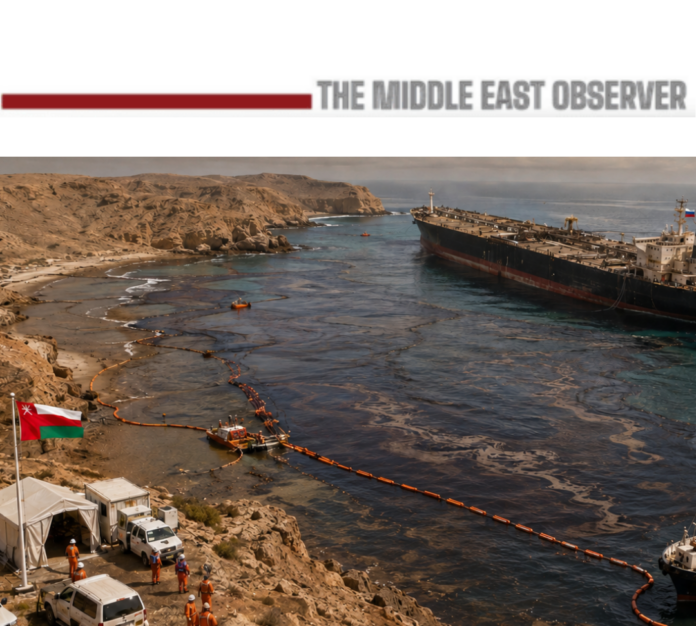
The Caroline Bezengi, a roughly 25-year-old tanker under international sanctions over its role in transporting Russian oil, ran aground on June 30 near the Hallaniyat Islands after reporting difficulties off Yemen on June 8.
Reuters reported on August 13 that the vessel had been carrying about 800,000 barrels of Russian crude and that British maritime risk-management company Ambrey was coordinating an international salvage response with Oman and other stakeholders. International specialists, salvage vessels and aircraft are being mobilised alongside about 100 tonnes of specialist equipment, with monsoon conditions complicating the operation.
The intervention has become increasingly urgent. Oman’s Environment Authority has confirmed that oil has reached the mainland, while satellite imagery shows the partially submerged tanker settling deeper into the water.
June 8: Trouble Begins off Yemen
The Caroline Bezengi loaded Russian crude at the Black Sea port of Novorossiysk before sailing towards Asia, according to ship-tracking information reviewed by Reuters.
On June 8, the tanker reported difficulties off Yemen. Maritime-security sources subsequently told Reuters that initial assessments indicated a blast aboard the vessel. No group has claimed responsibility and the cause has not been conclusively established.
The casualty occurred amid heightened security risks to commercial shipping around Yemen, but available evidence does not establish who or what caused the damage.
The crew was subsequently evacuated and the damaged vessel was unable to continue its voyage normally.
June 30: Tanker Grounds near Omani Nature Reserve
On June 30, the Caroline Bezengi grounded near the Hallaniyat archipelago off Oman’s southern coast.
The location raised the environmental stakes. Reuters reported that the tanker lies close to a marine nature reserve supporting endangered wildlife, including Arabian Sea humpback whales and Socotra cormorants.
The vessel remained stranded as seasonal monsoon conditions complicated access and salvage operations.
Satellite imagery reviewed by the Associated Press subsequently showed the tanker increasingly submerged, intensifying concerns over its structural condition and the possibility of further leakage.
Late July-August: Slick Spreads to Mainland Oman
Clear evidence that the casualty was developing into a substantial pollution event emerged towards the end of July.
Reuters reported on July 31 that satellite imagery showed crude leaking from the Caroline Bezengi. Wim Zwijnenburg, a remote-sensing specialist with Dutch organisation PAX who examined the imagery, said darker slicks indicated that part of the vessel appeared to have been breached. He warned that monsoon conditions could rapidly spread the oil.
The affected area expanded sharply during August.
Omani authorities initially estimated the slick at roughly 400 sq km. AP subsequently reported satellite measurements showing a larger footprint, while a broader independent analysis reviewed by Reuters estimated that oil and associated surface sheens had spread across more than 2,000 sq km.
The estimates are not directly comparable. They reflect different observation dates and methodologies and can vary according to whether analysts measure concentrations of heavier oil, thinner surface sheens or both.
Crucially, none of these figures measures the volume of crude discharged.
That quantity remains unknown.
The environmental threat escalated further when Oman’s Environment Authority confirmed that oil had reached beaches around Ras Madrakah on the mainland. Authorities warned that about 40km of coastline could be affected, while pollution was also threatening Masirah Island.
The incident had by then evolved from a stranded-vessel casualty into a coastal pollution emergency stretching far beyond the original grounding site.
Remaining Cargo and Liability Raise the Stakes
The amount of crude already released remains uncertain, making whatever oil remains aboard the vessel the more immediate concern.
Reuters’ latest reporting puts the tanker’s original cargo at about 800,000 barrels of Russian crude. Satellite imagery showing the vessel increasingly submerged has heightened concerns that further deterioration could compromise additional cargo tanks.
It would therefore be premature to rank the incident definitively alongside the world’s largest historical oil spills. The surface area affected cannot be translated directly into a volume discharged.
The Caroline Bezengi is more accurately characterised as a serious environmental emergency with the potential to become substantially worse if structural failure releases a significant portion of whatever cargo remains aboard.
The accident has also renewed scrutiny of environmental and financial risks surrounding Russia’s so-called “shadow fleet”. Reuters identifies the Caroline Bezengi as part of the network transporting Russian oil outside traditional Western-controlled shipping and financial channels and reports that the vessel is subject to international sanctions.
Western governments and maritime specialists have raised concerns about ageing vessels and opaque ownership and insurance arrangements in parts of the fleet, potentially complicating liability when casualties occur.
In the Caroline Bezengi case, the compensation picture is further complicated by Reuters’ report that the International Oil Pollution Compensation Funds is not expected to finance the clean-up because the casualty falls under an “act of war” exclusion.
The incident therefore illustrates how risks surrounding sanctioned energy flows can ultimately become environmental and financial liabilities for coastal states along international shipping routes.
Salvage Operation Becomes Decisive
Attention has now shifted decisively towards preventing further leakage.
Ambrey said on August 13 that it was working with Oman and other stakeholders on the salvage operation and had engaged an international oil-spill response specialist.
International experts, salvage vessels and aircraft are being mobilised alongside about 100 tonnes of specialist equipment, Reuters reported. The operation is complicated by monsoon conditions and the tanker’s proximity to the protected marine area.
The operation is focused on stabilising the tanker and securing whatever crude remains aboard while response teams contain oil already at sea and protect affected coastline.
For Oman, the immediate priority is containing pollution already released while stabilising the vessel and securing its remaining cargo. Whether that succeeds will determine if the Caroline Bezengi remains a serious regional pollution emergency or develops into a substantially larger environmental and financial liability.
Related news:
ENPPI Secures $355mn Oman Gas Contract in Gulf Expansion Milestone
The role of environmental policy in the nuclear industry: Rosatom’s case study
Read also:
The $10 iPhone Question: What China’s Manufacturing Model Really Teaches Us
AfDB Approves €100mn Loan for Morocco’s First EV Battery Gigafactory