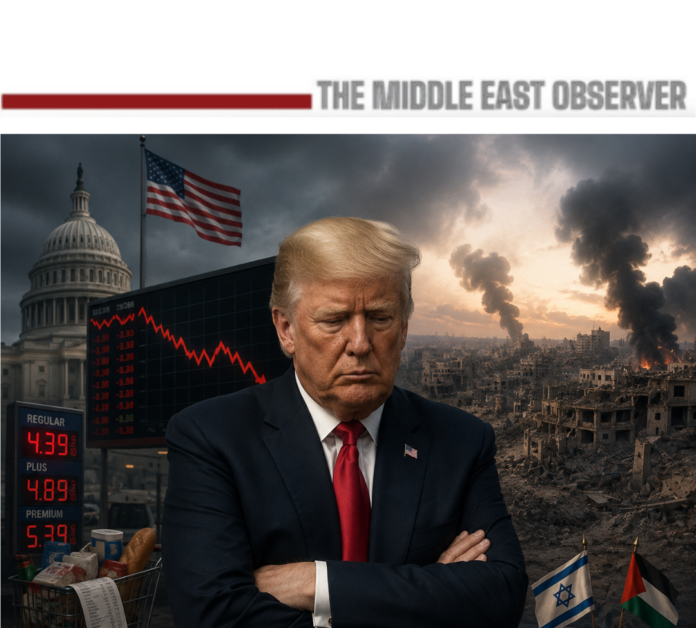
Washington’s Gaza diplomacy is moving towards mechanisms for reciprocal implementation just as the Iran track moves in the opposite direction. With Hormuz still severely disrupted and oil back above $91, Donald Trump’s Middle East deadlocks are increasingly feeding into the economic argument ahead of November’s midterms — while Iran’s already fragile economy absorbs mounting costs of its own.
Donald Trump is entering the final months before November’s midterm elections confronting three unresolved Middle East negotiations whose consequences increasingly extend beyond the region. In Gaza, Washington is trying to convert a fragile peace framework into reciprocal steps on Hamas’s disarmament, Israeli withdrawal and reconstruction. In Lebanon, further Israeli withdrawals remain tied to verifiable Hezbollah disarmament and deployment of the Lebanese state. Iran presents the most immediate global economic danger: diplomacy has stalled, Tehran is threatening a more offensive posture and disruption of the Strait of Hormuz is pushing energy, shipping and insurance costs higher.
A Financial Times/Focaldata poll conducted on August 7-10 found 53 percent of registered US voters saying their financial position had worsened since Trump returned to the White House in January 2025, against 21 percent who said they were better off. Nearly two-thirds said the economy was heading in the wrong direction, while Democrats led Republicans 44 to 39 per cent among likely voters on the congressional generic ballot.
The emerging risk for Washington is a feedback loop. Unresolved regional conflicts sustain energy and trade disruption, which feeds into inflation and household costs precisely when affordability is becoming a greater political vulnerability.
Gaza: From Sequencing Dispute to Verified Implementation
The latest US diplomatic push has clarified both the obstacle to a Gaza settlement and a possible route around it.
Jared Kushner held talks in Egypt with senior Hamas leader Khalil al-Hayya before travelling to Israel for extensive discussions with Prime Minister Benjamin Netanyahu. The talks ended without an officially announced breakthrough: Hamas and Israel remain divided principally over the sequencing of disarmament and withdrawal.
Trump’s framework calls for an end to IDF hostilities, Hamas’s disarmament, Israeli withdrawal and reconstruction under a civilian Palestinian administration. Hamas has indicated willingness to surrender its weapons within a broader settlement, but wants credible guarantees of Israeli withdrawal and an end to attacks. Netanyahu continues to insist that Hamas must disarm before Israel completes its withdrawal.
The fundamental obstacle therefore remains straightforward: Hamas does not trust Israel to withdraw after it disarms. Since the ceasefire brokered in Sharm el-Sheikh, which took effect on October 10, 2025, it has not ended the bloodshed. More than 1,250 Palestinians, mostly civilians with estimates suggesting 300 children, have been killed since the ceasefire, according to Reuters, while UN agencies have documented continuing civilian and child casualties. Violence has also intensified in the occupied West Bank. UN monitoring has documented a sharp rise in settler attacks, Palestinian fatalities and displacement, adding another source of instability to an already difficult Israeli-Palestinian negotiating environment.
American public opinion is also changing. Gallup found that 53% of Americans aged 18–34 now sympathise more with Palestinians, against a record-low 23% who sympathise more with Israelis — the first time a majority of that age group has favoured Palestinians. The shift forms part of a broader reversal in US opinion, with a Gallup poll that shows 57% of Americans support establishing an independent Palestinian state. This trend reflects shifting public views across political parties and age groups in the United States.
But Washington is beginning to move beyond simply describing the problem. The latest talks have produced working mechanisms dealing with demilitarisation and essential public-health infrastructure, including water and sanitation. The diplomatic effort is increasingly focused on converting political commitments into measurable steps. That is the direction in which a workable settlement needs to move.
Rather than requiring either side to make an irreversible concession first, Hamas could progressively surrender weapons and dismantle military infrastructure under external verification. Israel would withdraw from predetermined areas as agreed benchmarks are certified. A Palestinian civilian administration would assume authority simultaneously, while essential reconstruction and public-health work proceeds under internationally supervised arrangements. The principle is reciprocity without requiring trust.
Reconstruction should also become part of the incentive structure rather than remain indefinitely hostage to the security dispute. Water, sanitation, electricity, hospitals, housing and basic infrastructure represent both an urgent humanitarian requirement and an economic mechanism through which compliance can produce visible dividends.
Yet here the political obstacle is becoming harder to ignore.
The ceasefire has not ended the bloodshed, and Israeli strikes have continued during the diplomatic process. At the same time, powerful members of Israel’s governing coalition continue to advocate continued military control, renewed settlement and far more aggressive policies towards Gaza. National Security Minister Itamar Ben-Gvir has called for nightly killings in the territory, while other far-right coalition figures have openly opposed territorial concessions and Palestinian statehood.
This raises a more fundamental concern: Israel may take every available measure to avoid relinquishing territory already taken, irrespective of the clarity of the diplomatic route now being presented.
That concern does not rest on rhetoric alone. Netanyahu faces domestic political incentives that make territorial withdrawal especially difficult, while coalition partners have made loud and repeated promises against retreat. The danger is therefore that a technically workable Gaza framework becomes trapped not by an absence of mechanisms, but by an unwillingness to implement them.
This distinction matters.
The path towards continued peaceful implementation is increasingly visible: verified disarmament, phased withdrawal, civilian administration and reconstruction. The question is whether Israel’s government is prepared politically to follow that path once it requires actual territorial concessions.
Washington’s challenge, therefore, is no longer simply to design the architecture of implementation, but to ensure that the commitments already negotiated are carried out in practice — particularly those requiring action from Israel. Regardless of shifting opinion polls on either side, this remains the first critical deadlock. The United States holds considerable influence to help clear the way for implementation, yet the decisive step ultimately rests with the Israeli government, which appears reluctant to surrender that leverage before forthcoming elections clarify the political direction it is prepared to take.
Lebanon: Disarmament for Withdrawal — but Will Withdrawal Follow?
Lebanon presents a structurally similar problem.
Lebanon’s human toll has continued as well to rise despite US-backed efforts to contain the conflict, reinforcing the urgency of converting the present framework into an enforceable settlement linking Hezbollah disarmament, Lebanese state deployment and phased Israeli withdrawal.
Israel has tied further withdrawal from southern Lebanon to verified Hezbollah disarmament, arguing that relinquishing positions without dismantling military infrastructure would allow the group to rebuild. Beirut wants Israeli forces withdrawn so that the Lebanese Armed Forces can restore sovereign control, while Hezbollah continues to resist comprehensive disarmament.
Here too, requiring one side to complete its obligations before the other moves risks perpetuating the second deadlock.
The more practical route is a zone-by-zone exchange: Hezbollah weapons and military infrastructure are removed from a defined area; independent monitors verify compliance; Lebanese forces deploy; and Israel withdraws from the corresponding territory.
Successful implementation would create its own momentum. Each transferred zone would demonstrate that reciprocal compliance is possible, strengthen the Lebanese state’s authority over armed forces and reduce the probability of another Israel-Hezbollah war.
But Lebanon raises the same political question emerging in Gaza.
If Hezbollah complies in defined areas and Lebanese state forces deploy, will Israel actually withdraw from the corresponding territory?
Israeli domestic politics increasingly point towards resistance to withdrawal from strategically useful positions once they have been occupied. Statements by senior Israeli officials advocating an indefinite presence in security zones reinforce that risk.
A settlement can therefore succeed only if withdrawal obligations are as explicit, measurable and enforceable as disarmament obligations.
The broader objective should remain restoration of Lebanese sovereignty. Any security mechanism must therefore facilitate the transfer of authority back to the Lebanese state rather than normalise indefinite external military presence.
Verification cannot apply solely to Hezbollah.
It must apply equally to Israel.
Iran: Hormuz Becomes the Economic Centre of the Crisis
Iran is different in scale. The disruption of the Strait of Hormuz has transformed what began as a military confrontation into a global economic problem.
Before hostilities, roughly one-fifth of globally traded oil and LNG passed through the strait. The collapse in normal traffic has since transmitted the crisis directly into energy prices, tanker rates, insurance premiums, freight costs and inflation expectations.
The diplomatic trajectory is also deteriorating. A senior Iranian official has said Tehran is moving towards a “fully offensive” posture as negotiations stall and warned that Iran could take military action to break the US naval blockade. Trump has ruled out extending the collapsed interim framework and has threatened military action against Oman if it obstructs US efforts over Hormuz.
Tehran, meanwhile, has linked reopening the strait to US concessions including removal of the blockade on Iranian ports, oil-sanctions relief, access to frozen assets and an end to military threats and operations.
Hormuz has consequently become Iran’s principal bargaining chip. But leverage over a waterway central to global energy trade cannot remain indefinitely embedded in an opaque bilateral confrontation whose terms Washington and Tehran subsequently interpret differently.
That is where the negotiating architecture needs to change.
A Hormuz Agreement Must Be Public, Reciprocal and Dated
The next arrangement should be publicly announced, mutually acknowledged and governed by a clearly dated implementation schedule.
A renewed agreement ultimately appears more sustainable than prolonged confrontation because neither Washington nor Tehran has a durable economic or strategic interest in an open-ended war. Any settlement, however, must provide both sides with sufficient reciprocal gains to make de-escalation politically defensible.
Transparency should therefore be integral to the agreement. The consequences now extend well beyond the belligerents: Gulf exporters, energy-importing economies, shipping companies, insurers, manufacturers, airlines, central banks and consumers are already absorbing the costs. Once a bilateral confrontation begins generating systemic consequences for the world economy, the credibility and implementation of its settlement become matters of wider international concern.
A first-stage agreement should publicly establish:
the date for restoring secure, non-discriminatory commercial passage through Hormuz;

the timetable for ending interference with civilian shipping;

corresponding dates and conditions for reducing specified elements of the US naval blockade;

clearly defined, reversible sanctions or frozen-asset measures linked to verified compliance;

an agreed monitoring mechanism; and

predetermined procedures for addressing breaches by either side.
Such clarity would address one of the weaknesses exposed by previous arrangements: Washington and Tehran subsequently disputing what was agreed, which deadlines applied and which party failed to meet its obligations.

A published implementation calendar would make those disputes harder to sustain while giving Gulf governments, energy importers, shipping interests and financial markets an objective basis for assessing compliance.
Settle Hormuz First, Schedule the Harder Questions
Reopening Hormuz should remain the immediate priority because it offers the largest and fastest global economic dividend. But passage can no longer be separated entirely from the blockade, sanctions and security measures Tehran has explicitly tied to reopening the strait.

The initial bargain should therefore be broader than a shipping agreement but narrower than a comprehensive US-Iran settlement.

Iran would restore and guarantee commercial passage against verified reciprocal reductions in US maritime pressure and narrowly defined economic measures. Neither side would therefore be required to surrender its principal leverage without corresponding implementation by the other.
The more difficult disputes should then move into a published negotiating calendar, rather than being allowed to delay the immediate agreement:

    Nuclear programme: enrichment limits, highly enriched uranium, inspections and verification.

    Sanctions and frozen assets: the scope, sequencing and reversibility of relief and phased access to Iranian funds.

    Compensation: Iranian wartime claims and corresponding US claims.

    Security guarantees: Iranian demands against renewed attacks and US requirements on nuclear and regional security.

    Regional security: missiles, armed groups and wider escalation risks.

    Hormuz governance: permanent rules for navigation, maritime safety, environmental protection and any permissible service charges.
These issues need not be settled simultaneously. They should, however, have agreed starting dates, review points and target deadlines. Failure to resolve one track should not automatically paralyse progress elsewhere.

This would turn an open-ended confrontation into a managed negotiating process while recognising that Hormuz is no longer simply an American-Iranian dispute: its disruption imposes economic costs on countries with no role in the conflict.
Hormuz Needs a Wider Governance Framework

Nor can the strait’s long-term future be determined solely by Washington and Tehran.

Iran and Oman are its littoral states; Gulf economies depend heavily on it; Asian and European markets consume much of the energy passing through it; and international shipping and insurance markets carry the commercial risk.
Trump’s threat against Oman is therefore strategically problematic. Muscat has long provided a valuable diplomatic channel between Washington and Tehran, while geography makes Omani participation indispensable to any durable arrangement.

The objective should not be to determine whether Washington or Tehran “controls” Hormuz. It should be to establish a legally grounded framework under which no state can weaponize it.

International maritime law provides a starting principle: transit passage through straits used for international navigation should not be impeded. Any permanent framework should consequently accommodate Iran’s legitimate security and economic interests while preventing Iran, the US or any other power from turning commercial navigation into an instrument of coercion.

Any navigation, environmental or safety charges should be transparent, proportionate, non-discriminatory and legally grounded. An internationally supported mechanism involving Iran, Oman, Gulf states, major energy importers and maritime stakeholders could monitor compliance and investigate violations.

The longer-term objective should be to transform Hormuz from an instrument of geopolitical leverage into protected international economic infrastructure.
The Market Is Already Pricing the Deadlock
The economic consequences make a settlement increasingly urgent.

Brent crude moved above $91 a barrel on August 18 as markets reassessed the prospects for a US-Iran agreement. Oil flows through Hormuz remain dramatically below pre-war levels, while freight, refining, insurance and energy-security costs have risen.

The transmission extends far beyond crude. Higher oil prices feed into petrol and diesel; bunker fuel and insurance increase shipping costs; LNG disruption affects electricity and industrial energy prices; airlines face higher jet-fuel bills; and petrochemical and manufacturing costs rise. Some of those increases ultimately reach consumers.

Persistent energy inflation also constrains monetary policy by making it harder for central banks to reduce interest rates.

Hormuz is therefore no longer merely an oil-market story. It connects energy, shipping, aviation, manufacturing, inflation, interest rates and household purchasing power.

That is precisely why its political importance to Trump is increasing — and why the confrontation is becoming progressively more costly for Iran, whose already fragile economy faces the cumulative pressure of disrupted trade, sanctions, military expenditure and diminished normal commercial activity.
The pressure therefore runs in both directions. Washington faces voters increasingly concerned about affordability; Tehran faces mounting economic attrition.

Neither has an unlimited economic horizon.

That mutual vulnerability should provide powerful leverage for a negotiated settlement. The remaining question is whether economic rationality can overcome the political pride and strategic brinkmanship that have so far prevented both sides from converting their shared interest in avoiding prolonged war into an enforceable agreement.
The US Economic Exposure
America is far more resilient to an oil shock than it was in the 1970s, thanks to the expansion of domestic energy production. But energy independence does not mean price isolation: US consumers remain exposed to global crude and refined-product markets, while higher fuel, freight and transportation costs ultimately feed through to businesses and households.

That exposure comes at an awkward political moment. Consumer confidence remains under pressure from living and borrowing costs, and persistent energy inflation could further complicate the Federal Reserve’s policy choices.

The Middle East conflicts did not create America’s affordability problem. Housing, healthcare, interest rates, wages and domestic policy remain far larger structural factors. But prolonged disruption of one of the world’s most important energy corridors adds an external inflationary pressure that Washington has some capacity to reduce through diplomacy.

For Trump, approaching the midterms with voters already concerned about household finances, allowing a potentially negotiable geopolitical risk premium to become embedded in energy and transportation costs carries an increasingly obvious political price.

Iran faces the opposite side of the same equation. Hormuz provides Tehran with substantial leverage, but that leverage loses value if prolonged confrontation simultaneously damages Iranian trade, revenues, investment and domestic economic stability.

The economic case for de-escalation therefore exists on both sides.

Three Deadlocks, One Negotiating Principle
Gaza, Lebanon and Iran are fundamentally different conflicts, but the immediate routes out of their respective deadlocks increasingly rest on the same principles: verification, reciprocity, transparency and staged implementation.

In Gaza, verified Hamas demilitarisation would be matched by predetermined Israeli withdrawals, alongside the transfer of administration to Palestinian civilian authorities and the progressive opening of reconstruction.

In Lebanon, verified Hezbollah disarmament in designated areas would be followed by Lebanese army deployment and corresponding Israeli withdrawal.

In Hormuz, verified restoration of commercial navigation would trigger reciprocal reductions in US maritime pressure and clearly defined economic measures under a public implementation timetable.

The advantage is that none of these arrangements depends primarily on trust. Verification establishes compliance; reciprocity reduces the risk of moving first; transparency identifies breaches; and staged implementation allows credibility to be earned through action rather than promises.
The remaining obstacle is political will.
Gaza already has an increasingly discernible implementation path, yet movement remains obstructed. Lebanon has a similarly identifiable formula linking disarmament, state deployment and withdrawal, but uncertainty persists over whether territorial concessions would follow. In Hormuz, the economic rationale for reopening the strait is overwhelming, yet Washington and Tehran continue to increase pressure while disputing the terms of de-escalation.

The mechanisms are becoming clearer. The politics remain considerably harder.
The Hardest Barrier May No Longer Be the Terms

Trump does not need three comprehensive Middle East peace treaties before November. He needs credible movement away from open-ended confrontation towards enforceable settlements — above all, restoration of dependable commercial passage through Hormuz.

Each breakthrough would deliver a different dividend. Gaza could reduce humanitarian suffering and unlock reconstruction. Lebanon could lower the risk of another Israel-Hezbollah war while strengthening state authority. Reopening Hormuz could deliver the most immediate global economic benefit by reducing energy risk premiums, tanker and insurance costs, freight pressures and disruption to oil and LNG supplies.

Yet all three deadlocks expose the same underlying contradiction.

Israel can demand Hamas’s disarmament, but a durable Gaza settlement ultimately requires corresponding Israeli withdrawal. Hezbollah can be required to relinquish its weapons, but restoration of Lebanese sovereignty likewise requires Israeli withdrawal from agreed territory. Iran can use Hormuz to seek relief from blockade and sanctions, but cannot indefinitely impose the economic consequences of restricted passage on countries outside the conflict. Washington can maintain pressure on Tehran, but pressure without an executable reciprocal settlement risks prolonging the very energy disruption Trump has an economic and political interest in ending.
The paths towards de-escalation are therefore narrow, but increasingly visible. What remains uncertain is whether the principal decision-makers are prepared to accept the political costs of taking them.

Foreign policy rarely determines a US midterm election by itself. But once geopolitical confrontation travels through oil markets into petrol prices, freight costs, inflation, interest-rate expectations and household bills, the distinction between diplomacy abroad and politics at home begins to narrow.

That is why the central obstacle may no longer be identifying possible terms. Increasingly, it lies in whether political ego, domestic commitments and national pride can give way sufficiently for reciprocal compromise to become possible. Without that shift, workable mechanisms risk remaining agreements on paper rather than settlements in practice.

Breaking these Middle East deadlocks has consequently become more than a foreign-policy objective. For Trump, it is increasingly part of the economic argument he must win at home; for Iran, a question of mounting economic endurance; and for the wider world, a test of whether the interests of a few belligerents can continue to impose disproportionate costs on everyone else.
Related news:
Can America Become the World’s Energy Shock Absorber?
Trump-Xi Summit Signals Strategic Stabilisation Ahead of High-Stakes September Talks
Read also:
Iran War Diplomacy Advances as Trump Signals Progress on Deal