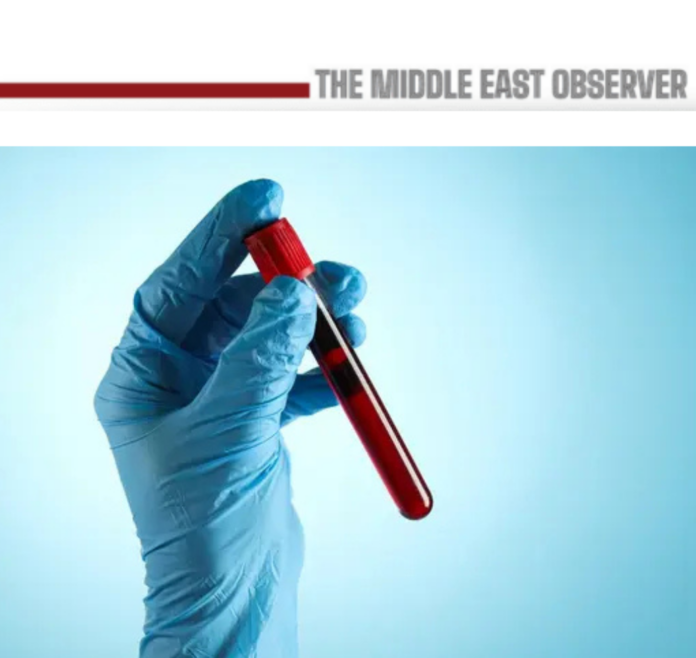
Egyptian researchers are developing increasingly sensitive biosensors capable of detecting cancer-related biomarkers from small blood samples. The harder challenge is turning laboratory performance into a clinically validated, commercially viable diagnostic.
A research team including Egyptian scientist Rabeay Younes Hassan has developed an experimental nanosensor capable of simultaneously detecting two breast-cancer biomarkers in laboratory testing. The harder challenge begins outside the laboratory: proving that the technology works reliably in patients and turning it into a regulated medical product.
A peer-reviewed study published in ACS Applied Bio Materials in 2025 describes an electrochemical dual immunosensor developed by Hassan and fellow researchers for the simultaneous detection of HER2 and MUC1, two biomarkers associated with breast cancer.
The sensor combines MXene-based material with ruthenium and palladium-oxide nanostructures and uses electrochemical impedance to identify the biomarkers. In laboratory testing, the researchers reported high analytical sensitivity and selectivity, with a detection time of about 20 minutes. Tests using spiked serum samples produced recovery rates of roughly 86 to 106 per cent.
The results point to the potential for rapid, minimally invasive biomarker testing. But they do not establish a clinically proven blood test for cancer.
That distinction matters — scientifically and commercially.
The question for Egypt is no longer only whether its laboratories can develop sophisticated medical technology. It is whether the country’s healthcare and investment ecosystem can finance, clinically validate, manufacture and ultimately export it.
From laboratory sensitivity to clinical accuracy
A sensor capable of detecting a cancer-associated biomarker under experimental conditions is not the same thing as a diagnostic capable of reliably determining whether a patient has cancer.
The critical measure is therefore not simply how little material a biosensor can detect. It is how accurately the technology distinguishes patients with disease from those without it across sufficiently large and diverse clinical populations.
That requires measurements of clinical sensitivity and specificity, comparisons with established diagnostic standards and prospective testing involving real patients.
The 2025 study tested the platform’s analytical performance, including through serum samples spiked with known concentrations of HER2 and MUC1. That is an important step in development, but publicly available evidence does not yet establish the large-scale, multi-centre clinical validation required for routine diagnostic use.
Hassan’s technology is therefore better understood as promising diagnostic research rather than an established blood test for cancer.
That is the boundary separating an encouraging laboratory result from a medical product.
Egypt is already shortening the diagnostic journey
The potential value becomes clearer against Egypt’s broader effort to reduce delays in cancer diagnosis and treatment.
Under the Presidential Women’s Health Initiative, the average interval between suspected diagnosis and the start of treatment has fallen from about 270 days to 49 days, according to the Ministry of Health and Population. The government is targeting a further reduction to 28 days.
In March 2026, Egypt launched the first phase of a national digital pathology network linking seven medical sites. The programme is intended to digitise pathology samples, connect specialists across facilities and use artificial-intelligence-supported systems to accelerate cancer diagnosis.
Those improvements largely address infrastructure and workflow: getting patients, samples and diagnostic information through the health system more efficiently.
Biosensors could address another part of the problem.
If a clinically validated point-of-care device could identify relevant biomarkers rapidly from a small blood sample, it could potentially reduce dependence on centralised laboratory processing for some stages of screening or assessment, particularly where specialist diagnostic capacity is limited.
But cancer is not a single disease with a universal biomarker. Any test would have to demonstrate sufficient predictive value for the cancers and patient populations for which it is intended, while positive findings would generally still require confirmation through established clinical pathways.
The more credible near-term proposition is therefore complementing existing diagnostics rather than replacing them.
The commercialisation gap
Hassan’s work also illustrates a broader problem for Egyptian research: scientific capability does not automatically translate into commercially scalable medical technology.
Moving an invention from a university laboratory to a regulated product requires intellectual-property protection, repeatable manufacturing, clinical studies, quality-management systems, regulatory approval and post-market oversight.
It also requires patient capital.
Egyptian startups raised about $263 million across 89 deals in 2025, ranking third in MENA, according to Wamda. But total investment fell 21 per cent year on year, even as deal activity increased from 84 transactions in 2024. Early-stage companies dominated, with 63 startups raising $133 million.
The regional funding gap is substantial. Saudi Arabia attracted about $5 billion across 211 deals in 2025, while the UAE raised about $2 billion.
Those figures cover the entire startup ecosystem rather than biotechnology specifically and were influenced by large transactions and debt financing. They should not be interpreted as pools of capital available to medical technology.
They nevertheless illustrate the difference in scale between Egypt’s venture market and those of its two leading Gulf peers. That matters for medical technology, where companies may need to finance years of product development, clinical validation and regulatory work before generating meaningful commercial revenue.
The manufacturing opportunity
If those barriers can be crossed, Egypt has attributes that could support a diagnostics manufacturing industry.
Its large population offers a potentially substantial domestic market, while its existing scientific and engineering base could support research and production. Competitive manufacturing costs and Egypt’s geographic position could also provide a platform for eventual access to markets across the Middle East and Africa.
The potential opportunity is particularly relevant in affordable diagnostics designed for healthcare systems where sophisticated laboratory infrastructure and specialist capacity remain uneven.
But production costs alone do not create a medical-device export industry.
Quality-management systems, reproducibility, regulatory recognition and internationally accepted certification are essential. A diagnostic that is inexpensive to manufacture but unable to satisfy major regulatory or procurement standards has limited international commercial value.
That leaves three tests for Hassan’s research and similar Egyptian technologies: Can they reproduce their performance in large real-patient populations? Can they clear the regulatory and manufacturing requirements for routine medical use? And can Egyptian companies turn the resulting intellectual property into commercially scalable products?
A drop of blood may eventually be enough for some sophisticated diagnostic tests. But between that drop and routine hospital use lies the difficult machinery of clinical validation, regulation, manufacturing and capital.
Hassan’s research matters not because Egypt has already solved rapid cancer diagnosis, but because it shows that its laboratories are working on technologies capable of addressing it. The harder test is whether Egypt can build the infrastructure to turn that science into a regulated — and ultimately exportable — medical technology.
Related news:
MENA Market Snapshot: How Healthcare, Biotechnology and Food Security Are Reshaping Regional Growth
Beyond Sugar: How Health Awareness Is Reshaping Consumer Choices in Egypt
Read also:
The Translation Machine: How Language is Becoming Currency in Egypt’s Digital Economy
Aydhab: Egypt’s Lost Red Sea City of Pilgrims, Gold, Porcelain and Forgotten Empires