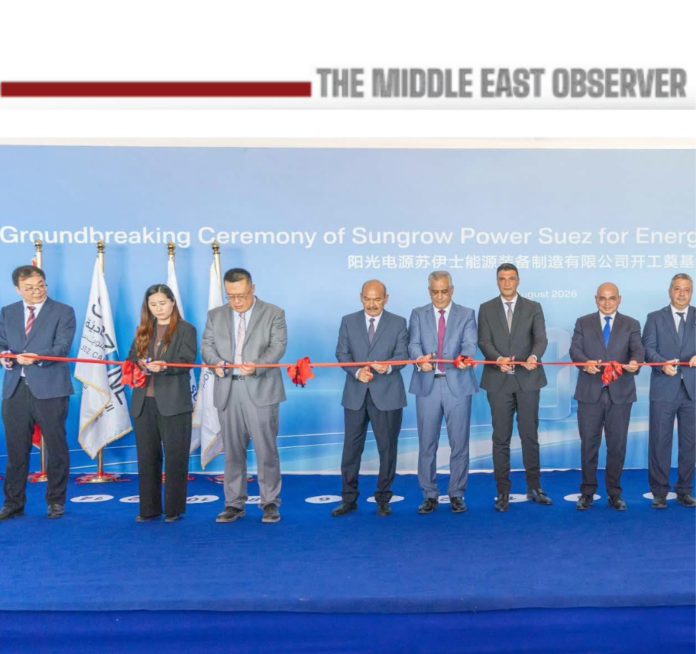
China’s Sungrow has broken ground on a $50 million battery-energy-storage systems factory in Egypt’s Ain Sokhna industrial zone, giving Cairo a potential manufacturing base for equipment critical to its renewable-energy expansion.
The facility, being developed by Sungrow Power Suez Energy Equipment in the China-Egypt TEDA zone within the Suez Canal Economic Zone (SCZONE), will assemble battery energy storage systems (BESS) and create more than 100 jobs.
Egyptian officials say it will be the first dedicated BESS manufacturing facility of its kind in the Middle East and Africa. Earlier disclosures put planned annual production capacity at up to 10 GWh, with production targeted for 2027.
The scale makes the project more significant than its $50 million investment suggests. The test is whether Egypt can move beyond assembly towards a competitive storage-equipment supply chain.
An anchor market
The factory already has prospective domestic demand.
In January, Egypt announced renewable-energy agreements involving Norway’s Scatec and Sungrow worth more than $1.8 billion. Scatec signed a 25-year power purchase agreement covering 1.95 GW of solar capacity and 3.9 GWh of battery storage, with part of Sungrow’s Egyptian production expected to supply the project.
That linkage connects renewable generation, storage and domestic manufacturing while reducing the factory’s initial dependence on exports.
The planned 10 GWh capacity is substantial. By comparison, Sungrow’s new manufacturing facility in Poland is designed for annual energy-storage-system capacity of 12.5 GWh, alongside inverter production.
The localisation test
The larger economic question is how much of the storage value chain Egypt can capture.
Industry Minister Khaled Hashem said the project would support technology transfer, workforce development and local suppliers. The industrial payoff will depend on how much higher-value equipment and engineering can eventually be sourced locally rather than imported.
Ain Sokhna also gives Sungrow access to Red Sea and Suez Canal shipping routes, providing a potential platform for supplying projects elsewhere in the Middle East and Africa.
For Egypt, the commercial test will be capacity utilisation, local content and exports.
If Sungrow can build regional demand while sourcing more equipment and engineering locally, Sokhna could give Egypt a foothold in the battery-storage supply chain. If the plant remains largely an assembly operation dependent on imported components and domestic projects, its industrial impact will be more limited.
Related news:
Scatec to Invest EGP 5 Billion in Egypt Renewable Energy Grid Infrastructure
Egypt Signs $1.8bn Renewable Energy and Storage Deals
Read also:
Made in Lebanon: How Crisis Is Rebuilding the Productive Economy
US-Jordan Trade Deal Unlocks Strategic Mining and Energy Investment