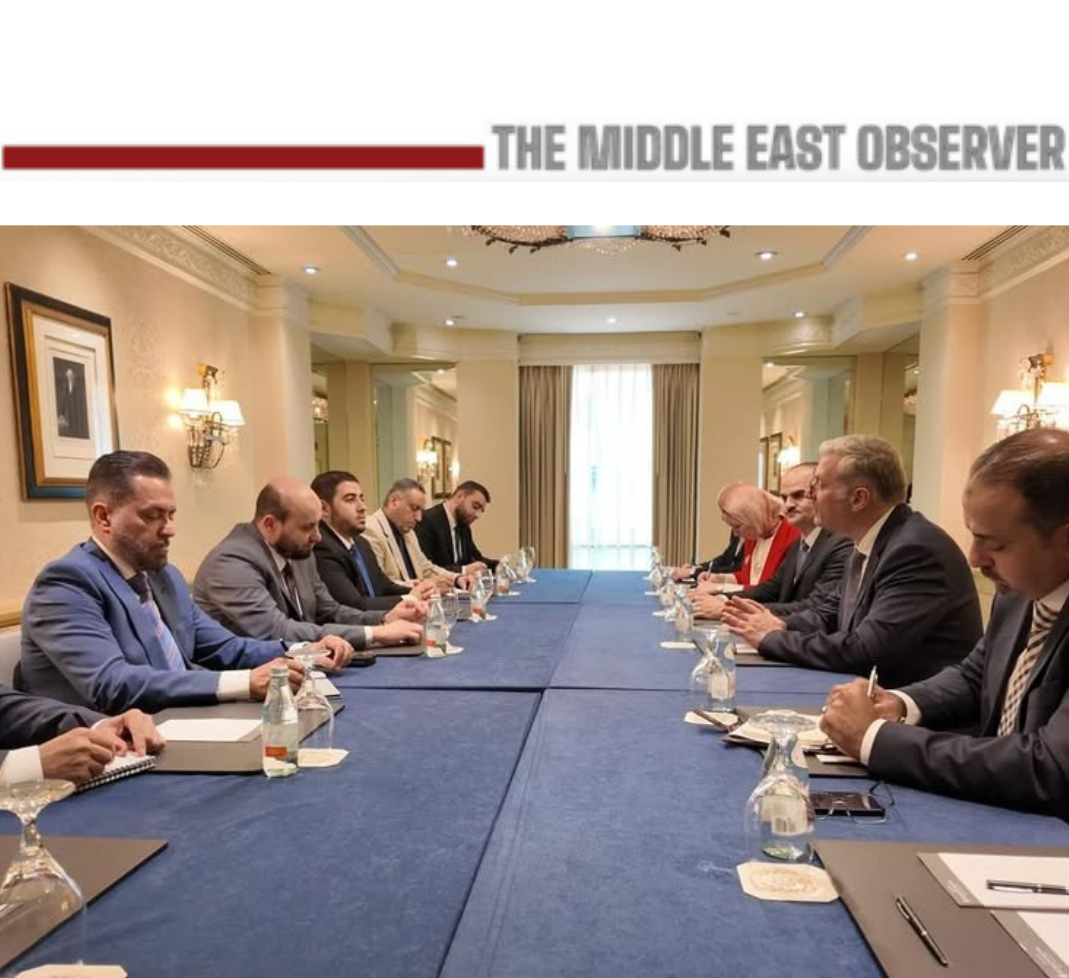

UAE capital is clustering around ports and urban development, Saudi investment across transport, technology, telecoms and finance, while Qatar has moved furthest into power and payments as Gulf investors position themselves across Syria’s estimated $216bn reconstruction challenge.
UAE developer Arada’s planned $7bn development west of Damascus is the latest in a run of Gulf-backed projects spanning Syrian ports, airports, power plants, telecommunications, technology systems, transport networks and payments.
Taken together, the deals point to a broader shift: Gulf investment is beginning to cluster around distinct parts of Syria’s reconstruction economy.
Emirati capital is strongest in ports, logistics and urban development. Saudi Arabia has announced the broadest portfolio, stretching from aviation and transport to fibre networks, digital government, cybersecurity and banking. Qatar has secured an early lead in electricity generation while helping reconnect Syria to international payment systems.
This is not a formal carve-up. The sectors overlap and the investors range from private developers to state-linked companies and financial institutions. But distinct investment clusters are becoming increasingly visible.
The World Bank estimates rebuilding Syria’s damaged physical assets could cost about $216bn. That figure is not equivalent to a $216bn private investment opportunity: much of the country’s roads, grids, municipal infrastructure and social housing will require public or concessional finance.
For Gulf investors, the more immediately bankable opportunities lie in assets capable of producing long-term revenues — ports, airports, electricity, telecoms, technology infrastructure, logistics, property and financial services.
Sanctions relief has lowered formal barriers to investment, but banking compliance, correspondent access and political risk continue to constrain many international companies. Gulf investors are therefore moving into a market that is more open than before, but still far from fully normalised.
UAE: Ports First, Property Next
The UAE has established positions at two important ends of Syria’s recovery: trade gateways and urban development.
DP World is implementing an $800mn, 30-year programme to develop and operate Tartous Port, giving the Dubai-owned logistics group a long-term position in one of Syria’s principal Mediterranean gateways.
Unlike many reconstruction announcements, the project is already moving through implementation. DP World said in August it had delivered new harbour cranes as part of upgrades covering quays, storage areas, equipment and digital operating systems, with cargo-handling capacity expected to increase by about 40%.
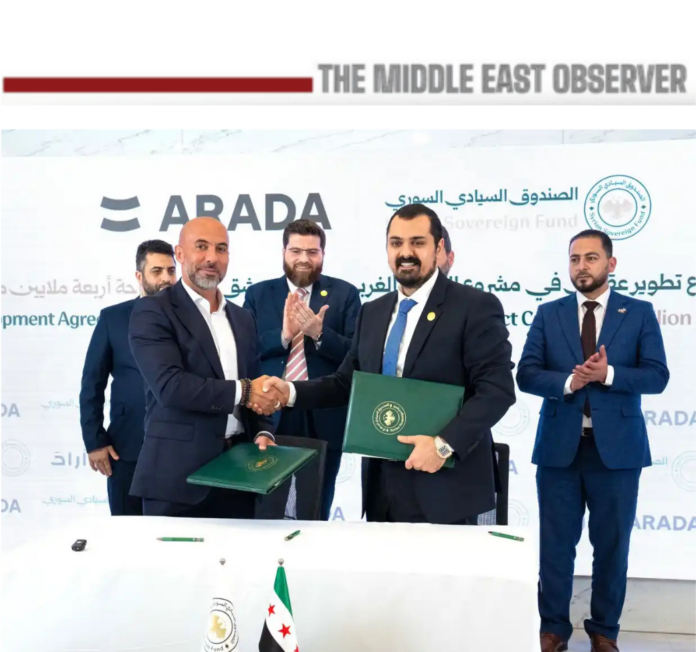
Arada’s entry extends Emirati capital from logistics into large-scale urban development.
On August 31, the developer agreed with the Syrian Sovereign Fund to develop a four-million-square-metre district in New Damascus encompassing housing, hotels, retail, education, healthcare and commercial space.
The headline $7bn figure represents gross development value rather than disclosed committed capital. Neither side has published the project’s equity structure, financing arrangements or the valuation of land contributed by the Syrian partner.
That distinction matters in a market where announcement values can run well ahead of capital actually deployed.
The project nevertheless marks a significant expansion in UAE-Syria commercial ties. UAE non-oil trade with Syria reached $1.4bn in 2025, up 132%, while Emirati companies have been examining additional projects in property, tourism, infrastructure and logistics.
The pattern of Emirati investment is becoming clearer: Mediterranean logistics infrastructure paired with urban and property development.
The economic logic is straightforward. Better port infrastructure can lower trade friction and improve access to regional supply chains, while property, hospitality and services provide a route to monetising recovery through urban redevelopment.
Large-scale real-estate projects, however, also carry risks around land valuation, ownership and property claims arising from years of displacement — issues likely to become more important as reconstruction moves from announcements to execution.
Saudi Arabia: Building the Physical and Digital Connectivity Layer
Saudi Arabia has announced the broadest Gulf portfolio in Syria, increasingly spanning the infrastructure required to move people, goods, data and capital.
Its commitments include a $2bn programme through the Elaf Fund to develop two airports in Aleppo, plans to establish flynas Syria, and more than SAR3bn, about $800mn, from STC for the Silklink telecommunications programme.
STC’s project envisages more than 4,500km of fibre-optic infrastructure, alongside data centres and international connectivity designed to reconnect Syria with regional and global communications networks.
If implemented as planned, Silklink would provide part of the digital backbone required for cloud services, digital government, fintech and data-intensive businesses.
Saudi technology involvement is also moving above the infrastructure layer.
Elm is working on digital-government systems and administrative processes, GO Telecom on municipal platforms, cloud and smart-city applications, while Cipher has entered cybersecurity partnerships covering critical infrastructure and digital systems.
The distinction is important: Saudi involvement spans both capital-intensive digital infrastructure, such as fibre and data centres, and lower-capital technology services, including government platforms, data management and cybersecurity.
Several of these technology agreements remain at MoU or planning stage rather than fully financed execution contracts, but collectively they indicate that Saudi companies are seeking positions across Syria’s emerging digital stack.
That digital layer sits alongside a growing physical transport network.
Saudi and Syrian officials signed agreements on August 27 covering roads, railways and logistics, including studies aimed at rehabilitating damaged networks and improving cross-border trade.
Those agreements are less advanced than the airport and telecom projects. They remain frameworks for studies and cooperation rather than fully financed construction programmes — an important distinction when assessing actual capital deployment.
Riyadh is also moving into financial infrastructure.
The Syrian central bank and Saudi-Syrian Business Council have agreed to establish a joint bank and direct banking channels to facilitate investment transfers. Capitalisation, ownership and a timetable have yet to be disclosed.
Saudi companies are also entering electricity and water, showing that the sectoral boundaries remain fluid.
Even so, Riyadh’s strongest cluster is distinct: aviation, land transport, fibre networks, data infrastructure, government technology, cybersecurity and finance.
If implemented, that could give Saudi-linked investors exposure not only to how people and goods move through a reconstructed Syria, but increasingly to how data, public services and investment capital move through it as well.
Qatar: Power First, Payments Next
Qatar’s strongest position lies in one of the most fundamental layers of reconstruction: electricity.
A consortium led by Qatar-based UCC Holding is advancing plans for about 5GW of new generating capacity, combining gas-fired and solar projects.
Parts of the programme have moved beyond preliminary agreements. Work has begun on the 1GW Zayzoun power project, while the consortium has secured manufacturing capacity with Siemens Energy for major equipment for Zayzoun and Deir Ezzor.
That places the Qatari programme among the more advanced large-scale reconstruction projects announced to date.
Qatar’s cluster is narrower than Saudi Arabia’s, but potentially more systemic because power is an input into almost every other reconstruction sector.
Reliable electricity is required to restart factories, operate telecommunications networks, support new housing, run water systems and reduce business costs. Restoring generating capacity could therefore have a multiplier effect across manufacturing, services, property and foreign investment.
Qatar has also moved into financial connectivity.
QNB has expanded card and digital-payment services in Syria, while international Mastercard transactions have begun returning as the country reconnects to global financial networks.
The combination gives Qatari-linked institutions positions at two important bottlenecks: the electricity needed to run the economy and the payment infrastructure required to reconnect Syrian businesses with international commerce.
Sectoral Clusters Take Shape
The boundaries are not absolute.
Qatar-backed investors are also involved in aviation. Saudi companies are entering power and water. Emirati groups are examining opportunities beyond ports and property.
But the emerging concentrations are increasingly clear.
The UAE is strongest in maritime logistics and urban development. Saudi Arabia is building the broadest position across transport, digital infrastructure, technology services and finance. Qatar has moved furthest into power generation and payment connectivity.
Their significance lies less in headline values than in how the assets connect.
Ports become more valuable when roads and railways function. Property becomes more investable when electricity supply stabilises. Digital government requires fibre, cloud infrastructure and cybersecurity. Airlines need airports, communications networks and payment systems. Foreign investors need banking channels capable of transferring capital.
Gulf investors are therefore beginning to establish positions across interdependent layers of Syria’s postwar economy.
First-Mover Advantage
Gulf investors could also gain a substantial first-mover advantage.
Syria remains a high-risk market, marked by damaged infrastructure, weak institutions, currency risk and unresolved governance concerns. Those factors are likely to keep many international investors cautious even after sanctions relief.
Regional companies, by contrast, combine geographic proximity, political access and greater tolerance for frontier-market risk. That allows them to move earlier and potentially secure long-term concessions, technology platforms, land partnerships and operating rights before competition broadens.
The attraction is therefore not simply reconstruction spending. It is the opportunity to secure strategic assets, digital infrastructure and recurring revenue streams in an economy rebuilding from a very low base.
But the commercial test goes beyond project announcements. Contract enforceability, property rights, currency convertibility and the ability to repatriate profits will be critical to determining whether headline deals become durable investment.
That does not mean every announced deal will materialise.
Arada’s $7bn represents expected development value rather than committed investment. Saudi road and railway agreements remain largely at study stage. Several Saudi technology projects are still governed by MoUs rather than financed execution contracts. The proposed Saudi-Syrian bank has yet to disclose its financial structure. Qatar’s power projects still require lengthy construction and wider rehabilitation of Syria’s transmission network.
Execution remains the decisive test.
The next phase will be measured by capital actually deployed, projects reaching operation and the durability of the concessions, technology platforms and equity positions Gulf companies secure.
If implementation follows the agreements, Gulf investors could emerge not merely as financiers of Syria’s reconstruction but as long-term participants in some of its most important physical and digital infrastructure.
The more consequential question is no longer how much Gulf capital Syria attracts, but which investors ultimately finance, develop and operate the infrastructure through which its postwar economy functions.
Related news:
Saudi Arabia Commits Multi-Billion Investment to Rebuild Syria
France Returns to Syria with Broad Reconstruction Pact and Strategic Investment Agreements
Read also:
Iran’s New Gas Find Runs Into Sanctions, War and Investment Constraints
AfDB Approves €100mn Loan for Morocco’s First EV Battery Gigafactory