

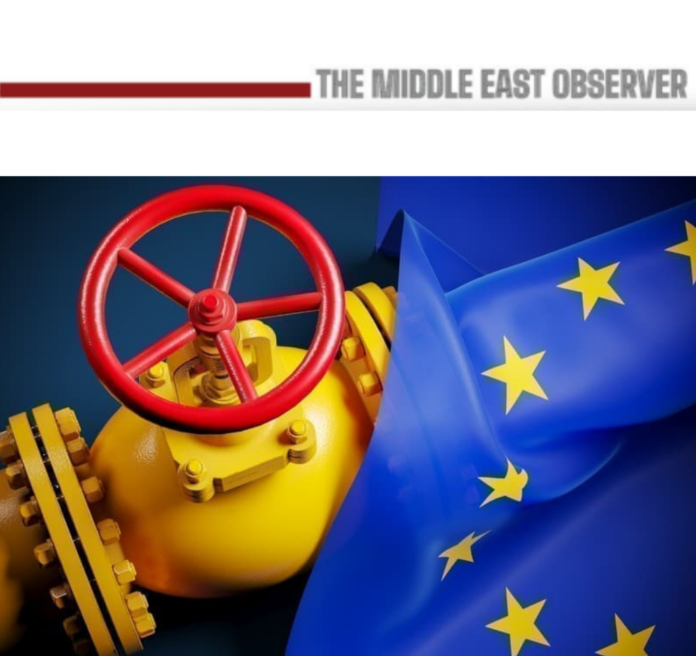
Europe is heading into winter with its lowest gas-storage buffer in 15 years, disrupted Gulf LNG supplies and a refill bill that could reach €15bn, putting the continent’s post-Russia energy architecture through its toughest test yet.
EU gas storage stood at 65.6% in early September, the lowest level for this point in the 15-year data series. ACER estimates Europe can still reach around 80% before winter, but filling the gap could cost an additional €10bn-€15bn.
Brussels says there is no immediate threat to security of supply, citing lower demand, expanded LNG capacity and greater supplier diversification. But Qatari LNG production remains shut, while geopolitical disruption continues to feed price volatility.
Europe has therefore become better at replacing lost gas — without necessarily escaping the cost of disruption.
From Russian Pipelines to Global LNG
Europe has sharply reduced its dependence on Russian pipeline gas, but its replacement system relies increasingly on globally traded LNG.
US cargoes now account for roughly two-thirds of EU LNG imports and about 30% of total gas imports, according to ACER. If Qatari production remains unavailable, Europe will need more flexible LNG cargoes, increasing its exposure to competition with Asian buyers.
Italy illustrates the new risk.
QatarEnergy has extended force majeure on its long-term contract with Edison until early November. Twenty-nine cargoes, equivalent to about 3.8 bcm, have been cancelled. Yet Edison has replaced 21 cargoes, or about 2 bcm, through alternative procurement.
The episode captures Europe’s new energy-security equation: a long-term contract can secure rights to gas, but it cannot guarantee the physical route delivering it.
Renewables Become Europe’s Second Winter Buffer
Europe nevertheless enters this crisis with one structural advantage: it needs less gas than it once did.
Renewables, efficiency gains and lower consumption are reducing the volume of imported fuel Europe must secure. Solar, wind, batteries, grids and interconnectors are consequently becoming energy-security infrastructure as much as decarbonisation investments.
Europe’s winter defence is increasingly two-layered: stored gas provides immediate insurance; renewable generation progressively reduces how much insurance must be bought abroad.
That helps explain why Europe can enter autumn with unusually low storage while Brussels still considers the system capable of weathering the disruption.
Gulf Gas Faces a Reliability Test
For Middle Eastern exporters, the equation is reversed.
Europe is becoming a smaller but more demanding gas market. Gulf producers increasingly have to compete not merely on reserves and production costs, but on delivery reliability, contractual flexibility and route security.
The response has already begun.
Qatar and UAE LNG cargoes have undergone rare ship-to-ship transfers outside the Strait of Hormuz, demonstrating how exporters can improvise logistics once cargoes have cleared the vulnerable chokepoint.
Europe offers another case. After Qatari exports were halted, five unloading, storage and regasification slots at Belgium’s Zeebrugge LNG terminal were released onto the secondary market, demonstrating how terminal capacity can be redeployed when normal supply chains fail.
Together, these developments point towards a broader commercial option: strategic LNG buffers outside the Gulf.
Middle Eastern exporters could increasingly combine temporary floating storage, contracted terminal capacity, cargo swaps and transshipment arrangements to pre-position LNG closer to major customers.
Such buffers cannot eliminate Qatar’s dependence on Hormuz — LNG produced at Ras Laffan must still cross the Strait — but they could reduce the commercial impact of subsequent disruption by positioning inventory on the customer side of the chokepoint.
The Mediterranean Option
The Mediterranean could form part of that architecture.
The EU already regards the region as an important diversification corridor, while Egypt possesses LNG, regasification and pipeline infrastructure connecting the Eastern Mediterranean with international markets.
QatarEnergy’s May agreement with ExxonMobil and Egypt to study the development and commercialisation of Cypriot gas through Egyptian infrastructure provides an important example. It is not a storage project, but it demonstrates that QatarEnergy’s commercial gas portfolio need not remain tied exclusively to production and exports from Qatar.
For Gulf producers, access to Mediterranean terminals, floating storage, trading capacity and European regasification infrastructure could therefore provide something additional reserves cannot: supply optionality closer to the customer and beyond the immediate Gulf chokepoint risk.
The crisis is changing LNG security economics on both sides.
Europe has traditionally accumulated gas stocks to protect itself against external suppliers. Middle Eastern exporters may increasingly need to position strategic inventories abroad to protect their European customers — and their own market share — against disruptions closer to home.
Europe must reduce how much imported gas it cannot afford to lose. Middle Eastern producers must make the gas Europe still needs reliable enough that European buyers cannot afford to replace it.
Related news:
Europe’s Energy Bridge: How to Exit Dependence Without Falling Into a New One
Read also:
Egypt Builds Smartphone Scale — Now It Must Build the Supply Chain