

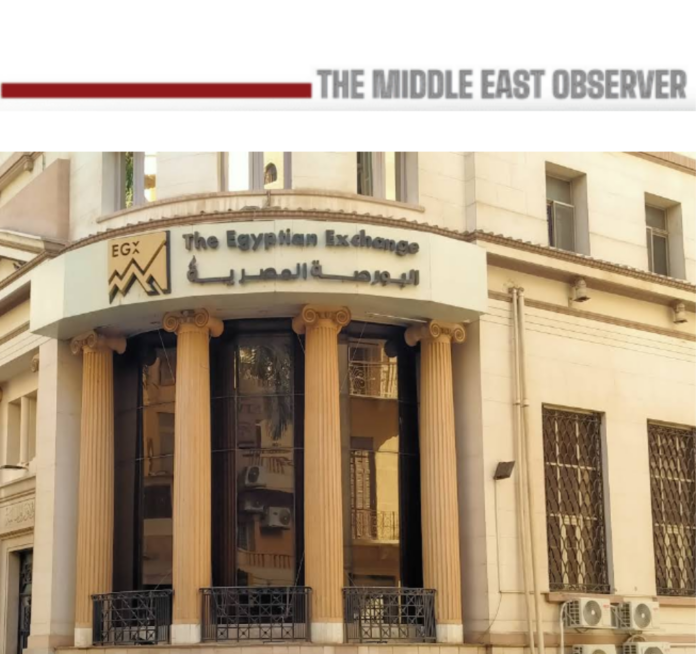
Egypt’s benchmark index recovered on Wednesday after Tuesday’s broad sell-off, but the rebound remained concentrated in large caps as smaller shares and market breadth weakened. Foreign capital also continued to favour high-yielding government debt over equities while the pound slipped further — leaving the EGX in consolidation rather than a convincing return to its record-setting advance.
The EGX30 rose 0.58% on September 9 to 56,500.74 points, recovering much of Tuesday’s 0.80% fall and taking its 2026 gain to about 35%. Market capitalization increased by about EGP2bn to EGP 4.426 tn, with equity turnover of roughly EGP12.5bn.
But the broader market did not confirm the rebound.
EGX70 fell 0.31% to 21,334.92 and EGX100 declined 0.23% to 27,950.35, while 139 stocks fell against only 69 advancers. Gains in heavyweight shares including CIB, Talaat Moustafa and Eastern Company were sufficient to lift the benchmark.
Large caps rebounded; the broader market did not.
Record Rally Moves Into Consolidation
The week’s progression increasingly resembles consolidation near record territory rather than another straight-line advance.
EGX30 rose 0.72% on Sunday, eased 0.09% on Monday, fell 0.80% on Tuesday and recovered 0.58% on Wednesday. Against last Thursday’s close of 56,270.32, the benchmark is only about 0.4% higher.
EGX70 and EGX100 are each less than 0.2% above last Thursday’s levels.
Tuesday’s correction has therefore not developed into a breakdown, but neither has Wednesday established that the broader rally has resumed.
For investors, participation beneath EGX30 now matters more than another attempt at 57,000.
Institutions Remain Cautious
Investor flows reinforce that message.
Detailed closing data show Egyptians as net buyers of roughly EGP56mn, Arabs buying about EGP1mn and foreigners selling around EGP57mn.
The more revealing divide was again institutional versus retail.
Egyptian, Arab and foreign institutions were all net sellers, while individuals across all three groups absorbed the supply. Egyptian retail investors alone bought about EGP173mn net.
That follows Tuesday’s heavier institutional profit-taking.
Wednesday’s rebound therefore did not yet signal a clear return of institutional conviction.
Domestic retail liquidity remains an important buffer, but a more durable advance will require broader institutional participation.
Foreign Capital Still Prefers Sovereign Yield
The government-debt market sent a stronger signal.
Foreign and Arab investors recorded combined net purchases of about $144mn of secondary-market government securities on Wednesday, following roughly $380mn of net buying on Tuesday.
Their two-day purchases therefore exceeded $520mn, with demand concentrated mainly in Treasury bills.
The contrast with equities is striking.
Foreign investors were modest sellers of listed shares while deploying substantially larger sums into Egyptian sovereign debt.
International capital remains more willing to take Egyptian yield risk than Egyptian corporate-equity risk.
With EGX30 already up about 35% this year and domestic rates still high, equities increasingly need stronger earnings growth to compete with short-duration government yields.
Pound Weakness Complicates the Picture
The dollar rose to about EGP 51.14 for buying and EGP 51.27 for selling, despite continued government-debt inflows.
That relationship should not be overstated: T-bill flows are only one component of Egypt’s foreign-exchange market. But the combination shows that broader dollar demand remains sufficient to pressure the pound even while foreign demand for sovereign paper is strong.
For equity investors, FX is becoming increasingly important to hard-currency returns and stock selection.
New Listings Could Convert Liquidity Into Depth
A more constructive structural development came from fintech.
MNT Tech Holding, an Egyptian arm of MNT-Halan, has applied to list 1.6bn shares on the EGX main market.
The stage classification is important: this is a listing application, not final approval and not yet an IPO launch.
Its significance is nevertheless broader.
As Egypt attracts more investors and greater trading liquidity, the market increasingly needs additional high-quality listed supply rather than simply more capital chasing existing shares.
A major private-sector fintech listing, alongside the government’s state-asset programme, could help convert stronger liquidity into genuine market depth.
Rally Holds, but Breadth Must Return
Wednesday repaired part of Tuesday’s benchmark loss without removing its warning.
EGX30 gained 0.58%, but smaller stocks declined and institutions remained sellers. At the same time, foreign and Arab investors continued buying government debt, showing that weakness in equities was not evidence of a general withdrawal from Egyptian assets.
The market is therefore consolidating rather than breaking down.
The next phase depends on three tests: breadth must recover, institutional equity demand must strengthen, and earnings must justify taking corporate risk against high sovereign yields and a weaker pound.
Egypt has already demonstrated that domestic liquidity can sustain equity prices near record levels.
The harder test is whether that liquidity can now produce broader participation, new listings and durable institutional capital — rather than relying on a handful of large stocks to deliver the next EGX30 record.
Related news:
EGX Pullback Tests Record Rally as Institutional Selling Broadens
EGX30 Pauses Below 57,000 as Rally Rotates Into Smaller Stocks
Read also:
AfDB Approves €100mn Loan for Morocco’s First EV Battery Gigafactory
When a Football Club Comes to Market, the Real Asset May Be the Destination