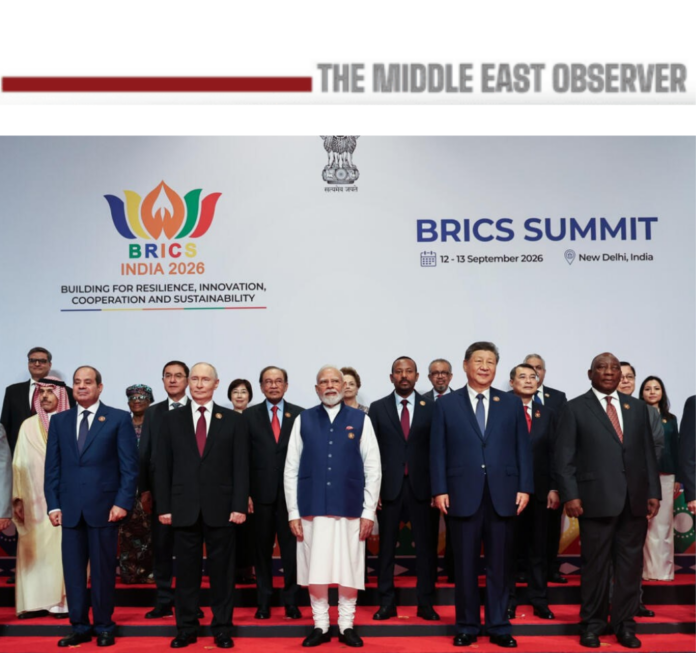
BRICS concluded its New Delhi summit with a clearer economic test: whether political coordination can be converted into mechanisms targeting lower financing costs, reduce trade friction and mobilise investment across member economies.
India proposed a system to track implementation, while Egypt and India renewed a $12 billion trade ambition centred on manufacturing and investment. At the same time, summit-related deals exposed a central reality: bilateral economic relationships are already generating transactions at a scale BRICS-wide institutions have yet to match.
Prime Minister Narendra Modi proposed a BRICS Continuity and Implementation Mechanism through the grouping’s Troika, supported by a secure repository recording responsibilities, deadlines and implementation status. He also called for a BRICS Reform Roadmap ahead of the next summit.
The proposal seeks to turn implementation into a trackable institutional process. China, which assumes the BRICS presidency in 2027, will inherit the harder task: demonstrating that common institutions can deliver economic advantages beyond what members already achieve bilaterally.
BRICS’ track will therefore depend less on adding initiatives than on whether its emerging architecture can make capital cheaper, payments faster and investment easier.
Egypt Offers India a Regional Production Platform
President Abdel Fattah El-Sisi and Modi renewed support for an existing target to raise bilateral trade to $12 billion within five years, alongside greater emphasis on manufacturing, investment and technology transfer. Currently the target should be identifying the areas for new developments and current segments growth.
For India, Egypt offers more than a larger export market. It could provide a production and distribution base serving Africa and the Middle East, supported by the Suez Canal corridor, industrial zones, ports and regional trade frameworks. Producing closer to these markets could shorten supply chains and reduce delivery times compared with serving them solely from India.
The industrial base is already material. More than 70 Indian companies operate in Egypt with combined investment exceeding $5.5 billion, while those businesses generate more than $1 billion in Egyptian exports annually. Indian investment in the Suez Canal Economic Zone has exceeded $175 million.
Potential sectors include pharmaceuticals, automotive and engineering components, chemicals, renewable-energy equipment, textiles and food processing — areas where India has manufacturing depth and Egypt is seeking greater localisation, specially on the level of feeding local industries.
For Cairo, the gain would be factories, technology transfer and export growth. For New Delhi, it would be access to a regional production platform rather than simply another end market.
Europe is a more conditional opportunity. Preferential treatment depends on product-specific rules of origin and sufficient processing in Egypt, requiring sector-by-sector assessment of localisation and production economics.
The $12 billion objective should therefore be judged by the productive capacity behind the trade figure, not the figure alone.
Bilateral Capital Is Moving Faster Than BRICS Finance
The Summit also illustrated how far bilateral capital flows remain ahead of BRICS-wide financial architecture.
The UAE’s International Holding Company announced an $11.5 billion integrated aluminium investment in India’s Odisha state, described by New Delhi as its largest integrated aluminium investment.
The project did not depend on a BRICS investment platform or multilateral guarantee mechanism.
That distinction captures the bloc’s economic challenge: capital already moves effectively between individual members; BRICS must show that common institutions can make those flows broader, cheaper or less risky.
The grouping is still developing an investment platform, multilateral guarantees, local-currency financing and cross-border payment mechanisms. Their relevance will depend on whether they mobilise investment that existing bilateral channels would not have generated as efficiently.
Bilateral Diplomacy Fills Gaps in Consensus
New Delhi revealed a similar pattern in diplomacy.
The summit produced collective language on Palestine and Middle East de-escalation but did not explicitly address Ukraine.
Diplomatic activity nevertheless continued outside the communiqué, with the Kremlin stating that Modi and Xi had offered Putin their good offices in seeking a settlement.
This was not a formal BRICS mediation initiative. It showed instead how the grouping can provide space for bilateral diplomacy where bloc-wide consensus remains difficult.
China 2027: The Accountability Test
China’s 2027 presidency will face two related challenges: whether Beijing can make its commercial relationship with India more predictable, and whether it can convert BRICS proposals into mechanisms that reduce transaction costs and deepen economic integration across the bloc.
Beijing has already identified three areas for advancing that agenda: a BRICS AI Open Source Zone to support cooperation in AI models, applications and training; closer coordination among special economic zones to connect industrial clusters, investment and supply chains; and a BRICS Service Trade Forum in 2027 to expand cross-border business in services.
Together, the proposals point to an effort to move BRICS beyond political coordination towards practical networks in technology, manufacturing and services. The test, however, will be whether they become operational at sufficient scale to alter the economics of cross-border business.
China’s presidency should therefore monitor four measurable indicators of institutional delivery:
- a working cross-border payment mechanism that lowers settlement costs or improves transaction speed;
- an initial BRICS Multilateral Guarantees transaction that attracts private capital or reduces project risk;
- measurable expansion in New Development Bank local-currency lending, reducing foreign-exchange exposure;
- identifiable customs, logistics, industrial-zone or supply-chain projects that cut trade friction or generate productive investment.
These are MEO-suggested benchmarks rather than formal summit deadlines, but they provide practical milestones for assessing whether BRICS institutions are developing towards measurable economic value beyond what bilateral relationships already deliver.
By the time leaders meet in China, the test should be straightforward: are payments cheaper, financing broader, risks lower and more projects reaching financial close?
Related news:
El-Sisi Links Global Economic Stability to Security and Development at BRICS 2026
BRICS Expands Yuan Network to 185 Nations
Read also:
Egypt, Greece and Cyprus Build a Mediterranean Bridge to Europe
Misr Petroleum Tops EGP230bn Revenue as Regional Expansion Accelerates