Egyptian equities extended their correction sharply on Monday as selling broadened across the market, while a separate $419mn exit from government Treasury bills pushed additional pressure through the currency market. The distinction is critical: foreign investors were modest net buyers of Egyptian shares, but sizable sellers of sovereign debt — turning Monday into a cross-asset risk-repricing session rather than a simple foreign flight from the stock market.
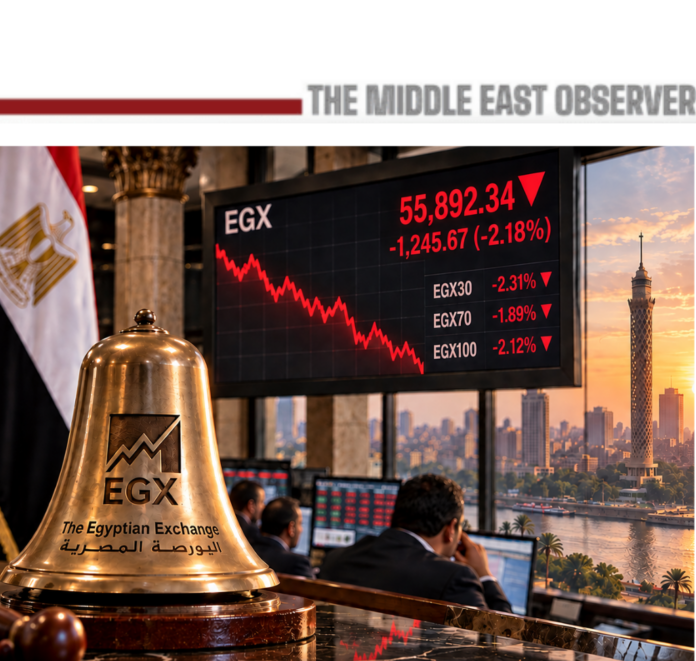
The EGX30 fell 1.56% to 54,796.55, following Sunday’s 1.09% decline. EGX70 dropped a steeper 2.67% to 20,625.93, EGX100 lost 2.30% and EGX33 Shariah fell 1.89%. Market capitalisation declined another EGP 64.9bn to EGP 4.301tn.
Breadth deteriorated sharply: 184 shares declined against only 31 gainers, with seven unchanged. Turnover rose to roughly EGP13.1-13.2bn, 13.8% above the 90-day average — a notable change from Sunday, when turnover was below its recent norm.
That combination — broader losses and rising activity — makes Monday a more consequential correction than Sunday.
Two Sessions Turn Consolidation Into a Broader Correction
Last week, the EGX30 finished almost unchanged while smaller shares modestly outperformed, suggesting rotation rather than outright deterioration.
That structure has now broken down.
Since Thursday’s close, EGX30 has fallen about 2.6%, EGX70 about 3.6% and EGX100 roughly 3.3%, while approximately EGP107bn has been erased from listed market capitalisation.
Small and mid-cap shares are now falling faster than the benchmark.
The market has therefore moved beyond blue-chip consolidation into a broad risk reduction across the listed universe.
The distinction remains important, however: a two-session correction after an approximately one-third rise in EGX30 this year does not by itself establish a bear trend. It does raise the burden of proof for the rally.
Foreigners Sold Debt — Not Egyptian Equities
Monday’s investor-flow data require a major classification correction.
Several reports carried figures showing foreigners selling EGP 20.5bn and Egyptians buying more than EGP21bn. Those numbers reflect government-debt transactions rather than ordinary listed-share flows.
In equities, foreign investors were actually net buyers of about EGP118.1mn, Egyptians bought approximately EGP12.3mn and Arab investors were the sole net sellers at around EGP130.5mn. Egyptians accounted for 67.2% of listed-share activity, foreigners 28.0% and Arabs 4.8%.
That fundamentally changes the stock-market diagnosis.
Monday’s EGX decline was not caused by a foreign equity exodus.
The real foreign retrenchment occurred in the sovereign market.
Foreign and Arab investors sold a net $418.8mn of secondary-market government securities, concentrated entirely in Treasury bills. Foreign investors accounted for about $395.3mn of the net selling and Arab investors another $23.6mn. Treasury-bond transactions showed no net foreign selling.
This is the session’s most important cross-asset signal.
International investors did not materially abandon Egyptian corporate equity; they reduced short-duration sovereign exposure.
Pound Nears 52 as Carry Trade Faces a Global Test
The debt outflow coincided with a sharp move in the currency.
The CBE’s official dollar rate ended Monday at EGP51.7883 for buying and EGP51.9283 for selling, compared with roughly EGP51.32/51.42 on Sunday — a depreciation of almost 1% in a single session.
That matters because Egypt’s high-yield government debt has remained attractive partly through the combination of nominal yield and currency stability.
Monday demonstrated the reverse mechanism: when portfolio investors cut Treasury-bill positions, dollar demand can quickly transmit the adjustment into FX.
The timing is also significant.
The Federal Reserve begins its two-day meeting on September 15, with its decision due Wednesday. A Reuters poll found 85% of economists expecting a 25-basis-point increase to 3.75%-4.00% after stronger US inflation and renewed energy pressures shifted expectations decisively towards tightening.
A higher US rate increases the opportunity cost of holding emerging-market assets and raises the required return for Egyptian debt and equities alike.
Regional Risk Adds Another Layer
The Fed is not the only external pressure.
Brent crude remained above $100 as renewed attacks on Gulf energy infrastructure and shipping routes increased supply concerns. Reuters reported that Egypt’s blue-chip market fell 1.6% on Monday while Gulf markets were mixed, with investors responding to attacks on Saudi infrastructure and heightened regional security risk.
For Egypt, persistently high oil prices matter beyond market sentiment: they can increase the import bill, complicate inflation dynamics and place additional pressure on foreign-currency demand.
The correction therefore sits at the intersection of domestic profit-taking, higher global yields, regional geopolitical risk and renewed FX pressure.
Qalaa Shows Stock Selection Has Not Disappeared
Even within Monday’s broad sell-off, investors continued to reward specific corporate catalysts.
Qalaa Holdings jumped 8.7%, sharply outperforming the market after announcing plans to more than double its indirect stake in Egyptian Refining Company to 27.1%. Heliopolis Housing and Mopco also finished higher, while GB Corp, Emaar Misr and Misr Cement were among the large decliners.
Qalaa’s move is significant because it demonstrates that the correction remains selective rather than indiscriminate.
Capital is still willing to move towards companies where investors perceive asset-value, restructuring or earnings catalysts.
Secondary Market Weakens as Primary Pipeline Advances
The correction also comes as Egypt’s primary-market pipeline becomes more tangible.
Baker Tilly’s updated study reportedly values Banque du Caire at EGP80.9bn, or EGP5.30 per share, while SEDICO shareholders have authorised management to proceed with listing and offering procedures.
Neither constitutes an IPO launch or final offering price.
But together they reinforce a structural point: Egypt’s capital market increasingly needs new investable supply, particularly as the existing listed universe undergoes a period of repricing.
The Market Now Faces a Harder Test
Monday materially changed the near-term picture.
Sunday showed broad weakness but below-average turnover. Monday delivered heavier losses, substantially worse breadth and higher trading activity, while sovereign-debt outflows transmitted pressure into the pound.
Yet the evidence still argues against describing the episode as a generalized foreign withdrawal from Egypt.
Foreigners bought listed shares even as they sold Treasury bills.
That distinction means the emerging risk is more complex: Egypt is facing a repricing of duration, currency and equity risk simultaneously, rather than a single-direction capital flight.
Three tests now matter.
First, whether EGX breadth stabilises after two sessions of accelerating losses. Second, whether Treasury-bill outflows persist after Wednesday’s Fed decision. Third, whether the pound can absorb portfolio adjustments without materially raising the return hurdle for Egyptian equities.
The EGX remains substantially higher in 2026. But the character of the market has changed.
The rally is no longer being tested only by profit-taking. It is now being tested by the interaction between equity breadth, sovereign-debt flows, global interest rates and the Egyptian pound — a considerably harder environment for the next leg higher.
Related news:
Modi Urges Indians to Cut Fuel Consumption to Protect Foreign Exchange Reserves
EGX30 Reclaims 55,000 as Market Rotation Tests the Breadth of Egypt’s Rally
Read also:
When Misreporting Meets Diplomacy—The Egypt/UK Embassy Protection Debate Setting the Record Straight
EGX30 Rallies Following CIB Results as Foreign Equity Buying Contrasts with Debt Outflows