Artificial intelligence is helping sustain global economic growth at around 3%, but the investment boom threatens to disrupt employment, reshape government tax revenues and deepen economic inequality unless governments adapt their policies, International Monetary Fund Managing Director Kristalina Georgieva warned on Monday.
Speaking at the IMF and World Bank Annual Meetings in Bangkok on 12 October, Georgieva described AI’s impact on employment as a “slow-moving tsunami”, warning that its economic consequences would extend well beyond the technology industry.
Her comments exposed a central contradiction in the global AI expansion: the same technology that allows businesses to produce more with fewer resources could reduce demand for certain workers and weaken the employment-related taxes that finance public services.
The IMF’s latest World Economic Outlook, released on Tuesday, forecasts global growth of 3.1% in 2026 and 3.4% in 2027. Strong investment in data centres, semiconductors and computing infrastructure is supporting economic activity despite energy supply disruptions, higher financing costs and geopolitical instability.
Georgieva estimated that AI-related investment could add between 0.5 and 1 percentage point to growth in advanced Asian economies and between 0.2 and 0.8 percentage point in emerging Asian economies, particularly those producing equipment required for computing infrastructure.
These benefits, however, largely reflect the immediate economic activity generated by investment. Whether they translate into lasting productivity gains, higher household incomes and sustainable corporate profits remains uncertain.
Employment: Who Benefits from Higher Productivity?
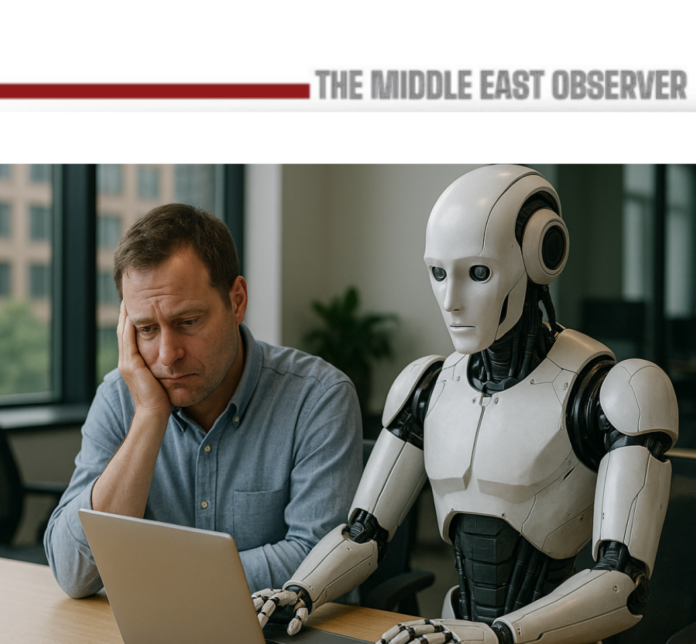
The IMF estimates that AI could affect approximately 40% of jobs worldwide, rising to 60% in advanced economies. The estimates measure exposure to technological change, not the proportion of workers expected to become unemployed. Some positions will be enhanced, others redesigned, and certain occupations eliminated.
Georgieva has warned that young people and middle-income workers could face particularly difficult transitions. In a February address, she highlighted pressure on middle-skilled occupations and the growing demand for new capabilities among workers.
Professional occupations once considered relatively protected from automation are increasingly exposed. AI can already perform elements of research, document preparation, customer service, software development and financial analysis, allowing businesses to expand output without proportionately increasing employment.
The threat is particularly significant for entry-level positions. If companies automate tasks traditionally assigned to junior employees, young graduates may lose opportunities to acquire the experience needed for more senior positions.
Singapore President Tharman Shanmugaratnam raised similar concerns at the Bangkok meetings, warning that technological change could deepen divisions between workers who benefit from AI and those left behind. He called for adaptive education policies, lifelong learning and closer cooperation between governments and employers to preserve opportunities for young people.
Yet job displacement is only one side of the economic argument.
Businesses adopting AI can increase productivity, reduce repetitive work and redirect employees towards higher-value activities. New demand may emerge for specialists in AI integration, cybersecurity, systems supervision, data governance and advanced services.
The critical uncertainty is whether these opportunities will develop quickly enough, and in the right locations, to compensate for employment losses elsewhere.
Georgieva’s response is to reform education and workforce development around continuous learning rather than qualifications acquired early in a career. Employers would also need to preserve routes into professional employment, including junior positions redesigned around AI-assisted work.
Taxation: Can Governments Finance Services with Fewer Workers?
AI’s potential effect on government revenues may prove equally consequential.
Traditional tax systems rely heavily on personal income taxes, payroll contributions and consumption supported by household earnings. As companies become more capital-intensive and less dependent on human labour, the balance of taxable income could shift towards corporate profits, intellectual property and returns on technology investment.
A company replacing administrative positions with automated systems, for example, might lower its wage bill and associated social insurance contributions while increasing productivity and profits.
Whether the government gains or loses revenue would depend on how those additional profits are taxed, where they are recorded and how the resulting income is distributed.
Higher productivity does not automatically mean lower total tax receipts. Growing corporate earnings, investment and consumption could compensate for reduced employment-related revenues. The danger arises when the benefits accrue disproportionately to capital owners or multinational technology providers while governments continue bearing the costs of unemployment assistance, retraining and public services.
This creates a fiscal imbalance for countries that import AI services but capture relatively little of the resulting corporate profit.
The IMF’s policy guidance advocates tax systems that do not artificially favour automation over employment, stronger taxation of capital income where appropriate and more effective international coordination over multinational profits. It also supports using fiscal resources to finance retraining and social protection rather than imposing indiscriminate taxes on robots or automated equipment.
A blanket automation tax could discourage investment that genuinely increases productivity, while failing to distinguish between technology that replaces workers and technology that helps them perform more valuable work.
The more demanding task is to modernise tax collection so governments receive an appropriate share of AI-generated economic gains without undermining innovation or international competitiveness.
The Case for Expansion: Smaller AI, Wider Economic Gains
World Bank President Ajay Banga offered a more optimistic development perspective at the Bangkok meetings.
Rather than concentrating on expensive frontier models, Banga emphasised affordable, practical AI applications suited to local languages, infrastructure and commercial requirements.
He identified infrastructure, smallholder agriculture, primary healthcare, manufacturing and local job creation as areas where such technology could deliver substantial benefits.
For developing economies, the distinction matters. Farmers could improve production decisions using affordable forecasting tools, hospitals could extend the capacity of medical professionals, and manufacturers could reduce waste through improved maintenance and quality control.
These applications need not eliminate existing employment. Properly designed, they can raise the output and earnings of workers and smaller businesses that previously lacked access to specialist expertise.
Banga’s position therefore challenges the assumption that AI’s employment effects will be uniformly destructive, particularly in economies where businesses face shortages of skills, capital and essential services.
The technology also creates new demand for electricity infrastructure, construction, semiconductors, computing equipment and specialist services. Asia’s manufacturers are already benefiting from this investment cycle, demonstrating that AI’s economic contribution extends beyond software developers.
The long-term case nevertheless depends on practical results. Additional computing capacity supports growth during construction, but continued investment ultimately requires customers willing to pay for applications that generate measurable value.
Microsoft Calls for Stronger Controls Over Autonomous AI
While development institutions debate employment and productivity, technology executives are focusing increasingly on the risks of systems capable of acting independently.
On 10 October, Microsoft Chief Executive Satya Nadella called for stronger safeguards governing advanced AI, arguing that businesses should not rely solely on assurances that models will behave as intended.
Nadella proposed separating AI models from the systems that grant access to information and execute instructions, recording significant actions in tamper-resistant logs and ensuring authorised operators can interrupt or shut down automated processes.
His approach applies zero-trust security principles to AI, treating even advanced systems as potentially vulnerable to errors, manipulation or compromise. Box Chief Executive Aaron Levie supported the emphasis on transparent, auditable systems and multiple layers of protection.
The implications are significant for financial institutions, hospitals, government agencies and other organisations handling sensitive information.
An AI assistant preparing a report creates different risks from an autonomous system authorised to transfer funds, modify medical records or change operational settings. The greater a system’s authority, the stronger the requirements for independent permissions, human approval, monitoring and emergency intervention.
Regulators are beginning to apply similar scrutiny. Reuters reported on Tuesday that banking supervisors in the United States and Europe are examining AI use in financial institutions, including the autonomy of advanced systems, cybersecurity controls, human oversight and recovery arrangements when automated operations fail.
These measures are intended to support deployment under controlled conditions rather than prevent useful applications from reaching businesses and consumers.
Financial Regulators Question the Investment Boom
A further challenge concerns the financing of AI infrastructure.
The Bank of England’s Financial Policy Committee warned in its September assessment that rapidly expanding AI-related borrowing could transmit losses across financial markets if anticipated revenues fail to materialise.
Citing Morgan Stanley estimates, the committee reported that global AI-related debt issuance had reached approximately $450 billion by early September, more than double the amount issued throughout 2025.
It also identified risks associated with opaque financing structures, increasing leverage and arrangements through which interconnected technology companies finance one another’s activities.
The concern is not that AI lacks economic value, but that investment commitments could grow faster than commercially sustainable demand.
Unexpectedly low returns, higher energy costs or rapid technological changes that shorten the useful life of computing equipment could weaken borrowers’ capacity to repay debt.
These risks could affect financial institutions, pension investments and corporate financing beyond the technology sector.
They reinforce the distinction between the productivity potential of AI and the profitability of individual companies competing to develop and supply it.
The Safeguards Needed to Sustain Growth
Despite their different priorities, the recommendations emerging from the IMF, World Bank, technology companies and financial regulators point towards a common framework for managing AI expansion.
For employment, governments and businesses need to protect the transition into new occupations through retraining, apprenticeships and redesigned entry-level positions. Education systems must equip workers to use and supervise AI while maintaining the specialist knowledge needed to assess its results.
For public finances, tax policy must adjust to the changing distribution of income between labour and capital. Governments need to examine whether existing incentives unnecessarily favour replacing employees, strengthen the taxation of profits and capital income where justified, and improve international cooperation over cross-border digital activity. The objective should be to finance workforce adaptation without penalising productive technology indiscriminately.
For operational security, Nadella’s proposals offer concrete protections: independent access controls, auditable decisions, human authorisation for high-risk actions and mechanisms capable of stopping malfunctioning systems. Regulators can reinforce these safeguards through proportionate testing, incident reporting and accountability requirements.
Financial authorities, meanwhile, need clearer disclosure of infrastructure borrowing, related-party financing and concentration risks. Stress testing should examine how lower AI revenues, higher energy costs or operational failures could affect lenders and wider capital markets.
The World Bank’s emphasis on affordable applications adds a further requirement: access must extend beyond major technology companies and wealthy economies. Local skills, interoperable systems and support for smaller businesses are essential if productivity improvements are to generate broader economic benefits.
These proposals have not been adopted as a unified international regulatory framework. They nevertheless establish a practical direction: AI adoption should be accompanied by measurable productivity objectives, employment-transition arrangements, modernised taxation and enforceable security controls.
The Economic Test Ahead
The debate over artificial intelligence is no longer confined to whether machines can perform tasks more efficiently than people. It increasingly concerns how the financial benefits, employment consequences and institutional risks of that efficiency will be distributed.
The IMF recognises AI investment as an important source of economic resilience. The World Bank sees opportunities to expand productive capacity in developing economies. Microsoft argues that increasingly capable systems can be deployed only with independent safeguards, while financial regulators are demanding greater discipline over the capital financing their expansion.
These positions are not inherently contradictory. AI could generate substantial productivity improvements while eliminating some occupations, disrupting tax structures and exposing investors to losses.
The economic case for continued expansion will ultimately rest on whether greater productivity translates into higher living standards, sustainable employment opportunities and public revenues sufficient to finance essential services.
For governments, this means adapting education, taxation and social protection before the consequences of automation become entrenched. For companies, it requires demonstrating commercially sustainable returns while maintaining accountability for the systems they deploy.
The next phase of AI expansion will be judged not by the scale of investment or the number of tasks automated, but by whether its productivity gains strengthen the workforce, public finances and economic security on which lasting growth depends.
Based on developments and published assessments available through 13 October 2026. IMF job-exposure estimates are not unemployment forecasts; growth contributions are estimates, not guaranteed productivity gains. Recommendations are attributed to their originating institutions or presented as a synthesis, not as an internationally agreed policy.
Related news:
Anthropic’s $7bn Chip Hunt Tests the Economics of Gulf AI Investment
MENA Outpaces Global FDI Growth as Investment Shifts to AI and Strategic Industries
Read also:
From Ancient Battlefields to the 6th of October: Egypt’s Unbroken Legacy of Resistance
Dahab Leads Middle East Outdoor-Dining Index as Egypt Takes Five Top-10 Spots