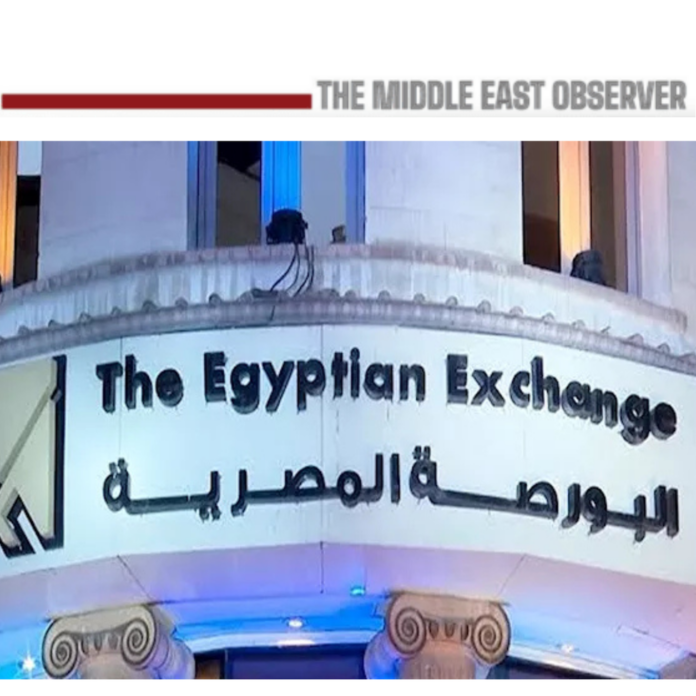
Egypt’s stock market suffered a sharp reversal on Sunday, October 18, as the benchmark EGX30 fell 2.63% to 50,896.19 points, its lowest close since July 1, wiping out the previous week’s two-session recovery just as Egypt prepared to launch two major equity-market transactions.
The EGX70 index of smaller companies plunged 6.58%, almost two and a half times the benchmark’s decline, while listed companies lost approximately EGP159bn in market value. Reported foreign net selling reached EGP5.56bn, intensifying concerns about institutional demand and the market’s ability to absorb substantial new offerings.
The timing presents an important test for Egypt’s capital-market development. Banque du Caire begins subscriptions for a proposed EGP22.05bn–24.25bn share sale on Monday, while financial-technology company MNT-Halan is scheduled to begin trading on Tuesday.
Market Breadth Reveals the Depth of the Correction
EGX30 closed at 50,896.19, down from Thursday’s 52,273.34. The EGX70 Equal Weighted Index fell to 17,265.74, while EGX100 lost 5.75% to 23,193.58.
The Shariah-compliant EGX33 declined 3.82% to 6,135.46, and the lower-volatility EGX35-LV retreated 5.02% to 5,932.53.
Market capitalisation dropped from EGP 4.051 tn to approximately EGP3.892 tn, taking the cumulative loss since October 4 to roughly EGP371bn.
The breadth of selling was particularly striking. Contemporaneous market reports recorded more than 200 declining shares and fewer than 10 gainers, demonstrating that the correction extended well beyond the benchmark’s largest constituents.
The latest decline also reversed a changing recovery pattern. Smaller shares had led Wednesday’s rebound, followed by blue-chip leadership on Thursday. Sunday’s losses overwhelmed both advances, leaving EGX30 approximately 5.6% below its October 4 level and EGX70 down 13.5%.
The disparity indicates that smaller companies remain particularly vulnerable when risk appetite deteriorates.
Foreign Selling Intensifies as Equity Turnover Rises
Foreign investors recorded net sales of EGP5.562bn, while Egyptian and Arab investors registered net purchases of EGP5.126bn and EGP436mn, respectively, according to Arab Finance’s October 18 closing report.
Foreign investors accounted for 33.05% of reported trading activity, compared with 64.85% for Egyptians and 2.1% for Arabs. Institutions represented 56.29% of transactions by reported value.
The scale of foreign selling contrasts sharply with Thursday’s EGP54.9mn in reported foreign net sales. However, the available figures do not establish how much of Sunday’s EGP5.56bn arose from ordinary share transactions rather than other exchange-recorded activity.
A separate brokerage market summary recorded EGP7.982bn in turnover across approximately 3.046bn securities and 247,908 transactions. Arab Finance’s broader market report recorded EGP15.667bn across 286,190 transactions.
These are different reporting scopes, not interchangeable measures of ordinary equity liquidity. The narrower brokerage figure suggests that share-trading activity increased from Thursday’s approximately EGP7.041bn, despite the sharp decline in prices.
The distinction is important: higher turnover during a sell-off may reflect more intensive selling and buying at lower prices, rather than improving investor confidence.
Intraday Rebound Fails to Restore Confidence
Historical market data placed EGX30’s intraday low near 50,480 points. The benchmark subsequently recovered approximately 417 points to close at 50,896.19.
The partial recovery showed that some buying emerged at lower prices, but the market remained substantially weaker by the close.
The severity of losses among smaller companies, combined with exceptionally negative breadth, provides stronger evidence of deteriorating risk appetite than the benchmark’s limited recovery from its session low.
Sunday’s performance therefore represents a renewed phase of the correction rather than an isolated setback.
Banque du Caire Offering Tests Institutional Appetite
The Financial Regulatory Authority approved Banque du Caire’s prospectus on October 18, clearing the way for a secondary offering of 4.575bn existing shares, representing 30% of the bank’s issued capital.
At the indicative price range of EGP4.82–5.30 per share, the transaction would raise EGP22.05bn–24.25bn before expenses. The approved framework permits an increase in the stake offered to 45%, potentially lifting gross proceeds to approximately EGP33.08bn–36.37bn if the same price range applies.
The base transaction allocates 95% of shares to qualified investors and 5% to the public. Institutional book-building is scheduled for October 19–23, with the final price expected by October 26 and the public offering scheduled to close on October 28.
The shares are being sold by Banque Misr. Proceeds would therefore go to the selling shareholder, not directly into Banque du Caire’s capital.
The transaction is substantial relative to recent Egyptian offerings. At its upper price limit, the base sale is more than three times MNT-Halan’s EGP7.84bn offering, while an expanded 45% sale could exceed four times its size.
That creates two potential outcomes. Strong participation by new foreign investors could deepen the market’s institutional base. Alternatively, existing investors might finance subscriptions by reducing other equity holdings, temporarily intensifying liquidity pressures.
Neither outcome can be assumed. The institutional book-building results will provide the first meaningful evidence of how much capital investors are prepared to commit at the proposed valuation.
MNT-Halan Debut Provides an Earlier Test
MNT-Halan is scheduled to begin trading on October 20 at a reference price of EGP24.50, following heavy demand for its EGP7.84bn offering.
The fintech company’s public tranche was reportedly oversubscribed 43.6 times, while the institutional tranche attracted demand exceeding 11 times its allocation.
The contrast with Sunday’s sell-off is striking. Investors demonstrated substantial demand for a new financial-technology listing while the broader secondary market experienced severe selling.
Yet oversubscription does not represent equivalent fresh cash entering the market. Unsuccessful subscription orders are not completed purchases, and the offering itself principally transfers existing shares between shareholders.
Analysts interviewed by EnterpriseAM have suggested that some fund managers were selling existing holdings to release cash for forthcoming offerings. That provides a plausible explanation for part of the recent pressure, but does not establish that IPO financing caused Sunday’s decline.
The more immediate test will be MNT-Halan’s trading performance after listing and whether demand remains strong once its shares become freely tradable.
Currency and Government Yields Raise the Investment Hurdle
The correction is unfolding against persistent currency pressure and substantial returns on government debt.
Central Bank of Egypt data placed the dollar at approximately EGP53.39 buying and EGP 53.53 selling in its October 15 reference quotations. Banking quotations on Sunday remained above EGP53, with the National Bank of Egypt quoting approximately EGP53.42 buying and EGP 53.52 selling.
Meanwhile, Sunday’s Treasury-bill auction accepted approximately EGP119.08bn across 182-day and 364-day maturities, at reported weighted-average annualised yields of about 27.15% and 24.99%, respectively.
These primary-market yields are not the same as secondary-market bond prices or evidence of direct transfers out of equities. They nevertheless illustrate the nominal returns available to investors outside the stock market.
The CBE’s overnight deposit and lending rates remain at 19% and 20%, with the main-operation rate at 19.5%, ahead of the October 29 monetary-policy meeting.
High domestic yields increase the return investors may demand from equities, while currency weakness can erode dollar-denominated portfolio returns.
New Listings Face a Weakened Secondary Market
Sunday’s decline fundamentally changed the near-term market outlook.
The previous week’s recovery had suggested that institutional selling was moderating and selective buying was returning. Sunday’s widespread losses showed that those developments had not established durable support.
The immediate test is whether market breadth stabilises, ordinary equity turnover reflects sustained buying rather than intensified selling, and institutions return as net purchasers.
Egypt’s forthcoming listings could expand the range of investable companies and attract additional international capital. But successful primary-market transactions do not automatically create lasting secondary-market liquidity.
The central challenge is now clear: Egypt is preparing to expand its equity market while confidence in existing listed shares remains under pressure.
Related News:
MNT-Halan Floats 20% of Egyptian Arm in EGP7.84bn EGX Deal
Egypt’s Equity Rebound Masks Continued Institutional Selling
Read Also:
EGX Correction Loses Momentum as Broader Market Stabilises
Egypt Launches Franchise Drive to Expand Local Brands Across Regional Markets