
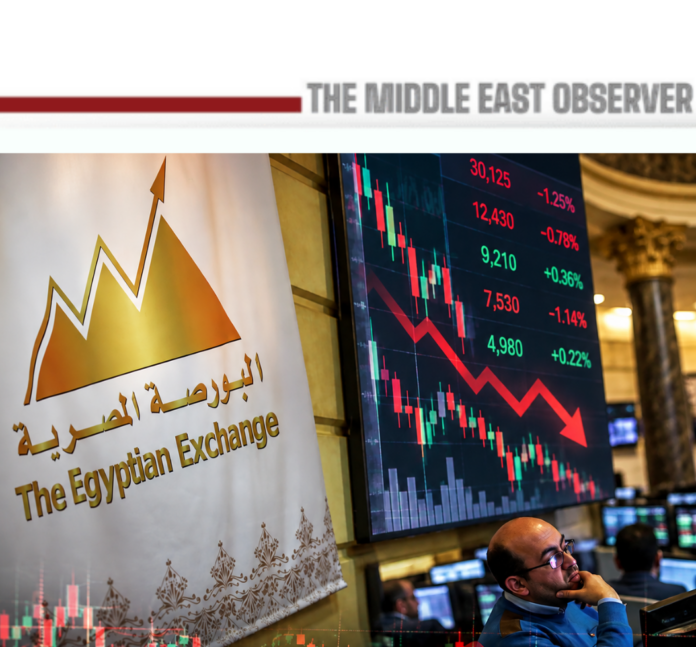
Egyptian equities showed their first meaningful signs of stabilisation since Sunday’s rally on Wednesday, as the EGX30’s decline narrowed to just 0.06% and the broader EGX70 and EGX100 returned to gains. But equity turnover fell sharply while offshore demand for Egyptian government debt surged, leaving the recovery short of full confirmation
CAIRO — The Egyptian Exchange entered the long weekend with selling pressure easing but buying conviction still limited, marking a shift from the deterioration seen over the previous two sessions.
The EGX30 slipped 0.06% to 53,265.16, following declines of 0.66% on Monday and 0.48% on Tuesday. In contrast, the EGX70 EWI rose 0.27% to 19,695.01 and the EGX100 EWI gained 0.22% to 26,010, reversing Tuesday’s broad-market losses.
Market capitalisation declined by approximately EGP10.1bn to EGP4.203tn, from EGP4.213tn on Tuesday.
Selling Pressure Eases, Conviction Does Not Return
Wednesday’s most important equity signal was the deceleration in selling.
EGX30’s three-session retreat has progressively moderated from −0.66% Monday to −0.48% Tuesday and −0.06% Wednesday, while small and mid-cap indices returned to positive territory.
Breadth nevertheless remained negative, with decliners still outnumbering advancing shares across available equity datasets.
More importantly, equity trading value fell to approximately EGP7.6bn, from EGP9.1bn Tuesday and EGP10.3bn Sunday. About 1.6bn shares changed hands.
Part of that contraction can reasonably be attributed to positioning before Thursday’s holiday, but the broader message is harder to dismiss: selling pressure weakened before strong buying conviction returned.
Egyptians Absorb Equity Selling
Egyptian investors were again the sole nationality group of net equity buyers, recording approximately EGP281.5mn, while foreign investors sold EGP214.4mn and Arab investors EGP67.1mn. Egyptians accounted for about 66.4% of Wednesday’s activity.
That preserved an important source of domestic support after Tuesday’s deterioration, when Egyptian institutions had switched from buying to selling and retail investors absorbed much of the pressure.
Wednesday’s aggregate nationality data, however, do not by themselves establish that domestic institutions returned decisively to accumulation. The distinction matters: Egyptian buying remains supportive, but renewed institutional sponsorship has yet to be demonstrated.
Offshore Debt Demand Surges
The strongest cross-asset signal again came from government debt.
Arab and foreign investors recorded combined net purchases of approximately $967.4mn in the secondary Treasury market on Wednesday, compared with $251.4mn Tuesday. Almost all of Wednesday’s demand was concentrated in Treasury bills, where combined net buying reached $949.1mn; Treasury bonds attracted another $18.3mn.
The composition was striking. Arab investors accounted for about $1.006bn of net T-bill buying, while foreigners were net sellers of roughly $57.1mn of bills but net buyers of $18.3mn of Treasury bonds.
The data therefore do not support a simplistic claim that all offshore investors moved uniformly into Egyptian debt. They do show that demand for short-duration sovereign exposure remained exceptionally strong even as foreign and Arab investors sold Egyptian equities.
The pound was broadly stable. The CBE’s latest published dollar rates remained around EGP52.25–52.39, while major state banks quoted roughly EGP52.34 buying and EGP52.44 selling on Wednesday.
Monetary conditions remain restrictive, with the CBE’s overnight deposit rate at 19%, lending rate at 20% and main-operation rate at 19.5%.
From Deterioration to Stabilisation
Wednesday materially changes the sequence of the correction.
Sunday established the rebound. Monday tested it. Tuesday weakened its institutional foundations. Wednesday stopped the deterioration from accelerating.
EGX30 continues to hold above 53,000, while EGX70 and EGX100 have returned to positive territory. But declining turnover and still-negative breadth mean the evidence is not yet sufficient to declare the recovery restored.
The market has therefore moved from deterioration towards stabilisation — not yet back into confirmed recovery.
The post-holiday test is now clear. Stronger breadth, rising turnover and renewed institutional accumulation while EGX30 holds 53,000 would strengthen the case that this week’s retreat was consolidation after last week’s rebound. A sustained break through 54,000–54,500 would provide stronger confirmation that the late-September correction has ended.
Failure to hold 53,000 would reopen that question.
For now, Wednesday delivered an important but incomplete improvement: equity selling momentum faded, while nearly $1bn of Arab and foreign net buying in the government-debt market showed that demand for Egyptian risk itself remains strong — but increasingly selective by asset class.
The EGX will reopen on Sunday, Oct. 11, following Thursday’s Armed Forces Day holiday.
Related news:
Egypt’s Food Trade Momentum Accelerates Across 186 Global Markets
EGX Rebounds as Global Capital Returns to Egyptian Assets
Red also:
EGX Pullback Tests Record Rally as Institutional Selling Broadens