Abu Dhabi-linked International Resources Holding is seeking control of one of the world’s most significant titanium-minerals deposits, extending a resource strategy that has already given the group major positions in African copper and tin and increasingly reaches from extraction into processing, trading and downstream industry.
Dublin-listed Kenmare Resources Plc confirmed on October 6 that it had received a non-binding proposal from International Resources Holdings, or IRH, for a possible cash acquisition of its entire issued and future share capital. No proposed price has been disclosed and discussions remain preliminary. Under Irish takeover rules, IRH has until November 17 to announce a firm intention to bid or withdraw, unless the deadline is extended.
The distinction over ownership is important. This is not a direct acquisition by the UAE government or by a sovereign wealth fund such as Mubadala or ADQ.
IRH is the Abu Dhabi-based natural-resources arm within 2PointZero Group, the ADX-listed investment group. 2PointZero’s latest annual disclosure shows IHC Capital Holding and IHC Digital Holding together owning 54.41% of the company, placing IRH within the wider International Holding Company, or IHC, corporate network.
IHC is chaired by Sheikh Tahnoon bin Zayed Al Nahyan, Abu Dhabi’s Deputy Ruler and UAE National Security Adviser. In September, IHC confirmed that Fount Trust now sits above Royal Group in its ultimate ownership structure, with Sheikh Tahnoon identified as the trust’s ultimate beneficial owner. The structure therefore makes IRH a royal-linked Abu Dhabi investment platform, rather than a direct state acquisition vehicle.
Mozambique adds titanium to an expanding metals portfolio
Kenmare’s principal asset is the Moma Titanium Minerals Mine in northern Mozambique, one of the world’s largest titanium-mineral deposits.
Moma holds about 9 billion tonnes of mineral resources, enough to sustain production for more than a century at current rates, and accounts for approximately 6% of global titanium-mineral production. Kenmare is also the world’s largest single supplier of ilmenite.
Its principal product is ilmenite, normally accounting for more than 70% of revenue, alongside rutile and zircon. These are not primarily finished titanium-metal products. They are upstream mineral feedstocks serving much larger industrial chains.
Approximately 95% of titanium consumption is in titanium dioxide, or TiO₂, the high-opacity white pigment used extensively in paints and industrial coatings, plastics, paper, rubber, construction materials and consumer products. That places Kenmare directly upstream of the global construction, automotive, packaging and manufacturing sectors.
A smaller but strategically important portion ultimately enters the titanium-metal and alloy chain, where titanium’s strength-to-weight ratio, heat tolerance and corrosion resistance make it valuable in commercial and military aerospace, defence systems, spacecraft, medical implants, chemical processing, offshore equipment and other advanced engineering applications.
Kenmare’s zircon adds another industrial layer. Zircon is principally consumed in ceramics, refractories and foundry applications, while downstream zirconium is used in highly corrosion-resistant chemical equipment and nuclear-fuel cladding.
The proposed acquisition would therefore give IRH exposure to considerably more than the titanium market alone.
From Zambia copper to Congo tin
The Mozambique approach follows a rapid African expansion.
In 2024, IRH completed the acquisition of 51% of Zambia’s Mopani Copper Mines, with state-owned ZCCM Investments Holdings retaining 49%. Mopani includes the Nkana and Mufulira mining and processing complexes and produces refined copper cathode. IRH is seeking to raise production towards 200,000 tonnes annually.
In July 2025, IRH completed the acquisition of 56% of Alphamin Resources for about $367 million, giving it control of the Bisie tin mine in the Democratic Republic of Congo, one of the world’s most important high-grade tin operations.
Tin is central to electronic soldering and increasingly important to advanced electronics and electrification, while copper sits at the core of power grids, renewable generation, electric vehicles and data infrastructure.
IRH has meanwhile widened its ambitions beyond mine ownership. Its Q1 2026 portfolio presentation described operations across seven countries, more than 15 traded commodities and substantial copper and tin resources, alongside exploration, technical services, commodity trading and mining technology.
In July, IRH and India’s Adani Enterprises also agreed to establish a 50:50 venture for an $11.5 billion integrated aluminium complex in Odisha, covering alumina refining, aluminium smelting and downstream manufacturing.
From resource ownership to industrial supply-chain control
Kenmare has attracted takeover interest before. Its board rejected a 530-pence-a-share proposal in March 2025 from Oryx Global Partners and former managing director Michael Carvill, arguing that it undervalued the company. Those discussions ended three months later when the consortium indicated it would proceed only at a substantially lower valuation. That history is likely to influence negotiations with IRH, particularly because the new bidder has yet to disclose its price.
The strategic significance, however, extends beyond Kenmare’s valuation.
IRH describes its model explicitly as “mine-to-market”: acquiring upstream resources while expanding into processing, logistics, technology, trading and downstream manufacturing. Its stated mineral priorities include copper, cobalt, nickel, lithium, iron ore and other materials critical to industrialisation and the energy transition.
The emerging portfolio now connects copper, tin, aluminium and potentially titanium and zircon to some of the fastest-growing industrial demand centres: electricity grids, renewable power, data centres and electronics; vehicles and transport; paints, plastics and construction; aerospace and defence; medical technology; advanced manufacturing and energy infrastructure.
That is a broader ambition than simply securing “critical minerals”.
The emerging direction is control over the raw-material gateways feeding modern industry — from African mines through processing and trading to downstream manufacturing. Mozambique would add titanium minerals to copper in Zambia and tin in the DRC, while the Indian aluminium project demonstrates an intention to move further along the value chain.
For Abu Dhabi-linked capital, the strategic target is increasingly clear: not merely ownership of mineral reserves, but participation across the industrial supply chains that convert those reserves into the materials required by electrification, infrastructure, technology and advanced manufacturing.
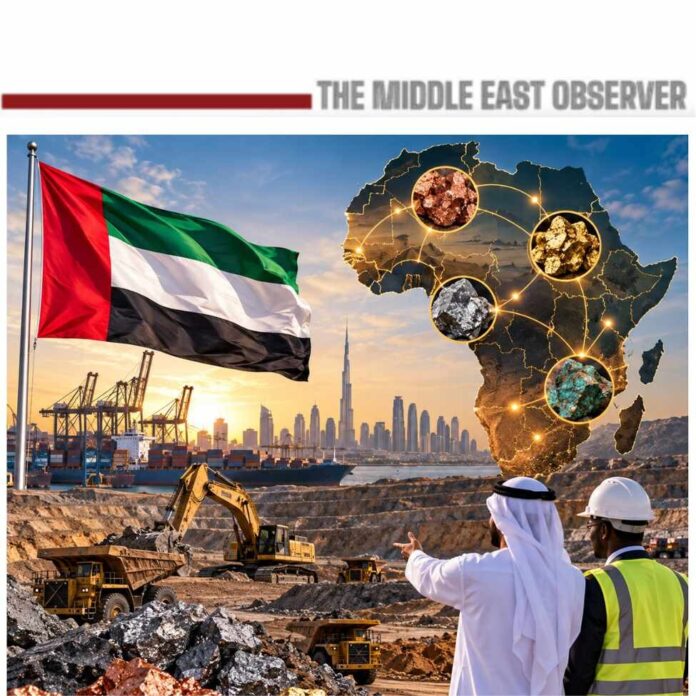
If completed, Kenmare would mark another significant step in that transition — and deepen the UAE-linked investment footprint across Africa’s strategic mineral map.
Related news:
Egypt’s Next Industrial Push Points to Grids, Machinery and Advanced Manufacturing
Egypt, UAE Leaders Deepen Strategic Coordination During El Alamein Summit
Read also: