
Egypt has raised its municipal waste collection and transport efficiency to 79%, up from 55% in 2018, as the government expands recycling facilities, sanitary landfills and waste-processing infrastructure in an effort to modernise a sector long constrained by informal dumping and uneven service coverage.
Figures released by the Cabinet’s Media Centre on Sunday showed that the government’s waste treatment efficiency indicator had also increased to 47%, compared with 21% in 2018. Authorities aim to raise collection efficiency to 85% and treatment efficiency to 60% by 2028.
The figures indicate progress in Egypt’s waste management programme, although the published announcement does not explain the methodology behind the efficiency indicators or establish how much collected waste is ultimately recycled rather than disposed of.
The distinction matters as Egypt seeks to turn waste management from a predominantly municipal service into an industry capable of recovering valuable materials, supplying alternative fuels and attracting private investment.
Expanding infrastructure
The Cabinet reported that 45 sanitary landfill cells had been delivered across 15 governorates, with another six under construction. The programme has also established 39 fixed and 16 mobile transfer stations and completed 38 waste treatment facilities.
Authorities said approximately 60 informal dumping sites had been closed and 7.5 million tonnes of accumulated waste removed.
One of the programme’s largest investments is the integrated waste management complex under development in 10th of Ramadan City, northeast of Cairo.
The facility is designed to handle up to 15,000 tonnes of waste daily, equivalent to approximately half the waste generated across Greater Cairo, according to Egypt’s environmental authorities. It will accommodate municipal, hazardous, medical, construction and demolition waste through specialised treatment and disposal facilities.
The World Bank, which is supporting the project under its $200 million Greater Cairo Air Pollution Management and Climate Change programme, said a public-private partnership was being developed to operate the municipal waste facility.
The planned capacity represents a substantial expansion of Egypt’s formal waste-processing infrastructure. Its economic and environmental impact, however, will depend on actual operating volumes, material recovery rates, compliance standards and the financial arrangements governing collection and treatment.
Waste becomes an industrial resource
The government is also expanding the conversion of waste into alternative industrial fuels, particularly for energy-intensive industries such as cement manufacturing.
According to the Cabinet, annual production of alternative fuel from waste reached 1.9 million tonnes in 2025, compared with 850,000 tonnes in 2023, an increase of 123.5%.
Processed waste can substitute for part of the conventional fuel consumed by industrial plants, potentially reducing fuel costs and the volume of material requiring landfill disposal.
However, alternative fuel production is distinct from generating electricity from waste. Its environmental benefits depend on the materials processed, the fuels displaced and the emissions controls maintained by industrial users.
The commercial challenge extends beyond processing capacity. Collection, sorting and transport costs must be covered by service contracts, public funding or revenues from recovered materials, while investors require predictable waste supplies and reliable payment arrangements.
Integrating Egypt’s informal recyclers
Modernisation also raises questions about the future of Cairo’s established informal waste collection and recycling industry.
The zabaleen, who have collected and sorted household waste for generations, remain an important part of the city’s recycling economy. Academic research cited by Reuters in September estimated that informal collectors handle approximately half of Cairo’s waste and recycle around 80% of the material they collect.
Those estimates relate to the informal collection system and should not be confused with the government’s national waste treatment indicator.
A dispute over automated bottle-collection machines introduced in Giza earlier this year illustrated the potential tensions between new recycling technologies and traditional collectors. The disagreement led to arrangements allowing informal collectors to participate in the scheme.
The experience highlights a broader challenge for policymakers: expanding modern waste infrastructure without undermining established collection networks, recycling expertise and livelihoods.
Integrating informal operators into licensed collection and recovery systems could improve material recovery while reducing disruption to an existing economic activity.
Tackling electronic and hazardous waste
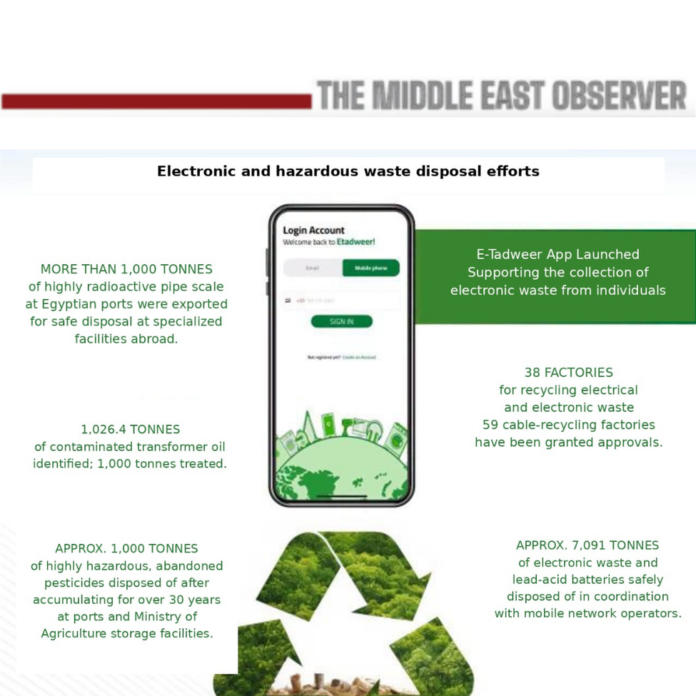
The Cabinet also reported progress in regulating electronic waste, including approvals for 38 electrical and electronic waste recycling factories and five cable recycling facilities.
The E-Tadweer application has been introduced to encourage individuals to dispose of electronic equipment through organized collection channels.
According to the government, approximately 7,091 tonnes of electronic waste and lead-acid batteries have been safely disposed of through arrangements involving mobile telecommunications operators.
More than 1,000 tonnes of obsolete cathode-ray tube screens stored at Egyptian ports have also been exported for specialized treatment abroad.
Separately, authorities reported treating approximately 1,000 tonnes of contaminated engine oil from an identified stock of 1,026.4 tonnes. They also reported disposing of roughly 1,000 tonnes of highly hazardous obsolete pesticides that had accumulated at ports and Ministry of Agriculture warehouses for more than three decades.
These operations address longstanding environmental risks, although approvals for recycling facilities do not necessarily indicate that all authorised plants are operating at commercial capacity.
From construction to performance
Egypt’s reforms are supported by Waste Management Law No. 202 of 2020, which established a regulatory framework for waste collection, transport, treatment, recycling and disposal.
The legislation provides a foundation for greater private-sector involvement, but the industry’s long-term viability will depend on enforceable service standards, adequate financing and transparent performance monitoring.
The World Bank has identified financing, stronger institutional coordination and improved data systems as central priorities for waste management across the Middle East and North Africa.
For Egypt, the immediate challenge is to translate newly built infrastructure into measurable results: higher collection coverage, greater recovery of recyclable materials, fewer uncontrolled dumping sites and financially sustainable treatment operations.
With the government’s treatment efficiency indicator still at 47%, the next phase of reform will be judged less by the number of facilities completed than by how effectively they operate, what resources they recover and whether they can sustain their costs.
Related news:
Abu Dhabi launches GIS roads layout data standards
The Green Uprising: Smashing the Zionist Grip on European Politics
Read also:
Tree Felling: Between Economic Necessity and Environmental Responsibility