
First market-wide suspension since 2021 follows a 10% plunge in EGX100, while the pound’s accelerating depreciation deepens pressure on equities. Banque du Caire’s offering attracts fresh demand despite the sell-off.
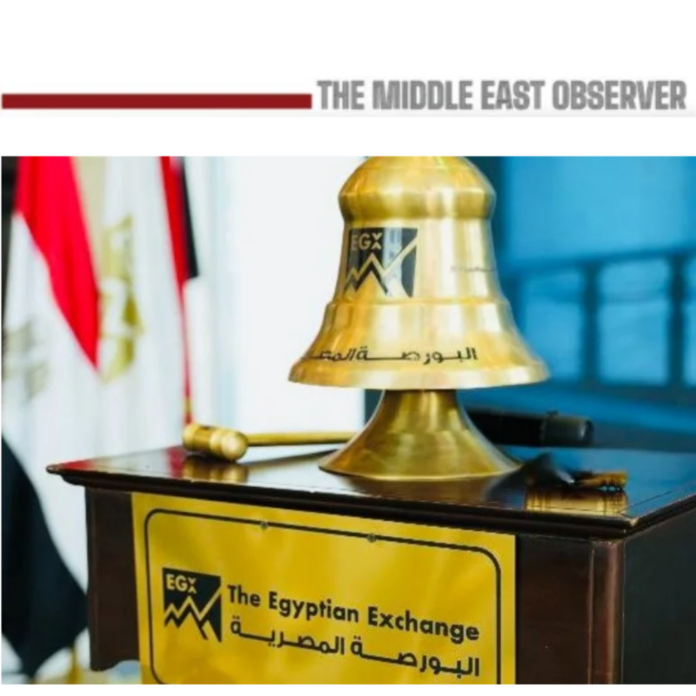
CAIRO, Egypt’s stock exchange suspended trading for 30 minutes on Sunday, October 25, for the first time since 2021 after its broad-market EGX100 index plunged 10%, as intensifying selling pressure erased EGP171bn in market value and pushed the dollar towards EGP56. The benchmark EGX30 recovered from an intraday loss exceeding 5% but closed 3.56% lower, while smaller shares plunged 11.07%. The simultaneous equity sell-off and currency depreciation marked a sharp deterioration in market conditions, even as Banque du Caire’s public offering attracted subscriptions exceeding its allocation by more than 2.5 times.
Trading Halt Signals Deeper Correction
EGX30 fell 1,817.91 points to 49,234.35, following Thursday’s 3.41% decline, taking its two-session loss to approximately 6.85%.
The benchmark dropped to an intraday low of 48,268.02 points before recovering nearly 966 points by the close. The exchange suspended trading for 30 minutes after EGX100 reached the 10% decline threshold, activating a market-wide safeguard for the first time since October 2021.
EGX70 plunged 11.07% to 15,282.64, while EGX100 closed 8.88% lower at 21,064.53. Of 224 traded shares in one closing breakdown, 209 declined, 10 advanced and five were unchanged.
Market capitalisation fell to EGP3.778tn from EGP3.949tn on Thursday, bringing the cumulative two-session loss to approximately EGP287bn.
Equity turnover declined to EGP7.18bn from EGP8.19bn, while transaction numbers rose to approximately 250,360. The combination of falling turnover, more transactions and overwhelmingly negative breadth suggests fragmented trading amid widespread selling.
Domestic Institutions Absorb Selling Pressure
Investor flows revealed an important distinction between market panic and institutional positioning.
Egyptian institutions recorded net equity purchases of approximately EGP320.9mn, while Egyptian individual investors sold EGP273.3mn. Arab individuals bought EGP33.2mn, foreign individuals purchased EGP1.4mn and foreign institutions sold EGP81.6mn.
By nationality, Egyptian investors were modest net buyers, Arab investors also purchased shares, while foreign investors remained net sellers.
The institutional figures suggest that domestic institutions absorbed part of the selling pressure, although their purchases were insufficient to prevent steep declines across the exchange.
Hany Genena, head of research at Al Ahly Pharos, attributed the sell-off to escalating regional and international political and economic uncertainty, which encouraged profit-taking after substantial gains in recent years.
Genena expects a recovery if geopolitical tensions ease, with EGX30 constituents potentially rebounding faster than smaller stocks as valuations become more attractive to foreign investors.
His assessment points to a distinction between short-term sentiment and underlying corporate valuations, although the timing and strength of any recovery remain uncertain.
Dollar Approaches EGP56 as Debt Pressures Persist
The dollar reached EGP55.75 buying and EGP55.89 selling at the Central Bank of Egypt on Sunday, up approximately 52 piastres from Thursday.
The US currency gained about EGP2.29, or 4.28%, over the preceding week and approximately EGP4.04, or 7.82%, against its September 24 level.
The depreciation compounds pressure on equity valuations by reducing foreign investors’ dollar-denominated returns and increasing import costs for companies dependent on overseas inputs.
Currency weakness followed substantial foreign and Arab selling of Egyptian government securities in the secondary market. Reported combined net sales reached approximately $1.84bn during October 19–22, although Sunday’s corresponding debt-market flows were not independently established.
EnterpriseAM separately reported, citing a banking source, that interbank transactions associated with financing foreign exits from the secondary debt market reached approximately $3.1bn during the preceding week. The figure is not directly comparable with secondary-market net sales.
The Central Bank’s October 29 monetary-policy meeting now approaches amid heightened currency volatility, inflation concerns and pressure on portfolio investment.
Banque du Caire Offering Defies Market Weakness
Banque du Caire’s public offering reached approximately 2.54 times subscription coverage on Sunday, with orders for about 581.4mn shares against 228.75mn initially allocated to retail investors.
The Financial Regulatory Authority approved increasing the potential sale from 30% to 45% of the bank’s issued capital on October 22, alongside supplementary disclosures concerning participation by the European Bank for Reconstruction and Development and the International Finance Corporation.
The institutional agreements envisage participation by each institution equivalent to 15.74% of the private-placement tranche, subject to final pricing and allocation.
The offering’s indicative price range remains EGP4.82–5.30 per share, with final pricing scheduled for October 26 and public subscriptions open until October 28.
The transaction presents a significant test of Egypt’s privatisation programme. Strong demand for the initial public tranche contrasts with widespread selling of listed shares, but it does not establish equivalent demand for the larger institutional placement or guarantee post-listing performance.
Recovery Now Depends on Currency and Confidence
Sunday’s sell-off overturned the tentative recovery recorded earlier in the week. The EGX30’s rebound from its intraday low and domestic institutional buying provided limited support, but neither prevented a market-wide decline.
The central question is whether institutional demand can stabilise prices while the pound’s depreciation and sovereign-debt selling moderate.
Until market breadth improves and currency pressures ease, Egypt’s equity market remains vulnerable to further repricing, even as selected assets continue to attract investors.
Related News:
EGX Rally Gains Institutional Support as Foreigners Sell Government Debt
Egypt’s EGX30 Rallies as Broader Stocks Fall, Debt Selling Persists
Read Also:
EGX Attracts 550,000 New Investors as Foreign Selling Deepens