

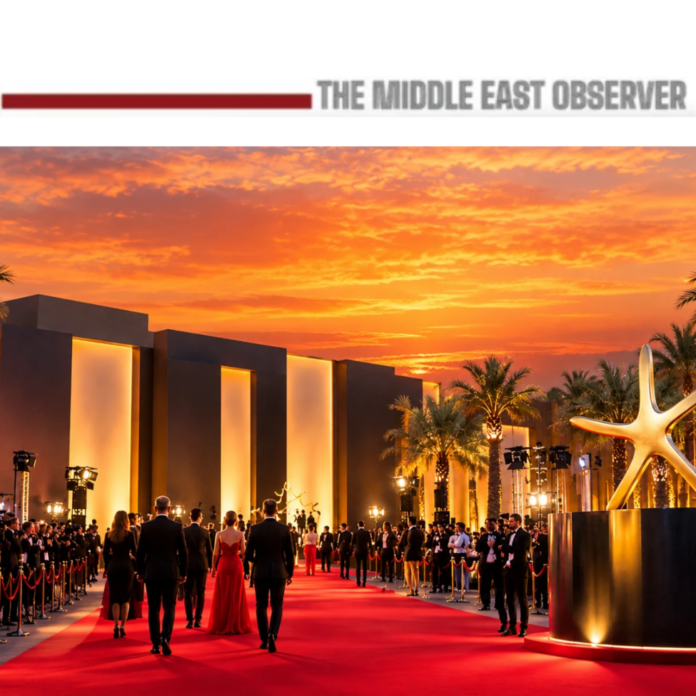
Egypt’s ninth El Gouna Film Festival crowned Egyptian and Palestinian filmmakers, distributed more than $350,000 in film-development support and expanded its international industry programmes, putting the spotlight on the region’s efforts to turn cinematic talent into sustainable productions and global distribution opportunities.
EL GOUNA, Egypt’s ninth El Gouna Film Festival concluded on October 23 after nine days of international screenings, major artistic honours and film-industry activities that brought filmmakers, producers and distributors to the Red Sea resort, highlighting the growing ambition to position Egyptian and Arab cinema within the global entertainment market.
Egyptian director Mohammed Hammad’s Safe Exit won the $50,000 Golden Star for Best Narrative Feature, while Palestinian filmmaker Ahmed Hassouna’s Citizen Osama secured the Golden Star for Best Documentary and Best Arab Documentary. The awards placed Egyptian filmmaking and stories emerging from Gaza at the centre of the festival’s closing ceremony.
Beyond the awards, the CineGouna industry platform distributed 40 financial and service awards worth more than $350,000 to 16 film projects, alongside an expanded programme of international co-production meetings, screenplay development, television initiatives and emerging-talent support.
The festival, held from October 15 to 23 under the theme Cinema for Humanity: Archiving Narratives, presented a reported 77 films across its competitive and non-competitive sections. Its programme included 10 Arab films, the largest Arab selection in the festival’s history.
The edition reflected a broader transition for El Gouna, which is seeking to move beyond its annual screenings and establish a lasting role in regional film development, international financing and cultural exchange.
Opening Ceremony Celebrates Egyptian Cinema and International Talent
The festival opened on October 15 at the Festival Plaza, bringing together Egyptian, Arab and international filmmakers, actors and industry executives.
Egyptian actress Mona Zaki received the Creative Achievement Award, presented by director Mohamed Shaker Khodeir, recognising more than three decades of work across cinema, television and theatre.
The ceremony also paid tribute to veteran lighting specialist Hassan El-Sayed for his contribution to Egyptian filmmaking, placing attention on the technical professionals whose work has helped shape the country’s cinema industry.
French director Marc Fitoussi’s All About Corinne, starring Isabelle Huppert and Sandrine Kiberlain, was selected as the festival’s opening film, adding a European production to an edition focused on connecting international cinema with emerging Arab filmmakers.
The programme combined feature narratives, documentaries, short films and special presentations with masterclasses and industry discussions covering artistic development, financing, distribution and emerging technologies.
The festival also marked the tenth anniversary of the death of Egyptian filmmaker Mohamed Khan through retrospective screenings and discussions examining his influence on cinematic realism and portrayals of Egyptian society.
During the tribute, Khan’s family announced plans to establish a foundation dedicated to preserving his films and archival materials, extending the festival’s cultural programme into the preservation of Egypt’s cinematic heritage.
Egyptian and Palestinian Films Lead Major Awards
The closing ceremony on October 23 marked one of the strongest showings for Egyptian and Palestinian filmmaking in the festival’s principal competitions.
Hammad’s Safe Exit, a psychological drama following a young Christian security guard in Cairo struggling with childhood trauma linked to his father’s murder by militants in Libya, won the Golden Star for Best Narrative Feature.
The film, co-produced by partners from Egypt, Libya, Tunisia, Qatar and Germany, demonstrated the role that international production partnerships can play in bringing locally rooted stories to audiences beyond their countries of origin.
Palestinian director Ahmed Hassouna’s Citizen Osama won two documentary honours worth a combined $40,000. Following a journalist in northern Gaza, the film examines the experience of documenting conflict while navigating the personal consequences of war.
Palestinian producer Rashid Masharawi, accepting the awards on Hassouna’s behalf, dedicated the recognition to journalists killed while reporting from Gaza and those continuing their work under dangerous conditions.
Rakan Mayasi’s Yesterday the Eye Didn’t Sleep received the $20,000 award for Best Arab Narrative Feature, while Jordanian actress Rakeen Saad won Best Actress for her performance in Zaid Abu Hamdan’s Boomah. Serbian actor Jovan Ginić received Best Actor for Miroslav Terzić’s 3 Weeks After.
International recognition extended across the festival’s other competitive categories.
Norwegian director Anders Davidsen’s Stolen Memories won the Golden Star for Best Short Film. Lebanese filmmaker Marie-Rose Osta’s Someday a Child secured Best Arab Short Film.
Documentary honours also went to Dongnan Chen’s Whispers in May and Raha Shirazi’s A War on Women, while Nobody Knows the World, directed by Roddy Dextre, and Egyptian filmmaker Jad Chahine’s My Village Blamed Women for the End of Mankind received Silver and Bronze Stars respectively in the short-film competition.
The Cinema for Humanity Audience Award went to Poh Si Teng’s American Doctor, while the environmental Green Star Award recognised Nuisance Bear, directed by Gabriela Osio Vanden and Jack Weisman.
The festival additionally honoured Moroccan filmmaker and actor Faouzi Bensaïdi with its Creative Achievement Award, presented by Egyptian director Yousry Nasrallah.
Its closing celebrations also commemorated the contribution of the late Egyptian composer Hany Shenouda, with singer Mona Aziz performing music associated with his career.
CineGouna Awards More Than $350,000 to Emerging Productions
The festival’s most consequential industry development came through CineGouna Funding, which announced its results on October 22.
More than 310 film projects had been submitted for consideration, with 19 selected to compete in the final programme. Of these, 16 received 40 awards exceeding $350,000 in combined cash grants, post-production services, promotional packages and distribution support.
Participating filmmakers held more than 140 individual meetings with production companies, funding institutions and representatives of international film festivals.
Among the principal beneficiaries, Egyptian director Sameh Alaa’s When I Close My Eyes, I See Your Eyes, produced by Mark Lotfy, received an EGP 1.5 million grant from the Sawiris Foundation for Social Development, alongside additional cash and promotional support.
Zoulikha Tahar’s Paradise Beach and Rama Abdy’s House No. 7 each received a $15,000 CineGouna award for development and post-production respectively.
Sudanese filmmaker Marwa Zein’s Lily’s Makkah secured support from the International Emerging Film Talent Fund and industry partners, while Saudi project Shorrab, directed by Emad Eskandar, attracted financial backing from regional production and entertainment companies.
The range of projects illustrated CineGouna’s increasingly international character, connecting filmmakers from Egypt, Sudan, Syria, Lebanon, Saudi Arabia and other markets with financing and professional services.
However, the total award value represents a combination of cash and in-kind services, not solely direct investment. The longer-term outcome will depend on how many supported productions are completed, secure distribution and generate commercial returns.
Television Development and New Talent Expand Industry Reach
CineGouna’s ninth edition expanded beyond feature filmmaking through programmes intended to address weaknesses in the regional production pipeline.
The inaugural CineGouna Series initiative selected six Arabic-language television projects from 165 applications, bringing writers into a structured development process with experienced industry professionals and prospective buyers.
The programme responded to growing competition among creators for a limited number of broadcasters, streaming platforms and commissioning opportunities.
CineGouna Emerge, the festival’s professional-development initiative, selected 118 participants representing 14 nationalities from more than 1,000 applicants, providing training, mentorship and direct engagement with established filmmakers and production executives.
The festival also introduced Egyptian Voices to strengthen the development of Egyptian film projects and Safe Harbour MENA, organised with the International Film Festival Rotterdam and the International Emerging Film Talent Fund.
The latter initiative supported four displaced filmmakers through training, networking and opportunities to present their projects to industry professionals.
CineGouna Forum offered approximately 35 planned engagements, including discussions and masterclasses addressing artificial intelligence, creative ownership, changing audiences, gender representation and the international prospects for Egyptian comedy.
The expansion strengthens El Gouna’s position as an industry meeting point, although the commercial impact of these initiatives will ultimately depend on completed productions, commissioned television series and distribution agreements.
Industry Leaders Confront Egypt’s Screenplay and Distribution Challenges
The festival’s industry discussions also addressed a longstanding challenge: how Egypt can convert its established filmmaking expertise into a consistent supply of internationally competitive productions.
Egyptian cinema historically dominated film production across the Arab world, but its output contracted substantially from late-20th-century levels.
Figures attributed to the Egyptian Chamber of Cinema Industry show production of 112 films in 1988, falling to 16 in 1998. More recently, annual production rose from 51 films in 2022 to 67 in 2023, although subsequent figures and differences between production and theatrical-release statistics make it difficult to establish a continuous recovery.
Syrian producer Mohamed Mashish, who has spent much of his professional career in Egypt, identified stronger screenplay development as a fundamental requirement for sustaining the industry’s growth.
Speaking to Variety, Mashish argued that producers need to devote more time and resources to developing scripts before moving projects into production.
Other filmmakers highlighted the growing expectations of audiences accustomed to international streaming services, while producers and distributors called for earlier engagement with sales agents and more effective international marketing strategies.
The commercial opportunity is significant.
Egyptian films generated SAR 187.7 million, approximately $50 million, in Saudi Arabian box-office revenue during 2025, accounting for about 21% of the kingdom’s theatrical market, according to figures disclosed by Saudi entertainment authorities.
That performance demonstrates the continuing appeal of Egyptian productions outside their domestic market, but box-office revenue does not directly measure producers’ earnings after exhibition fees, distribution costs and marketing expenditure.
For Egyptian cinema, success in regional and international markets will depend increasingly on stronger scripts, professionally structured financing, enforceable intellectual property rights and sustainable distribution arrangements.
Palestine, Cultural Heritage and Cinema Beyond the Red Carpet
The festival’s humanitarian and cultural initiatives extended its programme beyond commercial filmmaking.
Window on Palestine returned for a fourth consecutive year, providing a platform for Palestinian stories, while Safe Harbour MENA addressed the challenges facing filmmakers displaced by conflict.
On October 20, the United Nations World Food Programme, the festival and Zest named Fares El Tabey’s Between Two Shores the winner of the third Eish Short Film Competition, supporting cinematic storytelling around food security and livelihoods.
Another initiative, Cinema on Wheels, began taking short films from the festival’s official selection to audiences outside El Gouna.
Organised with the Sawiris Foundation and Jesuit Cairo, the free screening programme began in Hurghada on October 23, with further events scheduled in Minya, Qena, Luxor and Aswan through October 27, followed by a planned concluding event in Cairo.
The screenings, accompanied by public discussions, seek to broaden access to independent cinema in communities outside Egypt’s principal commercial exhibition centres.
The festival also strengthened accessibility measures in cooperation with its partners, reflecting a wider effort to make major cultural events more inclusive.
Together, these initiatives connected the festival’s international ambitions with its stated commitment to developing audiences, preserving cultural memory and supporting filmmakers whose voices may otherwise struggle to reach mainstream distribution.
Egypt’s Creative Economy Faces the Next Test
The ninth El Gouna Film Festival highlighted the potential of cinema to contribute to Egypt’s creative economy, international cultural influence and tourism positioning.
Film production generates activity beyond theatrical entertainment, supporting employment in cinematography, editing, sound engineering, post-production, set construction, translation, marketing, distribution and associated services.
International festivals can strengthen these sectors by attracting foreign producers, facilitating co-production arrangements and connecting Egyptian talent with overseas distribution networks.
El Gouna’s location on the Red Sea also creates opportunities to link cultural programming with destination development and international visitor engagement. However, independently verified figures establishing the festival’s incremental tourism receipts, hotel occupancy impact or direct economic contribution have not been published.
The more substantial opportunity lies in developing commercially viable Egyptian and Arab intellectual property capable of reaching wider audiences through cinemas, television platforms and legitimate digital distribution.
That will require investment in screenplay development, better access to production finance, stronger distribution arrangements and mechanisms that allow producers and creative rights holders to retain a sustainable share of revenue.
As El Gouna approaches its tenth edition in 2027, its success will increasingly be measured not simply by the films screened or stars honoured, but by the number of projects that advance from development to production, secure international releases and establish lasting commercial relationships.
The ninth edition demonstrated that the region possesses significant filmmaking talent and growing institutional support. The challenge now is to translate that momentum into a durable film industry capable of competing internationally while sustaining the distinctive stories and creative identity of Egyptian and Arab cinema.
Related News:
Cairo Film Festival’s 50th Anniversary Puts Egypt’s Cinematic Heritage in Focus
El Gouna Film Festival Unveils New Identity, Honours Mona Zaki
Read Also:
Egyptian Short Film Khufu Brings Contemporary Egyptian Storytelling to the Global Stage