

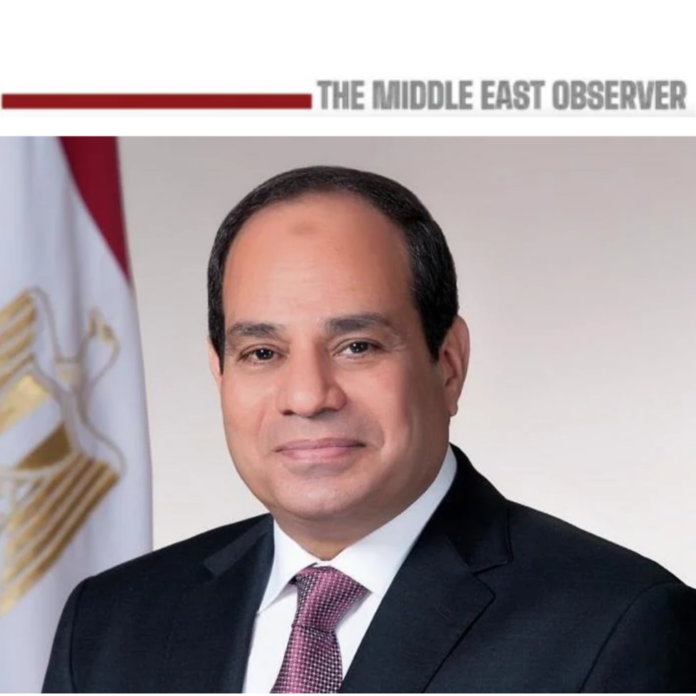
President reviews wind power, energy storage, desalination and domestic manufacturing as Egypt seeks to cut fuel imports, attract green investment and reduce public debt.
CAIRO, President Abdel Fattah El-Sisi reviewed Egypt’s accelerated renewable energy programme on Tuesday, placing electricity-grid expansion, domestic manufacturing and energy security alongside a renewed commitment to reducing government debt as the country seeks to raise renewable electricity generation to 45% by 2028.
Meeting Prime Minister Mostafa Madbouly, Electricity Minister Mahmoud Esmat and Finance Minister Ahmed Kouchouk, El-Sisi examined progress on a 200-megawatt wind farm in the Gulf of Suez, battery storage projects, green hydrogen, seawater desalination and higher-value processing of Egypt’s mineral resources.
According to presidential spokesperson Mohamed El-Shennawy, El-Sisi stressed the importance of a diversified, sustainable energy mix that reduces fossil-fuel dependence, strengthens supply security and makes better use of domestic resources.
The meeting followed government announcements outlining approximately EGP 200 billion in electricity-grid investment and a longer-term ambition to increase the contribution of new and renewable energy to 50% by 2030.
The 45% target for 2028, confirmed earlier this year, accelerates Egypt’s original objective of a 42% renewable contribution by 2030. Its implementation now depends on completing generation projects, transmission infrastructure and electricity storage within a compressed timetable.
Gulf of Suez Projects Put Grid Investment in Focus
The 200 MW Gulf of Suez wind development illustrates the challenges of accelerating renewable generation while building the infrastructure needed to deliver electricity to consumers.
Electricity Minister Esmat reported that a new 500-kilovolt transmission project had been contracted to carry wind-generated power from the Gulf of Suez towards major consumption centres.
On October 25, the Egyptian Electricity Transmission Company signed an agreement with Wadi El Nile Contracting for a 66-kilometre transmission-line segment, scheduled for completion within 12 months.
The project forms part of a wider electricity network investment programme estimated at EGP 200 billion, which Madbouly said on October 22 had been incorporated into government financing plans.
The timetable for the Gulf of Suez wind farm also warrants attention. Development agreements signed in 2024 envisaged commercial operation in October 2026, while an Electricity Ministry statement in August 2026 scheduled grid connection for December 2027. The statements refer to different project milestones, but the government has not publicly explained the change in timing.
For Egypt, transmission investment is becoming as important as additional generating capacity. Wind and solar projects cannot deliver their expected economic benefits without reliable grid connections, sufficient storage and the ability to supply electricity when consumers need it.
Renewable Expansion Faces a Delivery Test
Egypt had 10.5 gigawatts of renewable generating capacity connected to its electricity system as of October 22, alongside 1.1 GW of battery storage capacity, Esmat said. Total installed electricity capacity stood at 64.4 GW.
The ministry placed the combined contribution of renewable energy and battery storage at approximately 18% of the electricity mix. That measure, however, should not be confused with the share of electricity actually generated from renewable sources: batteries store energy, while installed capacity does not establish annual electricity output.
The government is pursuing private-sector projects involving approximately 11.6 GW of wind generation, 7.6 GW of solar power and 13.2 gigawatt-hours of battery storage.
A further investment development came on October 26, when Egypt signed preliminary financing agreements for Norway’s Scatec to develop the $650 million Dandara solar project in Qena.
The project is designed to deliver 1 GW of solar generation and 200 megawatt-hours of storage, with financing arrangements involving the European Investment Bank, European Bank for Reconstruction and Development, and African Development Bank.
The facility is intended to supply approximately one-third of the electricity requirements of Egypt Aluminium, linking renewable energy investment directly to industrial production and export competitiveness.
Cutting the Cost of Energy Dependence
The economic case for accelerating renewable power has strengthened as Egypt faces increased costs for imported natural gas and petroleum products.
Petroleum imports climbed 27.6% to $24.9 billion in the fiscal year ending June 2026, according to Central Bank of Egypt figures reported earlier this month. Natural gas accounted for approximately $4.7 billion of the increase in petroleum imports.
Greater use of domestically generated wind and solar electricity could reduce gas consumption in power stations, easing foreign-currency pressures and freeing gas for other economic uses.
The potential benefits, however, depend on actual electricity generation and the costs of financing, storage and transmission.
Private investment can reduce the government’s immediate capital requirements, but long-term electricity-purchase agreements and foreign-currency commitments must also be assessed against the cost of conventional generation and the value of fuel imports displaced.
The essential measure is not simply how many gigawatts Egypt installs, but whether renewable electricity can be delivered reliably and competitively.
Green Hydrogen, Water Security and Local Manufacturing
El-Sisi also reviewed green hydrogen developments and seawater desalination projects, including a planned integrated desalination complex in Dabaa.
The government is seeking international technical cooperation and investment to expand water supplies while building domestic manufacturing capabilities in equipment and technologies associated with desalination.
The President separately called for stronger localisation of industries associated with black sands and rare elements, emphasising the conversion of natural resources into higher-value industrial products rather than the sale of raw materials.
These initiatives could broaden Egypt’s industrial base, create specialised manufacturing opportunities and retain more value within domestic supply chains. Their commercial returns will depend on technology, financing, production costs and market demand.
Debt Reduction Tests Investment Priorities
Finance Minister Kouchouk presented the latest economic and fiscal developments, including cooperation with international financial institutions and efforts to reduce debt carried by public budget entities.
El-Sisi called for coordinated action across state institutions to achieve the government’s announced debt-reduction objectives.
The instruction adds an important fiscal dimension to Egypt’s energy strategy.
The government must reconcile substantial investment requirements with debt servicing, foreign-currency obligations and the need to maintain affordable electricity for businesses and households.
Renewable energy could strengthen that balance over time by lowering fuel-import exposure, but the economic gains are neither automatic nor immediate.
Related news:
1 GW Ras Shokeir Deal Deepens Egypt’s Gulf of Suez Wind Push
Egypt Expands Mediterranean Energy Hub as $24.9bn Import Bill Tests Resilience
Read Also:
Wind Energy: Egypt Plans EGP 12bn Grid Link for Suez Projects
When Electricity Becomes a Business: Who Will Control Egypt’s Next Power Market?
