
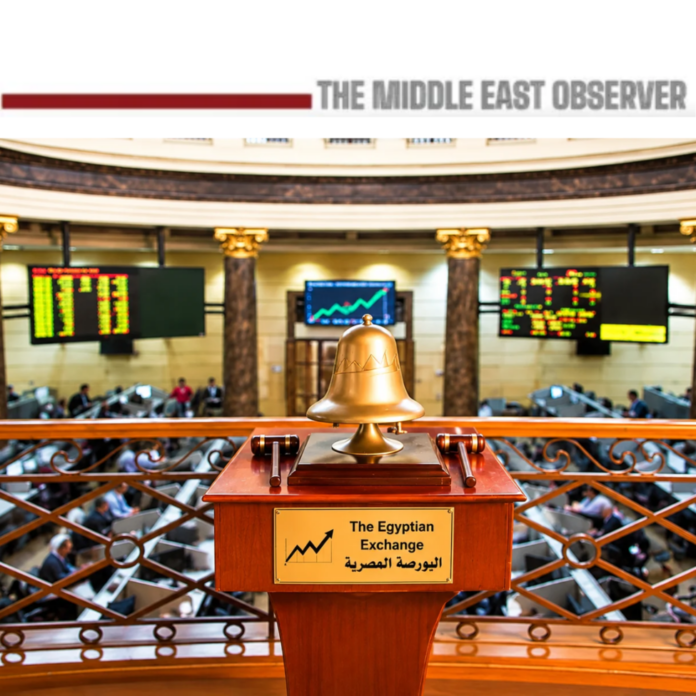
CAIRO, Egyptian stocks staged a broad recovery on Tuesday as foreign institutions reversed the previous session’s selling, lifting the benchmark EGX30 by 1.76% to 49,255.66 points. The advance recovered Monday’s losses, with 180 shares rising as foreign investors returned to government debt and the pound strengthened. Yet equity turnover remained approximately 30% below its three-month average, leaving the durability of the rebound uncertain.
Market Breadth Signals Stronger Recovery
The EGX70 small- and mid-cap index gained 2.18% to 16,648.16 points, while EGX100 rose 1.97% to 22,344.10. The Shariah-compliant EGX33 advanced 1.91%, and EGX35-LV added 1.01%.
Market breadth reversed sharply from Monday’s 185 declining shares against 24 gainers. On Tuesday, 180 stocks advanced, 29 declined and 16 remained unchanged.
The EGX30 recovered from an intraday low near 48,030 points to close near its session high, gaining 852.52 points after Monday’s 340.87-point decline.
Market capitalisation increased approximately EGP58 billion to EGP3.890 trillion, recovering most of Monday’s EGP65 billion loss.
However, the benchmark remained 0.7% below its October 29 close and approximately 6.8% below its October 21 level of 52,854.95 points.
Foreign Institutions Reverse Selling, but Turnover Lags
Foreign institutions purchased approximately EGP136 million net in listed equities, reversing Monday’s EGP140.2 million net selling — a swing of EGP276.2 million in a single session.
Egyptian institutions also bought EGP41.2 million, while Arab institutions sold EGP16.5 million. Egyptian individual investors recorded net sales of EGP169.8 million.
By nationality, foreign investors bought EGP130.1 million net, offsetting EGP128.6 million in Egyptian sales and EGP1.5 million in Arab sales, according to Arab Finance and Egyptian Exchange closing data.
The institutional turnaround marked an improvement in the composition of demand. However, equity turnover declined to EGP7.46 billion from EGP10.03 billion on Monday.
Excluding approximately EGP2.02 billion generated by Banque du Caire’s trading debut, Tuesday’s turnover was around 7% lower than Monday’s adjusted level.
More significantly, Beltone’s market analytics placed Tuesday’s turnover 30.2% below its three-month average and 5.9% below its ten-day average, using its own trading-value measure.
The rebound gained breadth and institutional support without a corresponding increase in market liquidity.
Foreign Treasury Buying Supports Pound Recovery
Foreign investors purchased approximately $364.8 million net in Treasury bills in the secondary market, reversing recent selling, according to Egyptian Exchange data reported by Hapi.
Arab investors sold $168.4 million net, leaving combined foreign and Arab purchases of approximately $196.4 million.
These secondary-market transactions indicate renewed demand for government securities but do not necessarily represent equivalent immediate foreign-currency inflows.
Meanwhile, the dollar declined eight piastres to EGP 55.28 buying and EGP55.42 selling, according to central-bank quotations, extending the pound’s recovery from levels above EGP56 in late October.
The simultaneous improvement in equity flows, government-debt purchases and the exchange rate suggests easing portfolio pressure, although one session cannot establish a sustained reversal.
Monetary Tightening Remains a Constraint
The Central Bank of Egypt absorbed EGP744.2 billion in surplus banking liquidity from 14 banks through its open-market operation at the existing 20.5% main-operation rate, maintaining monetary restraint following October’s 100-basis-point interest-rate increase.
Government securities continue to offer substantial competition for investment capital. Recent pound Treasury-bill auctions delivered accepted yields above 25%, while Monday’s euro-denominated issue cleared at 3.25%, against 2.25% at the previous comparable auction.
Higher financing costs remain a challenge for corporate valuations, particularly among companies dependent on borrowing.
Fertiliser Shares Defy Rally as Gas Supplies Are Cut
Recovery Improves, but Confirmation Remains Elusive
Tuesday’s rebound marked the clearest improvement in market breadth and foreign institutional participation since the latest sell-off. Foreign Treasury-bill purchases and a firmer pound provided additional support.
Nevertheless, the EGX30 remains below its October 29 close, trading liquidity is subdued and elevated government-security yields continue to compete with equities.
Abu Qir Fertilizers declined 3.59% to EGP 77.71 as investors assessed the implications of a government-directed 20% reduction in natural-gas supplies to fertiliser manufacturers, effective November 1.In separate Egyptian Exchange disclosures on Tuesday, KIMA confirmed implementing the reduction while maintaining normal operations at its urea plant. MOPCO also reported continued production, adjusting operating rates to the reduced gas supply. KIMA is assessing the potential impact of the cuts on production and financial performance, while MOPCO is monitoring gas availability and its implications for operations. Neither company has quantified potential losses.The restrictions raise concerns for an important export industry. Egypt’s chemical and fertiliser exports increased 34% to $9.54 billion in the first nine months of 2026. Prolonged gas shortages could constrain production and export earnings, although both companies have reported continuing operations.
The next test is whether the benchmark can recover the 49,600–50,000-point area with sustained institutional buying, stronger turnover and continued stability in sovereign-debt flows.
Egypt’s equity recovery has gained institutional support and broader market participation, but its durability remains unproven. The decisive shift will come when renewed foreign demand translates into sustained liquidity and confidence across the exchange, rather than another short-lived rebound.
Related news:
Egypt Stocks Recover as EGP36bn Bank Sale Dominates Market Flows
Egypt Stocks Struggle to Recover as High Yields Challenge Equity Demand
Read also:
Egypt Halts Stock Trading as Market Loses EGP171bn
Egypt Stocks Rebound 3.5% as $619mn Debt Selling Tests Recovery
