

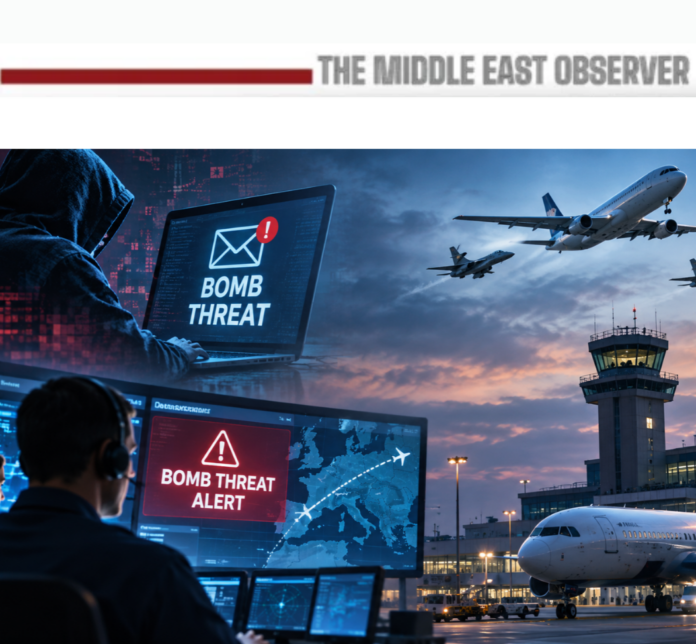
Europe faces a possible coordinated campaign of cyber-enabled disruption after a wave of false bomb threats targeted more than 30 commercial flights and thousands of schools, forcing emergency security responses and raising concerns over hybrid warfare. The perpetrators, their motives and any possible sponsors remain unidentified.
The threats, which intensified in early November, triggered flight diversions, fighter-jet escorts and aircraft inspections across several European countries. No explosives were found.
On November 11, approximately 6,300 school organisations in Italy received threatening emails, while hundreds of schools in Ireland and Britain faced similar alerts. Some schools were evacuated, but authorities found no evidence of a genuine bomb threat.
Investigators are examining whether the incidents form part of an organised effort to spread fear, disrupt essential services and impose substantial security costs without physical attacks. Some messages reportedly passed through compromised institutional email accounts, although no common perpetrator has been established.
Suspicions of possible state-backed hybrid activity have emerged amid wider European concerns over Russian and Iranian operations. However, no verified evidence links either government to the threats, and officials have cautioned against assuming that the incidents share a single source.
Against this backdrop, Airports Council International Europe (ACI Europe) unveiled its Strategy Paper on Hybrid Threats and Airport Resilience on November 12, calling for closer intelligence-sharing, stronger cyber-resilience and coordinated protection of critical infrastructure.
The strategy advocates integrated security arrangements linking airport operators, intelligence agencies and public authorities, alongside improved crisis management, clearer institutional responsibilities and dedicated resilience funding.
It seeks to shift European aviation security from fragmented responses to coordinated prevention and operational continuity, recognising airports as vital infrastructure for passenger transport, trade, supply chains and emergency services.
ACI Europe Director General Olivier Jankovec warned that hybrid threats could undermine public confidence and disrupt essential operations even without causing physical damage.
The latest incidents expose a growing security challenge: relatively inexpensive digital threats can trigger costly emergency measures and widespread civilian disruption.
Although the bomb alerts have so far proved false, their operational consequences have been real. With responsibility still unresolved, European authorities face mounting pressure to prevent repeated hoaxes from undermining public confidence and the resilience of essential services.
Related news:
Taiwan’s AI Cyberattack Offers a Warning for Global Banks
Africa’s Cybercrime Losses Rise 152% as AI Expands Criminal Reach
Read Also:
COP31: $6bn EBRD Plan Leads Climate Deals as Finance Disputes Persist
US, Egypt Renew Antiquities Pact After Recovery of 5,000 Artifacts