

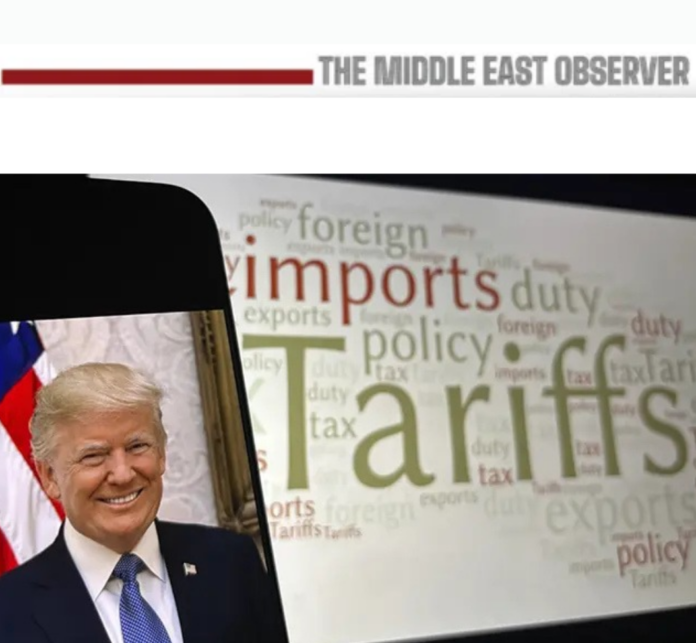
Washington’s proposed duties on 14 trading economies risk raising consumer prices and accelerating the fragmentation of global supply chains, as economists warn of a substantial long-term cost to world growth.
US President Donald Trump’s administration unveiled a new round of proposed tariffs on Wednesday, targeting 14 major trading economies over industrial policies that Washington argues have distorted international competition and undermined American manufacturing.
The measures, which could reach 35% on Vietnamese goods and 25% on Indian products, come as US inflation accelerates to 3.8%, threatening to renew pressure on consumer prices and complicate the Federal Reserve’s efforts to restore price stability.
The offensive coincides with research by Oxford Economics warning that a permanent division of the world into seven competing commercial blocs could leave global economic output 13% below its baseline by 2050, exposing the economic cost of reversing decades of international integration.
Rebuilding America’s tariff regime
Washington’s latest offensive follows a series of legal and commercial developments that have reshaped US trade policy since 2025.
On 20 February 2026, the US Supreme Court ruled that the International Emergency Economic Powers Act did not authorise the president to impose tariffs. The administration subsequently introduced a temporary 10% import surcharge under Section 122 of the Trade Act of 1974, while pursuing alternative statutory mechanisms.
On 11 March, Washington launched investigations under Section 301 into foreign industrial overcapacity. A separate investigation resulted in tariffs on 60 economies in July over their alleged failure to adequately restrict imports produced using forced labour.
The November proposals extend Washington’s commercial offensive beyond bilateral trade deficits to challenge government subsidies, industrial development strategies and manufacturing capacity across major economies.
They also reveal an increasingly differentiated system of market access. India could secure a preferential tariff rate of 17% instead of 25% by concluding a reciprocal trade agreement. Vietnam could obtain a reduction from 35% to 20%, while Singapore could negotiate a rate of 10% rather than 20%.
The proposed rates include exemptions and adjustments for existing duties and do not necessarily represent equivalent additional tariff increases.
Washington’s approach is increasingly making access to the world’s largest consumer market conditional on bilateral negotiations, reshaping the commercial considerations behind international investment and manufacturing decisions.
Public submissions are due by 5 January 2027, with hearings beginning on 25 January. No implementation date has been confirmed.
The price paid by American consumers
The renewed tariff offensive comes at a sensitive moment for the US economy. Figures released on Wednesday showed third-quarter GDP growth reaching an annualised 4.3%, while annual inflation, measured by the personal consumption expenditures index, rose to 3.8% in October. Core inflation reached 3.3%, considerably above the Federal Reserve’s 2% target.
Although nominal consumer expenditure increased by 0.3% in October, inflation-adjusted spending registered a marginal decline, despite an improvement in real disposable income.
The inflationary consequences of earlier tariffs are already measurable.
Research published in October by economists at the Federal Reserve Bank of New York found that approximately 90% of the 2025 tariff increases were passed through to US import prices, with around 26% of a broad tariff increase ultimately reflected in consumer prices.
The researchers estimated that tariffs had contributed 2.9 percentage points to inflation across the consumer goods covered by their study by February 2026. Approximately one-third of the overall consumer goods price effect arose through domestically manufactured products.
Tariffs therefore raise not only the price of imported goods but also the production costs of American manufacturers reliant on foreign machinery, components and raw materials. Reduced foreign competition may further increase the pricing power of protected domestic producers.
While the inflationary contribution of earlier tariffs has diminished, the higher price levels they generated remain. The November proposals risk initiating another round of price increases during 2027, weakening household purchasing power and potentially prolonging elevated borrowing costs.
Washington’s strategy nevertheless reflects a legitimate debate over industrial resilience. Greater domestic manufacturing capacity could strengthen employment in selected industries and reduce strategic dependencies. The challenge is achieving these objectives without imposing disproportionate costs on consumers and downstream manufacturers.
How protectionism raises global costs
For decades, globalisation enabled businesses to source labour, technology, components and raw materials from the most competitive international markets, reducing production costs and expanding consumer choice.
Successive tariff increases threaten to reverse some of these efficiencies.
Manufacturers facing restrictions on established suppliers must absorb higher import costs, identify alternative sources or relocate production. These adjustments require additional investment, regulatory compliance and, in some cases, the duplication of manufacturing facilities.
Retaliatory tariffs could compound these costs across international markets, while restrictions on technology transfers and industrial components would undermine productivity.
The financial consequences could be equally significant. Renewed US inflation may prolong restrictive Federal Reserve policy, increasing international borrowing costs and potentially strengthening the dollar.
For emerging economies dependent on imported commodities, industrial equipment and dollar-denominated debt, this could translate into higher import bills, financing costs and domestic inflationary pressures.
The effects will not be uniform. Trade diversion could make some goods cheaper in alternative markets, while weaker global demand could depress commodity prices.
Nevertheless, sustained protectionism risks weakening the international production efficiencies that have helped contain inflation while supporting economic growth.
Seven commercial blocs and a smaller world economy
Oxford Economics’ November Fractured World scenario examines what could happen if today’s trade disputes evolve into permanent barriers between seven competing commercial blocs.
According to published accounts of Oxford Economics’ research, the scenario envisages seven competing commercial blocs: the United States operating independently; the Western Allies, comprising Europe and Canada; a China-led bloc encompassing Russia and aligned economies; a Latin American grouping centred on Mercosur and incorporating Mexico; the six members of the Gulf Cooperation Council (GCC); the Southeast Asian economies of ASEAN; and a Democratic Asia-Pacific bloc comprising the region’s advanced democratic economies. India, Türkiye and much of Africa remain outside these principal groupings, retaining greater flexibility to engage commercially with competing blocs. These hypothetical alignments illustrate how geopolitical rivalry could increasingly reshape global trade along regional and strategic lines rather than economic efficiency.
India, Türkiye and most African economies remain outside the principal groupings in the hypothetical model.
Under this scenario, average annual global economic growth between 2026 and 2050 would decline from 2.3% to 1.7%, leaving world output approximately 13% below its baseline.
US export volumes would fall nearly 40% below baseline, while American economic output would be 15% lower, compared with 13% in China.
Perhaps the most significant finding is that even regional economic integration would fail to compensate for global fragmentation. Trade within blocs would be 12% below baseline by 2050, while trade between competing blocs would be 21% lower.
Restricted technology transfers, weaker economies of scale, reduced competition and higher innovation costs would transform initial trade losses into sustained reductions in productivity.
Oxford Economics’ baseline already incorporates existing US tariffs. Its adverse scenario is therefore neither a forecast nor an assessment of the November proposals alone, but an illustration of the additional costs of permanent economic fragmentation.
The Middle East’s Strategic Dilemma versus Opportunity
For Egypt and the wider Middle East, the restructuring of global supply chains presents a strategic dilemma: how to capitalise on the redistribution of international manufacturing and investment while mitigating the economic consequences of growing protectionism.
Egypt’s absence from Washington’s latest list of 14 targeted economies offers a potential competitive advantage. Moreover, the US recorded a $6.6bn merchandise trade surplus with Egypt in 2025, while bilateral trade in goods and services reached $16.1bn. This provides Cairo with a potentially favourable negotiating position, despite Egyptian products remaining subject to separate 12.5% Section 301 tariffs introduced in July, with specified exemptions.
Egypt’s Qualifying Industrial Zones and the Suez Canal Economic Zone could be positioned as alternative manufacturing and export hubs for international companies seeking to diversify production and reduce exposure to trade barriers, particularly across textiles, garments, electrical equipment and engineering industries.
Saudi Arabia, the UAE and Oman could similarly leverage their diversified commercial relationships, investment capacity and logistics infrastructure to attract industrial investment, strengthen domestic manufacturing and consolidate their positions as commercial bridges between competing economic blocs.
However, the opportunity comes with considerable risks. Higher international financing costs, imported inflation, weaker external demand and rising production expenses could undermine regional industrial competitiveness. For Egypt, a sustained slowdown in global trade could place additional pressure on Suez Canal revenues and foreign currency earnings.
The strategic imperative for Middle Eastern economies is therefore to exploit emerging trade and investment opportunities without becoming dependent on temporary tariff advantages. Maintaining diversified commercial relationships, strengthening local value chains, improving productivity and negotiating preferential market access will be essential.
The region’s opportunity lies not in the retreat of globalisation itself, but in its ability to position itself competitively within a changing global economic order.
Globalisation at a crossroads
The forthcoming December G20 summit and January tariff hearings will offer indications of whether Washington’s latest offensive leads towards negotiated settlements or deeper commercial confrontation.
Globalisation is unlikely to disappear. Its architecture, however, is increasingly being reshaped by industrial policy, strategic rivalry and politically negotiated market access.
For emerging economies, this transition offers opportunities to capture redirected manufacturing investment. Yet these gains will be difficult to sustain if protectionism weakens the international markets on which export-led growth depends.
For Washington, the challenge is more immediate. Restoring industrial competitiveness while raising production costs, consumer prices and barriers to American exports risks undermining the economic advantages it seeks to secure.
The ultimate test of Trump’s tariff offensive will be whether greater national industrial resilience can be achieved without sacrificing the productivity, purchasing power and prosperity generated by decades of global economic integration.
Related news:
WISE Politics Takes Centre Stage as Global Economy Reaches a Turning Point
Egypt’s Economy Grows 4.9% in Q1 FY2026/27 as Suez Canal Activity Rebounds
Read also:
Africa’s $105mn Cybercrime Crackdown Puts Cotonou Security Pledges to the Test
Saudi-Controlled Olam Agri Launches $400mn African Food Expansion