
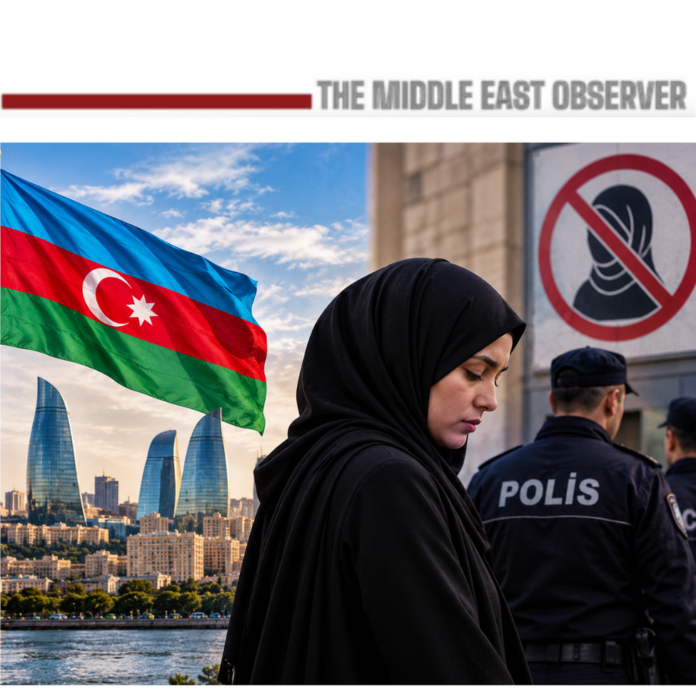
Azerbaijan guarantees compulsory education, freedom of conscience and the separation of religion from the state. Yet schoolgirls wearing Islamic headscarves are being turned away from classrooms under new regulations intended to preserve secular education. The contradiction raises a fundamental question: can a state defend religious neutrality by restricting the religious freedom of its citizens?
The dispute intensified on 12 October, when schools began enforcing dress regulations that prohibit clothing deemed incompatible with secular education. Although the rules do not explicitly name the hijab, some schools have interpreted them as grounds for excluding pupils and teachers who wear it.
The restrictions have triggered demonstrations, arrests and international criticism. On 16 October, Amnesty International called for affected pupils to be readmitted, describing the exclusions as discriminatory.
Azerbaijan is entitled to maintain a secular education system. It is also entitled to prevent religious indoctrination, political interference and coercion within schools. But those legitimate responsibilities do not automatically justify excluding children because of their religious clothing.
The distinction matters far beyond Azerbaijan. At stake is whether secularism protects the freedom of citizens to hold different beliefs or becomes an instrument through which governments regulate their personal expression.
Secular institutions, free citizens
Azerbaijan’s constitution offers a framework for resolving the dispute.
Article 18 separates religion from the state, establishes equality among religions and requires public education to be secular. Article 42 guarantees free compulsory secondary education. Article 48 protects freedom of conscience, including the right to practise a religion, reject religion and express religious beliefs.
These guarantees must be read together. None can be treated as though the others do not exist.
A secular school is an institution in which the state does not impose religious doctrine. Its curriculum, administration and educational standards should remain independent of religious authorities. Teachers should not compel pupils to adopt religious beliefs, and students should be protected from discrimination based on faith.
But the religious identity of a pupil is not equivalent to religious control of an institution.
A Muslim girl wearing a headscarf does not thereby turn her school into a religious establishment, any more than a Sikh pupil wearing a turban or a Jewish student wearing a kippah converts public education into an instrument of their faith.
The constitutional issue is not whether religious expression may ever be regulated. Restrictions can be justified in particular circumstances involving safety, identification or the rights of others. The question is whether the mere presence of a headscarf establishes a sufficiently serious problem to justify denying a child access to education.
Azerbaijan has yet to demonstrate why such exclusion is necessary.
National security is not a dress code
The government’s concerns deserve examination rather than dismissal.
Azerbaijan borders Iran, whose political system gives religious institutions substantial authority over government. Baku has longstanding reasons to scrutinise foreign political influence and activities that could threaten its institutional independence.
A government may reasonably seek to prevent extremist recruitment, religious intimidation or foreign-directed political activity in schools. It also has a legitimate interest in maintaining common educational standards.
However, a religious symbol cannot be treated as evidence of political allegiance without additional grounds.
Wearing a hijab does not establish support for Iran, political Islam or any foreign government. A pupil’s religious observance is not proof of involvement in unlawful activity.
Where authorities have evidence of coercion, recruitment or foreign interference, they should investigate the conduct concerned and apply the law to those responsible. Treating ordinary religious expression as a security concern risks confusing personal conviction with political activity.
It may also produce the opposite of the intended result. Excluding girls from school can deepen grievances, undermine confidence in public institutions and create opportunities for political movements to exploit perceptions of discrimination.
A state’s security is better protected by evidence-based enforcement than by broad assumptions about religious identity.
Protecting girls must mean protecting their choices
Another argument advanced in favour of restrictions concerns the possibility that girls may be pressured by their families or communities to wear religious clothing.
This concern is legitimate. Children must be protected against coercion, including coercion exercised in the name of religion.
But a prohibition does not establish that a girl is acting freely. It may simply replace pressure to cover her hair with pressure to uncover it.
The principle of individual autonomy requires protection in both directions.
A girl who chooses to wear a hijab should not be excluded solely because of that choice. A girl who rejects the hijab must likewise be protected against intimidation or punishment. Neither family authority nor state authority should extinguish her ability to develop and express her own convictions.
The problem becomes particularly serious when the sanction is exclusion from education.
If a family refuses to permit its daughter to attend school without a headscarf, barring her from the classroom may leave the child bearing the consequences of a conflict between adults and the state.
Rather than increasing her independence, the restriction may reduce her contact with teachers, educational opportunities and institutions capable of supporting her rights.
A government genuinely concerned about girls’ autonomy should prioritise keeping them in education, providing confidential support where coercion is suspected and ensuring that pupils can make choices without threats from either religious or secular authorities.
What international law actually permits
Secular democracies do not follow a single approach to religious clothing.
The United States generally protects students’ voluntary religious expression in public schools while restricting government endorsement of religion. France takes a more restrictive approach, prohibiting conspicuous religious symbols in public primary and secondary schools under legislation adopted in 2004.
European human-rights jurisprudence has permitted certain restrictions on religious dress, including in educational settings. Such rulings demonstrate that religious freedom is not absolute and that states have some discretion in balancing competing rights.
They do not establish that secular education necessarily requires a prohibition on religious head coverings.
The European Convention on Human Rights protects freedom of religion under Article 9, while allowing legally prescribed restrictions that are necessary in a democratic society for specified legitimate purposes. Azerbaijan is a party to the Convention.
The decisive legal questions therefore concern the basis, objective and proportionality of the restrictions.
Does the measure pursue a legitimate aim? Is there evidence that the clothing itself threatens that aim? Could reasonable accommodation achieve the same result without excluding children from compulsory education?
These questions are especially important where the disputed regulations do not explicitly identify the religious garment being prohibited, leaving substantial discretion to school administrators.
International law does not provide a simple answer that invalidates every restriction. It does, however, require a more rigorous justification than the assertion that a school is secular.
Education should not become the casualty
The economic implications reinforce the constitutional argument.
Education develops the skills, independence and future earning capacity of individuals. For girls in particular, sustained access to schooling can expand employment opportunities, strengthen financial autonomy and improve long-term social mobility.
Excluding pupils over religious dress risks interrupting those gains. It may also impose costs on families and public institutions if students miss examinations, require alternative arrangements or fall behind academically.
The scale of these consequences in Azerbaijan remains uncertain. There is insufficient independently verified information about how many pupils have been excluded, how long they have missed classes or whether the restrictions will persist.
Those gaps should be addressed through transparent reporting by education authorities.
Nevertheless, the policy raises an obvious development question: why should a state seeking to strengthen its human capital create additional barriers to girls’ participation in education when less restrictive alternatives are available?
A dress regulation should not become an obstacle to the very educational opportunity the state is constitutionally obliged to provide.
The democratic alternative
Azerbaijan does not need to abandon secularism to resolve this controversy. It needs to distinguish the legitimate authority of public institutions from unnecessary interference with individual conscience.
Schools can maintain standard uniforms while allowing reasonable accommodation for religious head coverings that do not prevent identification, compromise safety or interfere with essential educational activities.
Authorities can enforce prohibitions on intimidation, religious recruitment and coercion without assuming that every visible expression of faith constitutes such conduct.
Disputes should be subject to transparent review, with uninterrupted access to education while complaints are examined.
The government must also distinguish peaceful protest from violence. Amnesty International reported that 37 people were detained in Baku on 12 October, according to the Interior Ministry, while activists reported higher figures. Some demonstrations involved alleged violence, including an attempted attack on a school. Such allegations warrant investigation, but peaceful dissent should not be criminalised because others resort to unlawful conduct.
These measures would protect the secular character of education while respecting the constitutional freedoms of pupils and families.
The larger principle is straightforward. Secularism should prevent religious institutions from imposing their authority on the state. It should not become a justification for the state to impose unnecessary restrictions on personal religious practice.
A democracy must protect citizens who believe, those who do not and those whose convictions differ from the majority. Its credibility rests not on eliminating those differences but on governing fairly despite them.
Related news:
The 7 keys of Being a Moderate Muslim integrating Positively in Diversified Cultures & Communities
El-Sisi Advances Human Capital Strategy Through Health, Education, Research and Innovation
Red also:
Malala Yousafzai to be key speaker at Sharjah’s IFFMENA Conference
Rights not charity, disability measures after the 30th of June revolution