

Türkiye secures development-bank backing and advances Saudi renewable projects and regional electricity links, while negotiators remain divided over funding obligations.
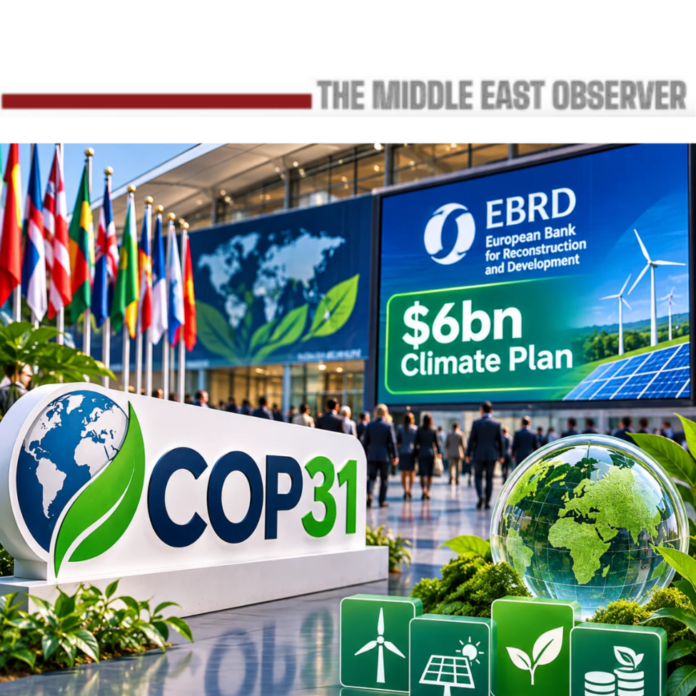
The European Bank for Reconstruction and Development (EBRD) plans to invest $6bn in Türkiye’s clean-energy transition over five years, leading a series of financing agreements and renewable-energy partnerships announced at COP31 as governments struggle to agree on climate-funding obligations to developing countries.
The 31st UN Climate Change Conference, running from November 9 to 20 in Antalya, has brought together government leaders, negotiators, development banks and businesses to accelerate implementation of the Paris Agreement. Türkiye is presiding over the conference, with Environment Minister Murat Kurum serving as COP president and Australia’s Climate Change and Energy Minister Chris Bowen chairing negotiations.
Other major developments through November 12 include a $1.6bn climate-financing agreement with the Asian Infrastructure Investment Bank (AIIB), a 5-gigawatt Saudi–Turkish renewable-energy partnership, a proposed electricity corridor linking Azerbaijan to European markets and agreements among international climate-finance institutions.
Saudi Arabia has also announced the opening of what King Abdullah University of Science and Technology (KAUST) describes as the world’s largest coral restoration facility on the Red Sea.
The announcements highlight growing efforts to turn climate commitments into investment. But they also expose a widening distinction between announced financing ambitions and capital available for projects, particularly in developing economies facing high borrowing costs.
Türkiye targets $300bn in clean-energy investment
The EBRD announced on November 11 that it plans to invest $6bn over five years through Türkiye’s Renewable Energy Acceleration and Clean Transition Platform (REACT).
Launched during COP31, the platform aims to mobilise $300bn in public and private investment by 2040 across renewable generation, transmission networks, energy storage, manufacturing and electrification.
Supported by Türkiye’s government, the EBRD, European Union, World Bank Group and other development partners, REACT is intended to help the country reach 175GW of installed wind and solar capacity by 2040.
The initiative comes as Türkiye faces an estimated $68bn in additional climate-investment requirements by 2030, approximately half of which is expected to come from private sources, according to Reuters.
Meeting those requirements will depend on developing commercially viable projects, expanding grid capacity and providing the regulatory stability needed to attract long-term investors.
Türkiye’s reliance on imported fossil fuels makes energy security another important consideration. Expanding domestic renewable generation could reduce exposure to international fuel-price volatility, although the financial benefits will depend on infrastructure costs and the pace of deployment.
The EBRD has invested more than €26bn in Türkiye historically, largely in the private sector.
Its planned $6bn investment under REACT is distinct from the platform’s $300bn mobilisation target, which is neither fully financed nor committed.
A separate Türkiye Industrial Decarbonisation Investment Platform, launched in September, aims to mobilise €5bn by 2030 for steel, cement, aluminium and fertiliser production.
Developed with international financial institutions, the programme targets annual emissions reductions exceeding 20mn tonnes through cleaner industrial processes.
Both platforms reflect growing pressure on exporters to reduce carbon emissions, particularly as the European Union’s Carbon Border Adjustment Mechanism increases the commercial importance of cleaner production.
AIIB agrees $1.6bn climate-policy financing
The AIIB has agreed to provide $1.6bn in sovereign financing to support Türkiye’s Climate Action Acceleration Program, targeting reforms in carbon pricing, sustainable finance, industrial decarbonisation and climate resilience.
Approved on October 22 and announced during COP31, the package comprises an $800mn core programme and $800mn in supplemental financing.
Unlike loans for individual infrastructure projects, the programme supports regulatory and institutional reforms intended to encourage wider investment.
Its performance targets include emissions reporting by at least 180 industrial facilities by April 2027, licensing 1,800MW of renewable capacity, and helping 225,000 farmers adopt less water-intensive crops.
The programme also aims to designate 50,000 hectares as carbon sinks by 2028.
These are implementation targets, not outcomes already achieved.
The financing supports Türkiye’s Climate Law and its commitment to reach net-zero emissions by 2053. Its effectiveness will depend on whether policy reforms attract investment and translate into measurable improvements in energy efficiency, industrial emissions and climate resilience.
Saudi Arabia and Türkiye advance 5GW renewable partnership
Saudi Arabia and Türkiye signed a memorandum of understanding on November 10 to advance renewable-energy projects with a planned combined capacity of 5GW.
The agreement, signed in the presence of Turkish President Recep Tayyip Erdoğan, builds on a bilateral framework concluded in February 2026.
Saudi developer ACWA is designated to implement the programme in two phases.
The first comprises two solar plants at Sivas and Taşeli, each with a capacity of 1GW. The projects represent approximately €1.6bn in estimated investment and are expected to begin operating in 2029.
A second phase envisages another 3GW of renewable generation, including wind power supported by battery storage and high-voltage transmission infrastructure.
On November 11, eight international financial institutions signed a letter supporting financing for the initial solar projects.
The signatories were the Asian Development Bank, AIIB, EBRD, International Finance Corporation, Islamic Development Bank, Germany’s DEG, Société Générale and Standard Chartered.
ACWA expects the plants to supply electricity equivalent to the requirements of more than 1.3mn households and avoid approximately 1.65mn tonnes of carbon dioxide emissions annually once operational.
The financing letter indicates lender support but does not constitute financial close. Individual lending commitments, the final capital structure and binding financing terms have not been disclosed.
The programme illustrates the growing role of Gulf developers in international renewable-energy investment and the importance of connecting bilateral agreements with commercially viable projects.
Four countries agree on electricity corridor to Europe
Azerbaijan, Georgia, Türkiye and Bulgaria signed an intergovernmental agreement on November 10 to develop a clean-electricity corridor linking the Caspian region with European markets.
The agreement covers cross-border transmission, electricity trading, supply security and related communications infrastructure.
Georgian officials have indicated that the corridor could provide approximately 2GW–3GW of transmission capacity, with national transmission operators expected to participate in a project-development joint venture.
The proposed route could diversify electricity export markets and strengthen regional energy security, extending established energy links between the Caspian region, Türkiye and Europe.
However, the capacity estimate remains preliminary. Final engineering specifications, construction costs, financing arrangements and completion dates have yet to be established.
The agreement is therefore a strategic development framework rather than a fully financed infrastructure project.
Development banks expand climate-finance partnerships
The OPEC Fund for International Development announced three institutional agreements at COP31, including cooperation with the Asian Development Bank, New Development Bank and partners supporting Kazakhstan’s energy transition.
Under its agreement with the Asian Development Bank, the OPEC Fund has earmarked up to $1bn over five years for development and climate-related investment.
It also signed its first cooperation memorandum with the New Development Bank and joined the EBRD, AIIB and Kazakhstan in an agreement supporting the country’s energy transition.
The European Investment Bank (EIB), meanwhile, is promoting its climate-adaptation programme targeting at least €30bn in financing between 2026 and 2030.
First announced in October, the programme covers resilient infrastructure, water systems, agriculture, energy networks and urban development across eligible markets.
The amounts represent different financial commitments and timeframes. The EIB programme is not a new €30bn commitment exclusively to Türkiye, while the OPEC Fund’s $1bn envelope represents prospective financing over five years.
Climate funds seek to attract private capital
The Green Climate Fund (GCF) and the Swedish International Development Cooperation Agency signed a memorandum on November 11 to expand the use of guarantees designed to attract private investment into developing-country climate projects.
The arrangement combines GCF concessional capital with Swedish government-backed guarantees intended to reduce investment risks and improve financing terms.
The GCF said its existing $7.18bn private-sector portfolio had mobilised $32.15bn in additional co-financing. These are cumulative portfolio figures rather than new COP31 commitments.
In a separate initiative announced on November 10, the GCF and Adaptation Fund introduced a framework to help successful adaptation projects move from smaller programmes to larger investments.
Solomon Islands also announced a $400,000 pledge on November 12 to the GCF’s next replenishment cycle, becoming the first small island developing state or least developed country to make such a contribution.
The developments reflect attempts to stretch limited public climate finance by attracting commercial capital. But guarantees and concessional lending cannot eliminate the currency, regulatory and fiscal risks that often deter investment in vulnerable economies.
Saudi Arabia opens large-scale Red Sea coral restoration facility
Saudi Arabia’s King Abdullah University of Science and Technology announced on November 11 the opening of what it describes as the world’s largest coral restoration facility.
Located on the Red Sea coast, the KAUST Coral Restoration Initiative is designed to cultivate up to 360,000 corals annually and transplant more than two million corals across 100 hectares around Shushah Island by 2030.
The programme aims to support a more resilient reef ecosystem by 2040, combining marine biotechnology, coral cultivation, robotics, artificial intelligence and environmental monitoring.
Its launch follows the most extensive global coral bleaching event recorded.
According to the US National Oceanic and Atmospheric Administration, approximately 84.4% of the world’s coral reef area experienced bleaching-level heat stress between January 2023 and September 2025.
NOAA said in June 2026 that the event probably ended in 2025. The figure measures reef area exposed to damaging heat stress, not the proportion of reefs that died.
KAUST’s programme represents a large-scale test of coral restoration technology, with implications for marine biodiversity, fisheries and coastal tourism across the Red Sea.
Its success will depend on long-term coral survival and the ability of restored ecosystems to withstand recurring marine heatwaves.
Electrification and industrial efficiency gain prominence
The COP31 presidency is promoting a voluntary initiative to increase electricity’s share of global final energy consumption to 35% by 2035.
The 35-by-35 Global Electrification Pledge seeks to accelerate electricity use in transport, buildings and industry while expanding clean generation and grid infrastructure.
The presidency is also advancing the Antalya Compact for Energy Efficient Buildings, targeting a 25% reduction in buildings’ operational energy intensity by 2035 compared with 2020.
Other initiatives address artificial intelligence, industrial efficiency, circular-economy policies and waste reduction.
Electrification, however, does not automatically reduce greenhouse-gas emissions. Its impact depends on the electricity-generation mix and the pace at which low-carbon sources replace fossil fuels.
Rising demand from industry, cooling systems and artificial-intelligence data centres makes investment in cleaner generation and transmission infrastructure increasingly important.
Climate negotiations remain divided over finance
While governments and financial institutions announce investment initiatives, formal COP31 negotiations remain divided over climate-finance obligations, emissions reductions and implementation mechanisms.
According to the International Institute for Sustainable Development’s Earth Negotiations Bulletin, discussions on November 11 covered the future of the Just Transition Work Programme, the global stocktake and financing for cooperative carbon-market arrangements under Article 6.2 of the Paris Agreement.
Delegates have expressed broad support for continuing the just-transition programme beyond 2026, although details of its institutional arrangements remain unsettled.
Developing-country groups continue to seek predictable, affordable finance and technical support for adaptation and emissions reductions.
Disputes remain over the scope of financial obligations, implementation arrangements and how progress should be assessed.
The formal negotiating agendas have been adopted, but the principal substantive decisions remain outstanding.
The conference is scheduled to conclude on November 20. Agreements signed by individual governments, companies and development banks do not constitute decisions collectively adopted under the UN climate convention.
Egypt seeks affordable finance and stronger adaptation support
Egypt is participating in the COP31 Leaders’ Summit through Minister of Local Development and Environment Manal Awad, representing President Abdel Fattah El-Sisi.
According to Egypt’s State Information Service, Awad has called for accelerated clean-energy deployment, affordable climate finance, support for adaptation and stronger assistance to countries facing climate-related losses and damage.
Egypt is also participating in African ministerial consultations, Developing Eight discussions and meetings with international development partners.
The investment announcements in Antalya have implications for Egypt’s renewable-energy expansion, electricity infrastructure, industrial competitiveness and climate resilience.
Türkiye’s REACT platform illustrates how governments can coordinate development banks, regulatory reforms and private investment around national energy priorities.
Investment ambitions face the test of delivery
COP31’s opening days have demonstrated a growing emphasis on financing the infrastructure, technology and institutional reforms needed to implement climate commitments.
Türkiye’s planned $6bn EBRD investment programme and $1.6bn AIIB financing package provide substantial institutional backing, while Saudi renewable projects and regional electricity agreements point towards expanding cross-border energy cooperation.
Climate-fund partnerships and scientific initiatives, including KAUST’s coral restoration programme, extend that effort to adaptation and biodiversity.
Yet the financial picture remains uneven.
Approved loans, planned investments, strategic memoranda and long-term mobilisation targets represent different stages of commitment. Their economic significance will depend on whether they produce binding financing agreements, completed projects and measurable results.
As negotiations continue towards November 20, governments must also address disagreements over the availability, affordability and responsibility for climate finance.
Antalya’s longer-term significance will depend less on the headline value of its investment ambitions than on how much capital ultimately reaches projects — and whether those projects deliver measurable economic and environmental results.
Related News:
Oman Advances $1bn Solar Expansion with Adam and Sinaw Projects
AI Competes With Europe for Both Capital and Electricity
Read Also:
The War of Narratives and the Redefinition of Power Dynamics in the Gulf