

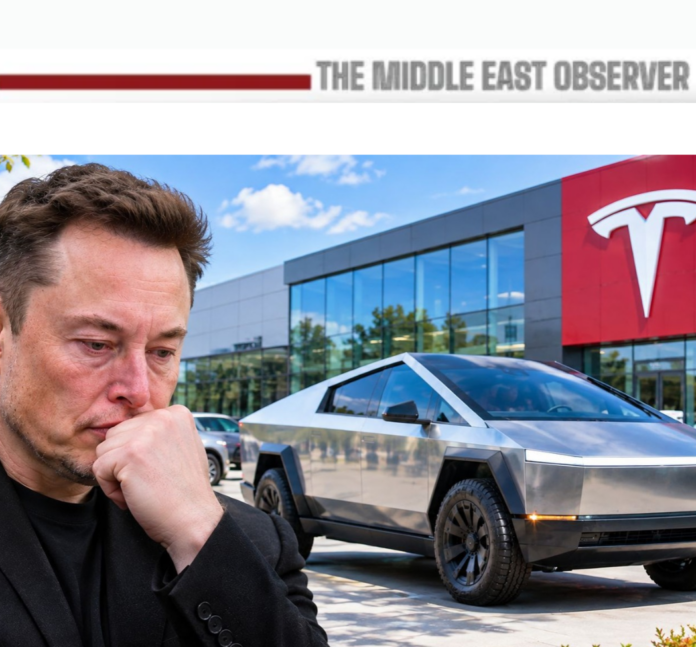
Tesla will wind down Cybertruck production at its Texas Gigafactory by mid-2027 after disappointing sales, CEO Elon Musk announced on November 6, redirecting manufacturing capacity towards its autonomous Cybercab as the company shifts its focus from electric vehicles to artificial intelligence and robotaxis.
The decision marks a major retreat from a project Musk once expected to sell 250,000 vehicles annually and raises a central financial question: whether autonomous transport can generate stronger returns than Tesla’s conventional vehicle business.
Musk said the Cybertruck production line would be dismantled around June or July 2027 to expand Cybercab output. Tesla has not confirmed whether manufacturing will move elsewhere, although its Austin plant is the only known facility equipped to produce the pickup’s specialised stainless-steel components.
Tesla plans to add a production shift to fulfil outstanding orders before the conversion. On November 9, Musk said the order rate exceeded remaining manufacturing capacity and warned that many customers would receive deposit refunds.
The claim contrasts with the Cybertruck’s weak sales record. US deliveries fell 48% to 20,237 vehicles in 2025 from 38,965 in 2024, according to Kelley Blue Book, far below Musk’s earlier ambitions.
The figures are not necessarily contradictory. Reduced production and a possible surge in orders following the shutdown announcement could explain the imbalance. However, Tesla has not disclosed its current backlog or the number of expected refunds, leaving the scale of renewed demand unclear.
Musk rejected suggestions that the Cybertruck was being discontinued because it was unprofitable, arguing instead that additional Cybercab production offered greater economic value.
That reasoning puts capital allocation at the centre of Tesla’s strategy. The Cybertruck requires specialised manufacturing processes, while Cybercab is intended to generate recurring revenue through autonomous passenger services. Tesla has not disclosed sufficient programme-specific costs or margins to establish which offers higher returns.
The Cybertruck, launched commercially in late 2023 after its 2019 unveiling, struggled with high prices, unconventional design and repeated recalls. Reuters reported 11 recalls since deliveries began, including defects addressed through software updates and physical repairs. A March 2025 recall affected approximately 46,000 vehicles over the risk of an exterior panel detaching.
Its rigid stainless-steel structure also restricted international expansion, particularly in Europe, where pedestrian-safety requirements prevented approval.
Former Aston Martin CEO Andy Palmer told Reuters that continuing production made little commercial sense when the vehicle was missing its targets. Automotive analyst Felipe Munoz noted that competing electric pickups had also struggled, suggesting weaker demand across the segment.
Despite those challenges, Tesla introduced the Cybertruck in selected Gulf markets, opening orders in the UAE and Saudi Arabia in 2025 before extending availability to Qatar.
The production wind-down raises questions about outstanding regional orders and future vehicle availability. Tesla has not disclosed how many Gulf customers may be affected, while the announcement does not establish any change to existing warranty, servicing or spare-parts obligations.
Tesla’s replacement strategy centres on the Cybercab, a two-seat autonomous vehicle without conventional steering controls or pedals. Limited commercial operations began in Austin in September 2026, but the programme remains at an early stage.
Tesla has reported installed Cybercab production capacity exceeding 125,000 vehicles annually. That represents potential manufacturing output, not actual production, passenger demand or profitability.
Robotaxi economics depend on fares, fleet utilisation, maintenance, insurance, charging and depreciation. Tesla has not published sufficient Cybercab-specific financial data to demonstrate that the service can generate sustainable returns at scale.
Regulation remains another obstacle. The US National Highway Traffic Safety Administration opened an audit in September examining Cybercab’s compliance with federal vehicle safety standards, while Alphabet-owned Waymo already operates a more established commercial robotaxi network.
The Cybertruck decision forms part of Musk’s broader push towards autonomous vehicles and robotics, including Tesla’s Optimus programme, as competition intensifies in the electric-vehicle market.
For investors, the central question is whether Cybercab can achieve the commercial scale and profitability needed to justify redirecting manufacturing resources away from the Cybertruck.
Related News:
1. BYD Surpasses Tesla with Breakthrough L4 Autonomous Parking Technology
2. El Nasr Launches Dongfeng EV With 45% Local Content
Read Also:
1. Volkswagen Evaluates East Port Said as Future Electric-Car Hub
2. Egypt’s X-GEN Targets EGP5bn Investment to Localise Drone and Robotics Production