

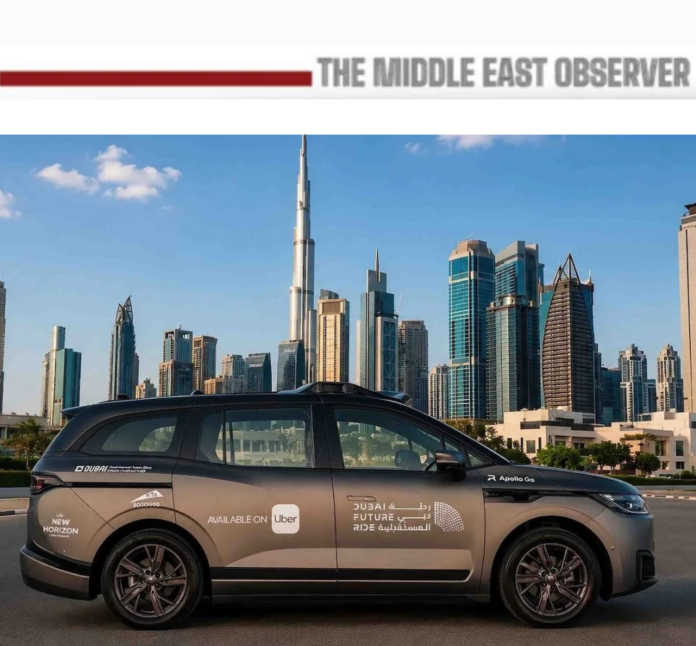
Uber expects to deploy nearly 200 fully driverless taxis in the United Arab Emirates by the end of 2026, accounting for approximately 29% of its projected global autonomous fleet as the US ride-hailing company expands commercial services in Dubai and Abu Dhabi.
The UAE target was confirmed in Uber’s prepared management remarks accompanying its November 4 third-quarter earnings results. The company expects approximately 700 fully driverless vehicles on its platform worldwide by December, rising to more than 2,000 by the end of 2027.
Uber expects its 2027 autonomous fleet to be split roughly evenly between the United States and international markets, reflecting its strategy of expanding driverless services through partnerships with autonomous-driving technology companies.
The UAE has become an important market for Uber’s autonomous operations. In March, Uber and China’s WeRide launched fully driverless, fare-charging robotaxi services in Dubai’s Jumeirah and Umm Suqeim districts, following an earlier supervised trial.
The service operates without a human driver or vehicle operator on board, with vehicles available through the Uber app in partnership with Dubai’s Roads and Transport Authority (RTA).
Uber expanded its Dubai offering in August by introducing Baidu’s Apollo Go autonomous vehicles through its platform, initially serving selected areas of Jumeirah and Umm Suqeim.
In Abu Dhabi, Uber operates fully driverless commercial services through its partnership with WeRide, which has secured regulatory approval for autonomous operations in the UAE.
Uber also works with Chinese autonomous-driving company Pony.ai as part of its broader international network. The company identified WeRide, Baidu and Pony.ai as partners already operating fully driverless services, without indicating that all three currently provide commercial services in the UAE.
The expansion forms part of a wider partnership between Uber and WeRide to deploy at least 1,200 robotaxis across Abu Dhabi, Dubai and Riyadh, potentially as early as 2027, subject to regulatory approvals and operational milestones.
Uber is seeking to use its established ride-hailing network to increase the commercial utilisation of autonomous vehicles. In its earnings remarks, the company said autonomous vehicles operated by its US partners complete approximately 30% more trips per vehicle per day on its platform than comparable first-party deployments nationwide.
Higher vehicle utilisation could improve fleet economics by spreading fixed costs across more paid journeys, supporting Uber’s strategy of scaling autonomous transport through partnerships rather than relying exclusively on conventional driver-operated services.
The expansion comes as Uber faces pressure from the Middle East conflict. The company said regional tensions reduced third-quarter gross bookings growth by 75 basis points and expects a 100-basis-point impact in the fourth quarter following renewed escalation during the busy travel season.
Elevated fuel costs, tighter labour conditions and competition for drivers have also constrained Uber’s ability to meet demand in several international markets.
Uber’s UAE deployment target highlights the country’s growing role in the commercial rollout of autonomous transport, while the company’s broader expansion will depend on regulatory approvals, fleet performance and its ability to operate driverless services at scale.
Related News:
1. Uber Streamlines Global Operations as $15bn Delivery Hero Deal Advances
2. Dubai to Launch Air Taxi Service in 2026