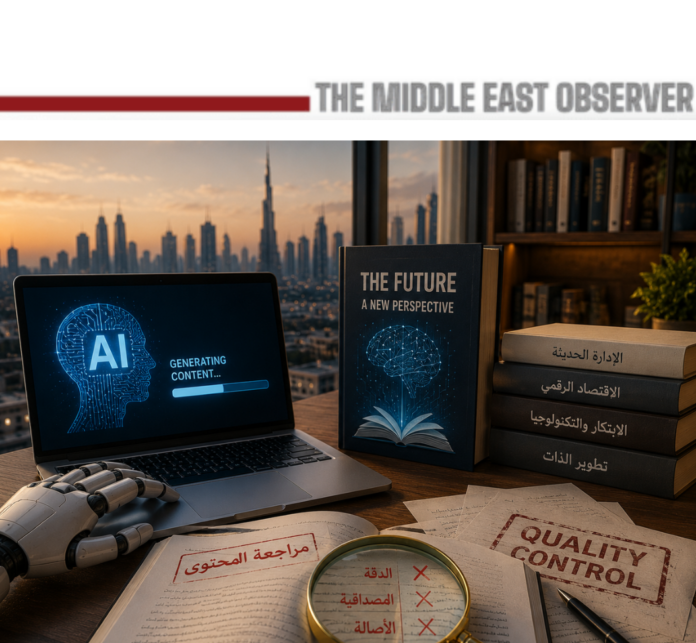
Generative AI is cutting the cost of writing, translation and production across the Arab book industry. The harder question is who verifies the result — and whether trust can become publishing’s new competitive advantage.
A controversy over apparently AI-generated books at the 2026 Cairo International Book Fair exposed a problem publishers increasingly face: artificial intelligence can produce books faster and more cheaply, but it cannot assume responsibility for what reaches the reader.
Images circulated during the fair showing passages that appeared to contain residual chatbot instructions. The episode triggered criticism over authorship and editorial standards, although no publicly documented forensic assessment has established precisely how much of the disputed material was produced by AI.
The larger question is more consequential than any one book: who is accountable when AI allows publishers to produce faster than they can verify?
As AI drives down the cost of producing text, publishing’s scarce commodity may no longer be content but trust.
Artificial intelligence was among the issues discussed at the Cairo fair by the International Publishers Association alongside Mohamed Rashad, president of the Arab Publishers Association. Rashad has argued that using AI in publishing is not inherently problematic, while raising concerns about intellectual-property infringement.
The commercial attraction is straightforward. Generative AI can cut the time and cost involved in drafting, translation, copy-editing, design, metadata and marketing — particularly attractive to smaller publishers producing Arabic and multilingual editions on narrow margins.
But those same economics create an incentive to cut the human controls needed to catch factual errors, mistranslations and rights violations — precisely as verification becomes more valuable.
Translation illustrates the bargain particularly clearly.
AI can generate first drafts, terminology lists and parallel-text comparisons, accelerating work on technical documents, scientific material and large archives. For Arabic publishing, that offers the prospect of expanding the volume of material translated both into and from Arabic.
But productivity gains are already raising labour-market questions.
A 2025 survey of Jordanian translation agencies found respondents reporting reductions of 40–70 per cent in translator employment after adopting AI. The relatively small sample means the finding should not be extrapolated across the Arab world.
The limitations become clearer in literature. A 2026 preprint examining literary translation in a Yemeni context, involving 30 professional translators, found that AI accelerated translation and improved accessibility but continued to require substantial human intervention for cultural references, literary style and figurative language.
The implication is less a contest between humans and machines than a redistribution of work.
AI is strongest at scale, repetition and first-pass processing. Domain specialists remain important for technical accuracy; literary translators for voice, metaphor and cultural meaning; editors for coherence and verification; and publishers for rights, attribution and accountability.
That hybrid model could also make limited translation budgets go further. Sharjah Book Authority selected 154 titles for its Translation Grant in 2026, up 56 per cent from 99 a year earlier, against an annual allocation of $300,000.
In principle, AI-assisted first drafts could allow such funding to support more titles, provided savings were redirected towards professional editing, specialist review and rights clearance.
Copyright law adds another uncertainty: existing frameworks were largely designed around human creative activity and offer no uniform regional answer to autonomous AI output.
For publishers, that uncertainty strengthens the case for documenting meaningful human creative involvement. Publishers trade partly on trust, with readers, authors and booksellers assuming that someone has accepted responsibility for the accuracy, provenance and legality of material carrying an imprint.
AI makes that chain harder to see.
An AI Publishing Passport?
One possible response is an “AI publishing passport”: a standardised production record identifying significant use of generative AI and the people responsible for the finished work.
It would certify neither quality nor authorship; its purpose would be traceability.
A copyright or disclosure page could identify whether generative AI played a significant role in drafting, translation or illustration; name the human editor or translator responsible for the finished work; and record whether factual verification and rights clearance were completed.
Such disclosure would leave publishers free to experiment with technology while giving readers greater visibility into how a book was produced.
It could also acquire commercial value. As synthetic content becomes cheaper and more abundant, established publishers may increasingly compete on something AI cannot manufacture cheaply: a reputation for editorial judgement. Provenance and verification could become part of the premium attached to a trusted imprint.
The lesson from Cairo is not that publishers should reject AI. Its productivity gains are real; the challenge is ensuring that efficiency does not erase accountability.
The cheaper it becomes to produce words, the more valuable it becomes to prove who stood behind them.
Related news:
Khaled Abdelghaffar Inagurates EIPICO 3 factory
The Translation Machine: How Language is Becoming Currency in Egypt’s Digital Economy
Read also:
Arab League Advances AI Integration Through Strategic Training Programme