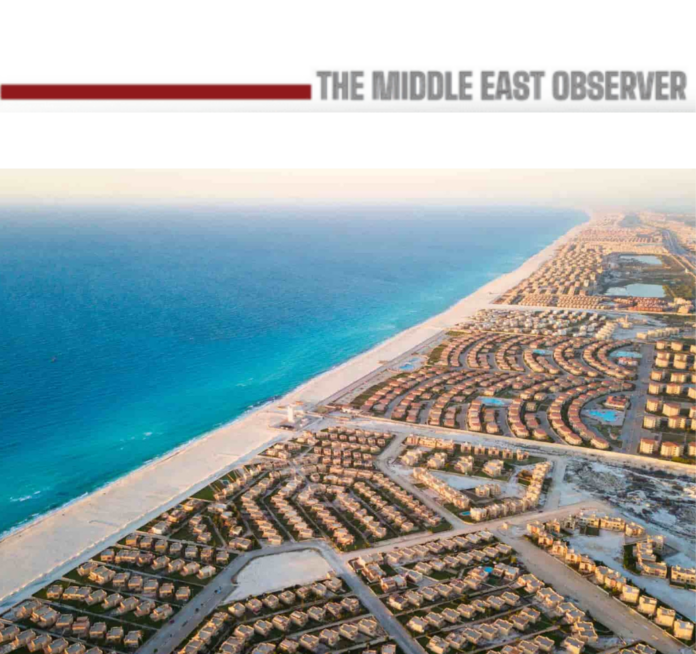
Egypt has learned how to sell the summer. Its next challenge is creating a North Coast economy that still works in January.
Egypt’s tourism industry entered 2026 after a record year. The country welcomed about 19 million tourists in 2025, up roughly 21%, while arrivals rose another 7% to 6.1 million in the first four months of 2026.
But the North Coast presents a different economic challenge. A destination can be full in August without having a functioning economy in February.
The financial question is whether billions of dollars flowing into coastal property and infrastructure can produce recurring economic activity, rather than assets whose utilisation peaks for a few weeks each summer.
The scale of property demand is already extraordinary. Industry estimates cited by Ahram Online put North Coast transactions at nearly EGP 1.2 trillion across 2024 and 2025, equivalent to about 36% of Egypt’s total property sales over the period.
That demonstrates a substantial market for owning the Coast. It does not yet prove there is an equally durable market for using it year-round.
The Real Test Begins After September
The government wants the North Coast to evolve from a seasonal retreat into a year-round tourism, residential and economic destination.
Private investment is moving in that direction. Emaar Misr’s Marassi combines hotels, residential property, a marina, retail, sports and entertainment. Palace Beach Resort Marassi, inaugurated in August 2025 with an estimated investment of EGP 9 billion, added another large hospitality asset.
Developers are increasingly designing projects around year-round use rather than seasonal occupation. But the development pipeline is becoming year-round faster than the demand profile.
Hotels can approach full occupancy during peak summer, while activity falls sharply outside the holiday months. Climate reinforces the problem. Unlike Hurghada and the Red Sea, Egypt’s Mediterranean coast does not offer the same winter-sun proposition.
Extending its economic season therefore requires demand that does not depend on beach weather: universities, conferences, business activity, healthcare, sports, culture, entertainment and permanent residency.
New Alamein: The First Test
New Alamein is Egypt’s clearest test case.
The city extends across almost 49,000 feddans along 14 kilometres of Mediterranean coastline. Government figures show 28 residential towers, 46,189 housing units and about 2,000 hotel units. Three universities operate year-round, alongside healthcare, education, commercial and conference facilities.
But 46,189 housing units do not mean 46,189 permanent households.
A functioning city is not measured simply by the property built, but by whether residents and institutions generate enough daily demand to support teachers, doctors, retailers, restaurants, transport operators, offices and service companies throughout the year.
The data gap is itself significant. Egypt publishes extensive measures of what has been built on the Coast, but far fewer indicators showing permanent residency, winter hotel occupancy, retail footfall or how intensively these assets perform outside summer.
The unanswered question is therefore not whether New Alamein has urban assets. It is how intensively they are used once summer ends.
That is the difference between a property development and a city.
It also matters for Egypt’s wider investment model. Selling coastal land and property can generate substantial upfront capital. A functioning city can produce recurring tourism receipts, employment, consumption, taxes and foreign exchange.
For Egypt, that distinction is particularly important: coastal land deals can deliver large one-off foreign-currency inflows, while successful year-round destinations can generate recurring foreign-exchange earnings.
Ras El Hekma Raises the Stakes
Ras El Hekma takes the experiment to another scale.
WATG, an adviser on the project’s hospitality strategy, says Ras El Hekma is planned for more than one million people across 17 precincts, with nearly 30 hotels. Seven are planned within Wadi Yemm, its first-phase resort district.
The development follows Egypt’s landmark $35 billion agreement with the UAE in 2024, a transaction that delivered a major foreign-currency injection during a severe FX shortage and helped change the country’s immediate financing position.
The investment wave extends beyond Ras El Hekma. Qatari Diar announced a $29.7 billion Mediterranean development, including a $3.5 billion upfront payment, reinforcing the North Coast’s emergence as a destination for Gulf state-backed capital.
Together, the projects raise the stakes. Egypt has demonstrated that its Mediterranean coastline can attract sovereign-scale investment. The harder test is converting exceptional land values and development capital into sustained economic output.
At this scale, seasonality becomes more than a tourism problem. It becomes an urban and financial one.
Housing alone cannot sustain cities of this ambition. They require schools, healthcare, offices, retail, entertainment, transport, public services and, critically, permanent employment.
The investment test is whether large upfront capital commitments eventually produce recurring economic activity — and whether coastal development can generate durable tourism receipts, jobs and foreign exchange rather than relying primarily on land and property sales.
Can Connectivity Change the Calendar?
Air connectivity could become one of the strongest tools for reducing the North Coast’s dependence on domestic summer traffic.
Egypt’s Ministry of Civil Aviation estimates that El Alamein International Airport will handle about 266,600 passengers in 2026, up 57% from about 169,500 in 2025. Aircraft movements are projected to rise 26% to roughly 3,190, while the number of airlines serving the airport is expected to increase from 15 to about 26 by the end of the summer season.
That expansion matters because international links can diversify a market historically dependent on Egyptian and regional summer visitors.
But connectivity alone cannot solve seasonality.
The more important question is whether El Alamein can support regular international services outside peak months — and whether hotels, conferences, events and other attractions can give travellers sufficient reason to use them.
An airport can provide access. It cannot manufacture demand.
The Red Sea Lesson
Egypt already has a domestic example of a tourism economy supported by multiple demand engines.
Hurghada and other Red Sea destinations attract international package tourists, divers, winter-sun visitors and residents, supported by extensive aviation links and mature hospitality infrastructure. Their climate gives them a winter advantage that the Mediterranean coast cannot replicate.
But the underlying economics are relevant: destinations become more resilient when demand comes from several markets and activities rather than one concentrated season.
Dubai — while an imperfect comparison — shows how leisure can be combined with business travel, conferences, aviation, retail and entertainment.
Egypt does not need to reproduce either model.
The lesson is simpler: year-round tourism is not created by extending the beach season. It is created by building an economy around tourism.
The Investment Test
For developers, success will increasingly depend not only on selling units but on sustaining activity after they are delivered.
For hotel operators, the question is whether conferences, wellness, sports, events, business travel and international visitors can generate sufficient demand outside July and August.
For retailers, the test is simpler:
Who is the customer in February?
For investors, year-round utilisation will determine whether coastal assets generate seasonal returns or recurring income.
For the government, infrastructure must serve two very different populations: the enormous seasonal influx during summer and the permanent population needed to sustain the economy during the rest of the year.
Egypt has already proved there is enormous demand for buying Mediterranean property and spending summers on its northern coast.
The harder task is converting that concentration of people and capital into recurring economic activity.
New Alamein and Ras El Hekma will provide the clearest tests.
The ultimate measure will not be towers completed or units sold.
It will be whether the lights are still on — and businesses are still making money — in February.
Related news:
Egypt targets pharmaceutical raw materials after decade of manufacturing growth
North Coast Fee Cuts Redefine Egypt’s Real Estate Investment Framework
Read also:
Egypt Honours Cultural Icons with 2026 State Awards
Orange Raises 2026 Outlook as Africa & Middle East Adds 10 Million Data Users