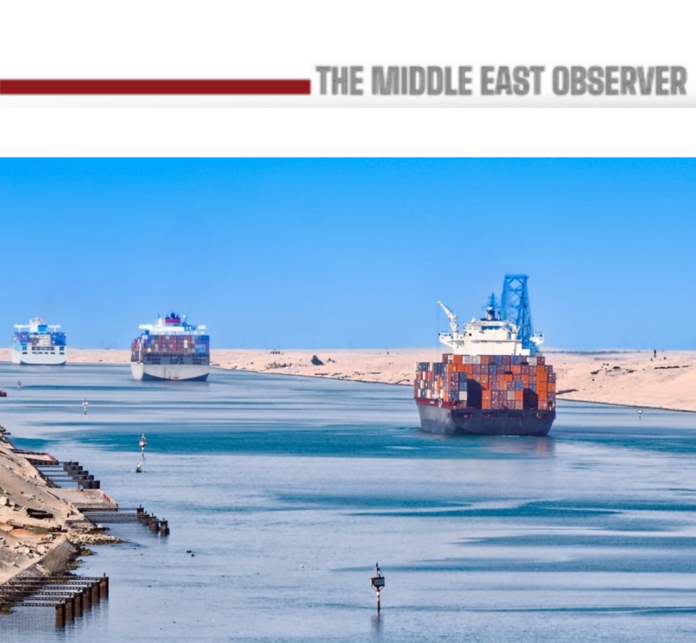
The Suez Canal’s strategic economic value is rising as inflationary pressures, elevated fuel prices and expensive vessel capacity increase the cost of every additional day in global trade. Container lines restoring selected services through the Canal are cutting India–US transit times by as much as two weeks, reducing fuel consumption, releasing ships for deployment elsewhere and shortening the period during which importers’ capital remains tied up in goods at sea.
The Georgia Ports Authority (GPA), the state agency responsible for Georgia’s major seaports, said Indian cargo is reaching the Port of Savannah 10–14 days faster as carriers shift selected services back to Suez from the longer Cape of Good Hope route around southern Africa. GPA said the shorter journeys allow faster inventory replenishment and lower inventory-carrying costs.
Savannah lies on the Atlantic coast of Georgia in the southeastern United States and serves as a major gateway into the US Southeast and inland markets. GPA describes it as the country’s third-busiest container gateway; an external ranking based on total 2025 container volume placed it fourth nationally. The port handled nearly 5.7mn twenty-foot equivalent units, or TEUs, in 2025.
Maersk provides a direct measure of Suez’s time advantage. Its MECL service has returned from the Cape route to the Red Sea and Suez, reducing the Nhava Sheva, India–Savannah journey to 28 days. Maersk separately says the routing change improves westbound MECL transit times by an average seven days and eastbound journeys by 14 days.
The commercial significance extends beyond faster delivery.
CMA CGM is returning its INDAMEX service to Suez, cutting Nhava Sheva–Savannah transit by about five days while requiring two fewer vessels to maintain the same weekly frequency.
That demonstrates a broader fleet-economics advantage. Shorter rotations allow carriers to maintain schedules with fewer ships, releasing expensive capacity for use elsewhere and reducing the capital required to operate a service.
Current charter markets illustrate the value attached to that time. The HARPEX benchmark on September 18 valued a 6,500-TEU containership at about $72,000 a day, while an 8,500-TEU vessel commanded about $79,000. At the 6,500-TEU benchmark, seven ship-days represent a market-equivalent charter value of roughly $500,000. This is not a disclosed Maersk saving, but an indication of the economic value currently attached to vessel availability.
Fuel makes longer diversions increasingly costly. Very-low-sulphur fuel oil averaged about $864.50 a tonne across 20 major bunkering ports on September 23, after exceeding $900 earlier in the month. Every additional sailing day around Africa therefore consumes not only vessel capacity but substantially more fuel.
Suez tolls and additional Red Sea insurance and security costs offset part of that advantage. But the Cape alternative requires materially more sailing time, bunker consumption and vessel capacity to maintain comparable service frequencies.
Cargo owners face a similar equation. Far East–US East Coast spot container rates reached about $10,955 per 40-foot container on September 10, up 313% from late February, according to Xeneta. The benchmark is broader than India–Savannah, but demonstrates the high-cost freight environment in which additional transit days and inventory delays are increasingly expensive.
Shorter Suez journeys consequently provide another financial benefit: importers receive goods sooner, replenish inventory faster and keep working capital tied up in cargo at sea for fewer days.
The recovery is also broadening. Maersk and Hapag-Lloyd have shifted another four Gemini services from the Cape to Suez. Yang Ming says it is seriously considering returning, OOCL expects an experimental Suez transit in October and COSCO is considering additional voyages after resuming selected passages.
The return remains selective and dependent on Red Sea security, but the economic case for Suez is strengthening.
For Egypt, the recovery is about more than restoring toll revenue. As fuel, vessel and financing costs rise, every additional day at sea becomes more expensive—raising the strategic value of the Canal’s shorter route.
Suez’s advantage is increasingly measured in time saved, fuel avoided, vessels released and capital freed—reinforcing its role as a critical cost-efficiency corridor in an inflation-sensitive global economy.
Related news:
Suez Canal Revenue Jumps 57% as Major Carriers Return
Suez Canal Recovery Gathers Pace as Maersk Restores More Services
Read also:
Jordan Broadens China Partnership, but $1bn Energy Pipeline Awaits Capital