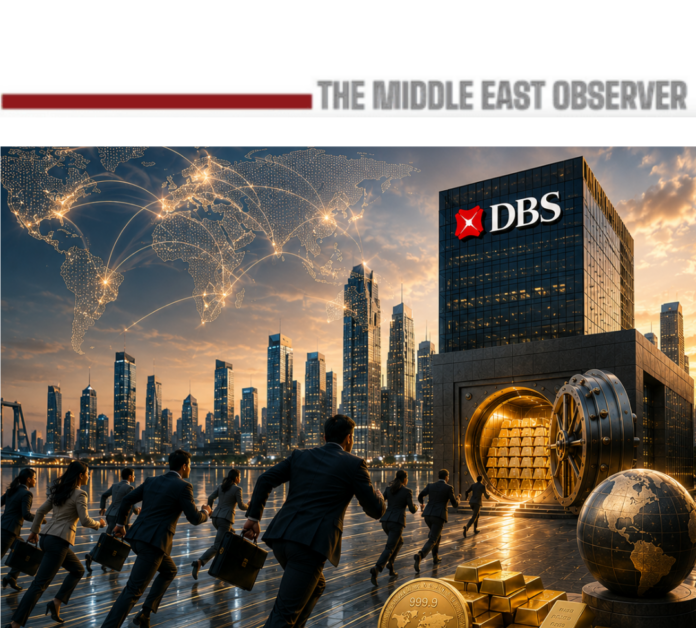
Singapore’s largest bank is betting that geopolitical risk will push wealthy families to separate residence, custody and investment across rival financial hubs
Singapore and Hong Kong are intensifying their competition for internationally mobile wealth as conflict, sanctions and tighter capital controls encourage rich families to spread their assets across several jurisdictions rather than rely on a single financial safe haven.
The immediate signal comes from DBS. Singapore’s largest bank aims to increase assets across its retail and wealth businesses from S$632bn at the end of 2025 to more than S$1tn by 2030. It plans to recruit more than 600 relationship managers, advisers and technology specialists by 2028, open 18 wealth centres and upgrade another 36 across Asia.
The target requires DBS to attract about S$400bn in five years—the same increase it achieved during the previous decade. By May, the number of newly acquired high-net-worth and ultra-high-net-worth clients had risen 20 percent from a year earlier. DBS is betting on both the creation of new Asian fortunes and the movement of existing global wealth towards the region.
Singapore appears ready to reinforce that expansion. The Monetary Authority of Singapore has held discussions with investment firms over possible measures to reduce their tax burden or operating costs as Hong Kong advances a proposed package covering funds, family offices, carried interest and performance-related earnings. One Singapore option reportedly under consideration could reduce the rate available through a qualifying incentive programme from 17 per cent to about 10 per cent, although no policy has been announced.
The contest extends beyond newly created Asian wealth. It increasingly concerns assets that have already moved once—from China, Russia, Europe or South Asia into Dubai, Switzerland and other international centres—and may now be seeking another jurisdiction as insurance against the next geopolitical or regulatory shock.
A second safe haven, not a second exodus
Global personal wealth increased 10.8 per cent in dollar terms during 2025, according to UBS, with Europe, the Middle East and Africa recording growth of 17.5 per cent. The figures partly reflected strong financial markets, rising non-financial assets and the depreciation of the US dollar, which amplified reported gains outside the United States. They should not be interpreted as an equivalent increase in capital immediately available for cross-border relocation.
Nevertheless, a larger pool of investable wealth is being managed against an increasingly fragmented political landscape. Modern wealthy families commonly live in one jurisdiction, operate businesses in several others and divide custody, portfolio management and succession planning among multiple financial centres.
That strategy became visible after Iranian missile and drone attacks on Dubai in early 2026. Two Indian entrepreneurs attempted to transfer more than $100,000 each from UAE accounts to Singapore, while Singapore-based advisers reported enquiries from other wealthy Asian clients considering transfers to Singapore or Hong Kong.
Ryan Lin, a Singapore-based private-wealth lawyer, told Reuters that six or seven of his 20 Dubai-based clients—each holding an average of about $50mn—had contacted him, with three preparing immediate transfers. Iris Xu of corporate and fund-services provider Anderson Global reported enquiries from between 10 and 20 family offices about moving Middle Eastern assets back to Singapore.
But the evidence does not support a broad abandonment of the UAE. Dhruba Jyoti Sengupta, chief executive of Dubai-based WRISE Private Middle East, said his clients had not entered “serious capital flight discussions” and remained invested in the UAE’s long-term growth. DBS and Bank of Singapore similarly said clients were largely adopting a wait-and-watch approach.
The more realistic development is partial diversification. Families may retain their residence, businesses and property in Dubai while moving a proportion of their liquid portfolios, custody arrangements or succession structures elsewhere.
Dubai can retain the resident while Singapore, Hong Kong or Switzerland captures part of the financial mandate.
The new safe-haven map
The principal wealth centers are not interchangeable. Each offers a different combination of taxation, market access, residence, regulation and institutional confidence.
Dubai is the residence-and-tax hub. The UAE does not impose personal income tax, giving it a clear advantage for entrepreneurs, executives, fund managers and wealthy retirees deciding where to live. Dubai also combines international connectivity with access to Gulf, African and South Asian business opportunities.
Its financial infrastructure has expanded rapidly. Dubai International Financial Centre ended 2025 with more than 500 wealth and asset-management firms, including 102 hedge funds, and more than 1,289 family-related entities. It added 4,122 jobs during the year.
Dubai’s edge therefore extends beyond taxation. It offers residence, lifestyle, regional deal flow and proximity to sovereign and family capital. Its vulnerability is geographic concentration: a family can remain committed to the UAE while concluding that its wealth should not all be exposed to the same regional risks.
Singapore is the neutral Asian booking centre. Its attraction rests less on offering the lowest headline tax rate than on political stability, an English-language legal system, regulatory credibility and access to Southeast Asia and India without Hong Kong’s dependence on mainland China.
More than 2,000 single-family offices had received Singapore tax incentives by the end of 2024, compared with about 400 four years earlier. Qualifying structures are expected to create local economic substance through expenditure, staffing and professional investment activity rather than merely booking assets through shell entities.
DBS intends to convert that ecosystem into assets and fee income. Its planned recruitment extends beyond private bankers to engineers and platform specialists who will accelerate onboarding, strengthen compliance and deliver increasingly personalised investment services.
Hong Kong is the China gateway—and has proposed the sharper immediate tax package for fund talent. The city provides direct access to mainland equities, bonds, companies and offshore renminbi liquidity, making it particularly attractive to Chinese entrepreneurs based in Dubai, Gulf institutions expanding into Asia and international families seeking significant China exposure.
Hong Kong’s asset and wealth-management industry held HK$35tn at the end of 2024, an increase of 13 per cent. Boston Consulting Group subsequently estimated that the city had overtaken Switzerland as the largest cross-border wealth-booking centre, although roughly 60 per cent of its international wealth originated from mainland China.
In June, Hong Kong gazetted legislation that would broaden preferential regimes for privately offered funds, family-owned investment vehicles and carried interest. The bill would expand eligible investments, include more fund structures and strengthen concessions for genuine performance-related carried interest while imposing reporting and economic-substance requirements. The changes remain proposed and are not yet fully enacted.
The distinction matters because Hong Kong is not merely competing for the billionaire who owns the assets. It is targeting the portfolio managers and investment firms deciding where to locate their teams and receive performance-related compensation.
“Senior investment talent is highly mobile,” said Kher Sheng Lee, Asia-Pacific co-head of the Alternative Investment Management Association. Personal tax certainty can therefore influence where leading managers establish themselves and their businesses, he added.
Hong Kong’s China connection remains both its principal strength and its concentration risk. It offers investment access that Singapore cannot easily reproduce, but its wealth industry is more exposed to Beijing’s decisions on cross-border capital movement.
Switzerland remains the custody-and-succession benchmark. Its competitive advantage is not tax dominance but a long record of private banking, currency stability, political continuity and multigenerational wealth planning. The Swiss financial sector remains a global leader in cross-border wealth management and accounts for about 9 per cent of national economic output.
For Gulf families and internationally mobile entrepreneurs, Switzerland remains a natural location for long-term custody and inheritance planning. Singapore and Hong Kong, however, sit closer to the economies producing much of the world’s new wealth, while Dubai offers a stronger proposition for personal residence.
Tax dominates the opening decision—not the final one
Tax competition is real, but its importance varies according to what is being taxed.
Dubai dominates when the question is where an individual should live and receive income because the UAE does not levy personal income tax.
Hong Kong has proposed the more aggressive immediate package for qualifying fund profits, carried interest and performance-related income. Singapore offers established fund and family-office incentives tied more explicitly to local substance, expenditure and professional employment, while considering whether further measures are required.
Switzerland competes principally through institutional custody and succession expertise rather than the lowest headline rate.
Hong Kong’s proposed carried-interest treatment could place it ahead of Singapore in tax certainty for some senior fund managers and bring it closer to Dubai’s personal-tax proposition, according to Eric Lam, an M&A tax partner at Deloitte. But qualifying treatment would apply only to genuine returns linked to fund performance, not ordinary salaries or discretionary bonuses.
Tax may determine where a hedge fund opens an office or where an investment vehicle is initially incorporated. It becomes less dominant when physical security, access to capital or confidence in a jurisdiction’s institutions is threatened. The attempted Dubai transfers suggest that some families will accept higher operating costs in exchange for geographic insulation.
Nor are Singapore and Hong Kong secrecy destinations. Hong Kong requires reporting financial institutions to identify accounts held by tax residents of reportable jurisdictions and submit the relevant information annually under its automatic exchange framework.
Hong Kong’s monetary authority also expects private banks to establish clients’ source of wealth and source of funds through risk-based collection, clarification and corroboration. Singapore applies comparable tax-transparency and anti-money-laundering requirements. Wealth that is sanctioned, criminal or inadequately documented cannot assume straightforward access to either centre.
Why mobile wealth is worth the competition
The prize is not simply the nominal amount held in a bank account. Much of the capital booked in Singapore, Hong Kong, Dubai or Switzerland remains invested internationally.
The direct economic benefit comes from the services built around it. Private banks earn custody, advisory, lending, foreign-exchange and investment-product fees. Asset managers receive management and performance income, while lawyers, accountants, auditors, insurers, fund administrators and compliance specialists support the structures.
DBS’s planned 600 hires illustrate this multiplier. Attracting additional assets requires relationship managers, but also engineers and platform specialists capable of managing data, automating compliance and delivering digital investment services.
Family offices can also bring investment decisions and operating businesses. Their capital may support private equity, venture funds, infrastructure, private credit and growing companies. The value to the host economy therefore depends not only on the amount booked, but on whether the family employs local professionals, purchases services and directs investment through the jurisdiction.
Dubai’s expansion demonstrates the same effect: the growth of its wealth-management, hedge-fund and family-office community has generated thousands of specialist jobs while attracting lawyers, advisers, technology companies and investment firms seeking access to Gulf capital.
There are political costs. Preferential treatment for billionaires and highly paid fund managers can be difficult to defend when ordinary households face expensive housing and rising living costs. That tension helps explain why Singapore may favour targeted corporate incentives or operating-cost relief rather than a conspicuous reduction in individual income tax.
Tax opens the door; confidence keeps the assets
The competition is unlikely to produce a single victorious safe haven.
A family may remain resident in Dubai, retain long-term custody in Switzerland, place Southeast Asian investments under Singaporean management and use Hong Kong for renminbi exposure and mainland opportunities.
This multi-hub market is the one DBS is targeting. Its S$1tn ambition does not depend on Singapore replacing Hong Kong, Dubai or Switzerland. It assumes that wealthy families will add Singapore as another layer of protection—and that a larger share of their custody, advisory and investment activity will consequently flow through the bank.
Dubai retains the strongest proposition for tax-efficient residence. Hong Kong offers the most direct access to China and has proposed a powerful incentive for mobile investment talent. Switzerland remains the institutional reference point for custody and succession. Singapore’s advantage is its ability to offer Asian access while remaining comparatively distant from several of the world’s principal geopolitical fault lines.
Tax may decide where a manager opens an office or where the first investment vehicle is established. The more durable test is whether the jurisdiction’s banks, courts, currency and international relationships will continue to function when the next crisis arrives.
In the emerging geography of private wealth, safety is no longer found in one city. It lies in ensuring that no single city is indispensable.
Related news:
Mashreq Partners with Goldman Sachs to Elevate Wealth Management Services
The World Isn’t Short of Minerals—It’s Short of Trust
Read also:
Egypt Expands Capital Market Reform with 10 New Non-Banking Financial Licences
Egypt Offers Concessional Financing to SMEs Joining Simplified Tax System