

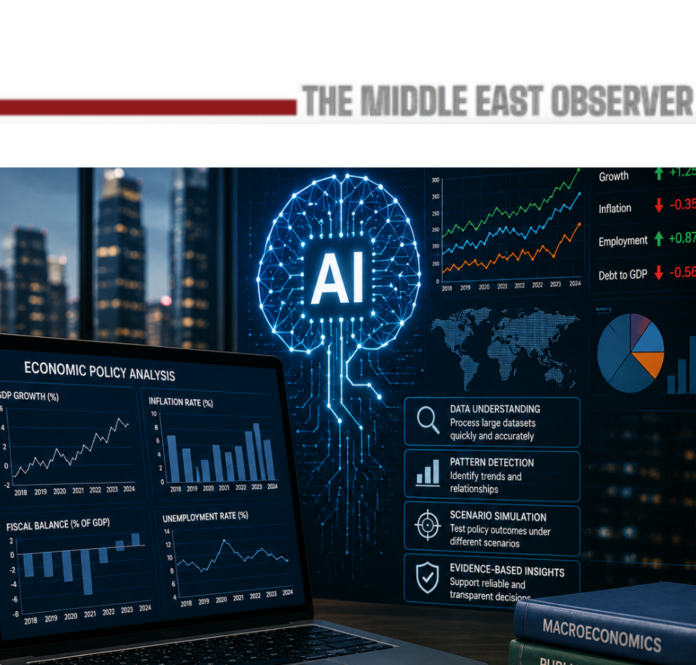
Researchers argue that combining deep learning with econometric techniques may enable more accurate cause-and-effect analysis by extracting information from unstructured text.
Artificial intelligence could significantly improve the way economists evaluate cause-and-effect relationships across public policy, healthcare, finance and labour markets, according to a new working paper published by the Egyptian Center for Economic Studies (ECES). The research suggests that modern AI language models can uncover valuable information embedded in unstructured text that conventional statistical methods often overlook, potentially improving the reliability of evidence derived from observational data.
The study comes as governments, central banks, financial institutions and businesses are increasingly adopting generative AI to analyse large volumes of documents and data. While much of the attention surrounding artificial intelligence has focused on automating tasks and improving predictions, the paper argues that AI may play an equally important role in strengthening evidence-based decision-making by helping researchers better distinguish genuine cause-and-effect relationships from simple statistical correlations.
If validated using real-world data, the proposed methodology could support more informed policy evaluation across numerous sectors. Governments could better assess labour-market initiatives, education reforms and social programmes; healthcare researchers could improve estimates of treatment effectiveness; financial institutions could refine analyses of investment and lending decisions; while businesses could gain clearer insight into the true impact of strategic and operational changes. Although these applications are illustrative rather than directly tested in the paper, they reflect the types of observational problems the methodology is intended to address.
The paper, Reading Between the Lines: Deconfounding Causal Estimates using Text Embeddings and Deep Learning, examines one of the central challenges facing empirical economics and social science: estimating the true impact of an intervention when important influencing factors cannot be directly observed. In such situations, conventional statistical models may incorrectly attribute outcomes to a policy or decision when they are actually driven by previously unmeasured characteristics.
Instead of relying solely on structured information such as age, education or income, the researchers argue that everyday documents—including CVs, medical records, financial reports and online profiles—often contain contextual clues about characteristics that traditional datasets cannot capture directly. Incorporating these textual signals into statistical analysis, they suggest, could help reduce distortions caused by previously unobserved influences.
To achieve this, the proposed framework uses artificial intelligence to convert written documents into numerical representations that capture their overall meaning rather than simply counting individual words. These AI-generated representations are then incorporated into advanced econometric models alongside conventional datasets, allowing the analysis to account for information that would otherwise remain outside traditional statistical techniques.
The researchers also argue that the choice of AI model is critical. According to the paper, widely used decision-tree algorithms are less effective at analysing complex language representations because they simplify relationships into a series of discrete choices. Neural-network models, by contrast, are presented as better suited to capturing the continuous patterns contained within modern language data, enabling more accurate estimation of causal relationships. The authors describe this distinction as an “Architecture Gap.”
Simulation results suggest the proposed methodology substantially improves estimation accuracy. While conventional statistical approaches produced large estimation errors, incorporating AI-derived language representations progressively reduced those inaccuracies, with the best-performing neural-network configuration producing estimates that closely matched the simulated underlying causal effect. Intermediate approaches—including models relying solely on structured data or combining text with conventional tree-based algorithms—also improved performance but retained noticeably larger estimation errors.
Another notable finding is that written language appeared to contain considerably more information about previously unobserved characteristics than structured variables alone. In the simulation, AI-derived language representations explained almost twice as much variation in these hidden factors as conventional datasets, suggesting that natural language may provide an important additional source of evidence for empirical research.
Across simulated professional sectors—including data science, web development, content creation and graphic design—the neural-network framework consistently produced estimates closer to the known underlying causal effect than traditional approaches, indicating that the methodology may be applicable across a broad range of analytical settings.
The authors acknowledge important limitations. The findings are based on a synthetic dataset developed to test the methodology under controlled conditions rather than on real-world observations. They note that further validation using administrative datasets and, where available, randomised controlled studies will be required before the framework can be applied with confidence in practical policy or business settings. The paper also recognises that selecting the optimal neural-network architecture becomes considerably more challenging when the true causal effect is unknown.
More broadly, the research reflects a wider evolution in the application of artificial intelligence. While early AI adoption focused primarily on prediction, automation and pattern recognition, attention is increasingly shifting towards using AI to strengthen causal inference—the foundation of evidence-based policymaking. If future empirical studies confirm these findings, AI could become an increasingly valuable tool not only for forecasting future outcomes but also for helping governments, businesses and researchers better understand the factors that genuinely drive economic and social change.
Related news:
IMF Signals Structural Economic Shift Across MENA
Cheering Egyptian-Cuban bilateral economic cooperation
Read also:
AI Everything MEA Showcases Egypt’s Expanding Tech Capabilities
Is Artificial Intelligence a Bogeyman Threatening Human Activity?