When Cairo opens its stages for the 33rd Cairo International Festival for Experimental Theatre (CIFET) from September 1 to 8, the city will receive more than performances from different countries. It will encounter competing ideas about what theatre can be, where it can take place, how audiences can participate and how the art form should respond to rapid technological and social change.
That is perhaps the most interesting proposition behind this edition. CIFET is not only presenting experimental theatre; it is also experimenting with the concept of the festival itself.
The programme brings 14 performances from 13 countries into the official competition, alongside seven international workshops, six days of intellectual discussions, publications, tributes and cultural partnerships. The viewing committee considered 324 productions — 164 international and 160 Arab — before reaching the final selection.
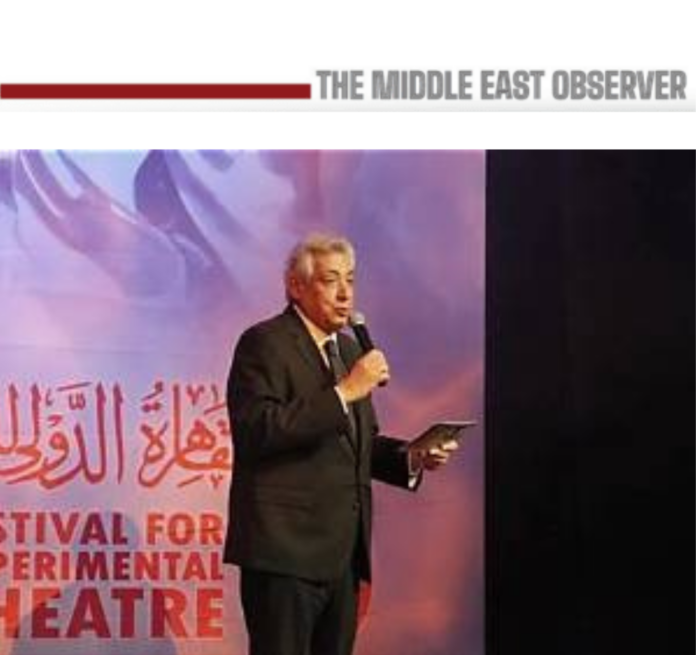
Yet this international ambition rests on limited financial resources. Festival president Sameh Mahran has said CIFET’s total budget does not exceed about $300,000, creating an underlying tension between the scale of the festival’s artistic ambitions and the resources available to realise them.
American actor Willem Dafoe will add further international attention. His relevance extends beyond celebrity: his artistic background is closely connected with experimental theatre, making his presence particularly suited to a festival built around challenging theatrical convention.
An International Stage
The official competition brings together 10 foreign and four Arab performances, with participation extending across Europe, Asia, Africa and the Arab world.
Among the international entries are Icaro by Swiss-Italian writer, director and performer Daniele Finzi Pasca, South Africa’s The Spiritual Massacre, China’s Purple Tail and the UK’s A Night’s Game by Alleyne Dance. Arab participation includes productions from the UAE, Saudi Arabia, Jordan and Tunisia.
The geographical range is significant because CIFET has long sought to position Cairo as a meeting point between Egyptian, Arab and international theatrical traditions rather than simply a venue for imported performances.
Beyond the Stage
Some of this year’s most consequential activity may take place away from the main stage.
Seven international workshops will address acting, writing, directing, movement, contemporary theatre and performance in unconventional spaces, led by artists and specialists from Egypt, Kuwait, the US, Greece, Spain and Italy.
Kuwaiti director and playwright Sulayman Al-Bassam will examine the journey from text to actor and the relationship between writing and directing. Greek theatre scholar Savas Patsalidis will address contemporary theatre’s relationship with politics, the body, technology, artificial intelligence and globalisation, while Spanish director Paco Gámez will explore performance in open spaces through storytelling, improvisation and audience interaction.
Other workshops range from physical storytelling and Commedia dell’Arte to programmes designed for younger participants, with some culminating in public performances.
In this sense, CIFET becomes more than a showcase for finished productions. It also functions as a laboratory in which artists can learn, test ideas and create.
Where Does Experimentation Come From?
The intellectual programme reinforces that ambition.
Its central theme, “Geo-Theatrical Experimentation,” examines the relationship between theatrical experimentation and cultural territories. Rather than asking simply what constitutes experimental theatre, the programme considers how geography, culture, politics, economics and audiences shape what experimentation means.
Across six days, discussions will address changing audience behaviour, cultural regions, experimentation’s relationship with the global capitalist system and the audience’s place within experimental performance. The programme has attracted 68 research papers from Arab and international researchers, academics and critics.
This pushes the debate beyond experimentation as an artistic label towards more difficult questions: why artists experiment, for whom they do so, and which cultural and economic conditions enable some forms of experimentation while constraining others.
The Economics of Experimentation
The festival’s ambitions also raise a practical question: how much can an international cultural event achieve when its artistic programme exceeds its financial resources?
A budget of about $300,000 must support performances, international artists, workshops, researchers, publications and cultural exchanges. Institutional partnerships can help stretch those resources, but they do not remove the underlying constraint.
The issue is especially relevant to experimental theatre, where unconventional productions, new performance spaces and unfamiliar relationships with audiences can carry additional artistic and financial risk.
CIFET therefore faces an experiment of its own: how to expand its international and intellectual ambitions without allowing limited resources to narrow the scope of experimentation it was created to encourage.
Looking Back to Move Forward
CIFET is also looking backwards as it attempts to redefine its future.
Its “Giving Back” programme will commemorate influential theatre figures including Sudanese scholar Yusuf Al-Aydabi, Iraqi director Awni Karoumi and Egyptian director Saad Ardash, connecting contemporary experimentation with the theatrical traditions from which it emerged.
The festival is also expanding cooperation with Egypt’s National Centre for Theatre, Music and Folk Arts to document its activities and mark Egyptian Theatre Day on September 5, a date carrying painful memories for Egyptian theatre but also associated with recognition of theatre’s contribution to cultural life.
Thirteen theatre figures from Egypt, the Arab world and elsewhere will also be honoured for contributions spanning acting, directing, writing, research, scenography, training and cultural work.
Cultural Partnerships Return
Another notable institutional development is the return of the British Council as a festival partner after an absence of more than 15 years.
British participation comes through Alleyne Dance and A Night’s Game, but the partnership has significance beyond bringing another production to Cairo. It signals renewed cultural links between British and Egyptian theatre communities.
CIFET has also developed cooperation with the Italian Cultural Institute and Swiss cultural foundation Pro Helvetia Cairo. The Swiss connection is particularly visible through Icaro and Daniele Finzi Pasca, an internationally recognised figure in contemporary theatre and performance.
Such partnerships demonstrate how theatre can create channels for cultural exchange alongside more formal diplomatic relationships.
From Experimental Theatre to Hollywood
Dafoe’s presence also illustrates how porous the boundary between “experimental” and “mainstream” can become.
Before becoming one of the most recognisable figures in American cinema, his artistic career was strongly connected to experimental theatre. His participation therefore resonates with CIFET’s identity rather than functioning merely as a celebrity appearance.
It is also a reminder that artists can move from experimental stages to global cinema while retaining the methods and influences developed through live performance.
Theatre Confronts Artificial Intelligence
One of this edition’s most contemporary questions concerns artificial intelligence.
Mahran has spoken about AI’s growing role in theatre and other fields, arguing that the technology can be useful but should remain an assisting tool rather than replace human thought.
Theatre has always absorbed new technologies, from lighting and sound to video and digital performance. AI presents a more fundamental challenge because machines can increasingly write, design, generate images, imitate voices and produce dramatic material.
The question is therefore becoming less whether theatre will use AI than what remains uniquely human when it does.
For a festival devoted to experimentation, that question belongs naturally within its remit.
Cairo as a Meeting Place
CIFET has passed through different phases and repeated debates about what “experimental” should mean. The 33rd edition appears determined to confront that question rather than simply inherit the label.
It wants artists to teach, researchers to debate, audiences to reconsider their role and cultural institutions to establish new connections. For eight days, stages, workshops, performers, critics, students and audiences will effectively create a temporary theatre city within Cairo.
There is something appropriate about that experiment taking place here.
Cairo is itself a city where old cultural forms coexist with new technologies and where the past continually encounters the future. The festival’s most important experiment may therefore be not any single production, but its attempt to bring different theatrical traditions, generations, countries and ideas about audiences together in one place.
For eight days in September, Cairo will pose a deceptively simple question:
What can theatre become when we stop assuming that we already know what theatre is?
Related news:
Egypt Expands National Theatre Festival Beyond Cairo in Cultural Decentralisation Drive
Egypt’s State Theatre Between Revival Ambitions and Structural Decay
Read also:
Egypt plans to issue the first tax certificates in its history during FY 2026/27
When the Grid Becomes Global: Can Egypt Become a Regional Electricity Trading Hub?