MENA’s next tourism race will be fought less over visitor numbers than over how long travellers stay, how widely they spend and how much value they create beyond the hotel door.
MENA’s tourism boom is entering a more demanding phase.
Travel and tourism contributed $385.8bn to Middle Eastern GDP in 2025 and supported 7.1mn jobs, according to the World Travel & Tourism Council. The sector expanded 5.3%, ahead of global growth of 4.1%.
But arrivals and hotel capacity are increasingly incomplete measures of competitiveness. The larger economic prize is yield per visitor: spending on restaurants, retail, culture, entertainment, transport, sport and wellness.
The objective is to increase tourism receipts without relying proportionately on higher arrival volumes — raising the value generated by each visitor and spreading it across more businesses. That shift, from selling accommodation to capturing spending across an entire trip, is the economics behind the experience economy.
Saudi Arabia: Can investment become sustainable demand?
Saudi Arabia represents the region’s most ambitious tourism transformation.
The kingdom recorded about 123mn domestic and inbound tourists in 2025, up roughly 6% from the previous year, while total tourism spending reached a record SAR304bn ($81bn). Inbound visitors numbered 29.3mn and generated SAR176.6bn in spending.
Non-religious purposes accounted for approximately 52% of inbound overnight visits, compared with 44% in 2019 — an important shift as the kingdom seeks to diversify beyond its established religious-tourism market.
Major events have become part of that strategy. Saudi officials said in late 2024 that 80 international sporting events had attracted 2.5mn tourists over the preceding four years. The Jeddah Formula One Grand Prix alone was estimated to have generated SAR900mn in economic impact and 20,000 jobs.
The scale of investment and demand growth is substantial. The harder question is whether visitor demand can eventually grow independently of the investment being used to create it.
Tourism Minister Ahmed Al-Khateeb has described the shift as a “structural transformation” of tourism into a high-impact economic engine. The next stage is proving that new destinations can sustain occupancy and spending — and ultimately generate returns commensurate with the capital deployed.
Dubai: A mature visitor economy
Dubai provides MENA’s most developed example of an integrated visitor economy.
The emirate welcomed a record 19.59mn international overnight visitors in 2025, up 5% from 2024. Average hotel occupancy reached 80.7%, while visitors stayed an average 3.7 nights.
Aviation connectivity feeds shopping, restaurants, exhibitions, entertainment and business events, allowing different parts of the visitor economy to reinforce one another.
Gastronomy illustrates the model. The 2025 Michelin Guide Dubai selected 119 establishments spanning more than 35 types of cuisine, showing how dining has evolved from a supporting hotel service into a destination attraction.
Dubai therefore faces a different challenge from newer tourism markets. It must raise spending and length of stay within an already mature visitor economy — without allowing higher prices to narrow its market.
Egypt: Connecting the assets
Egypt starts from a fundamentally different position.
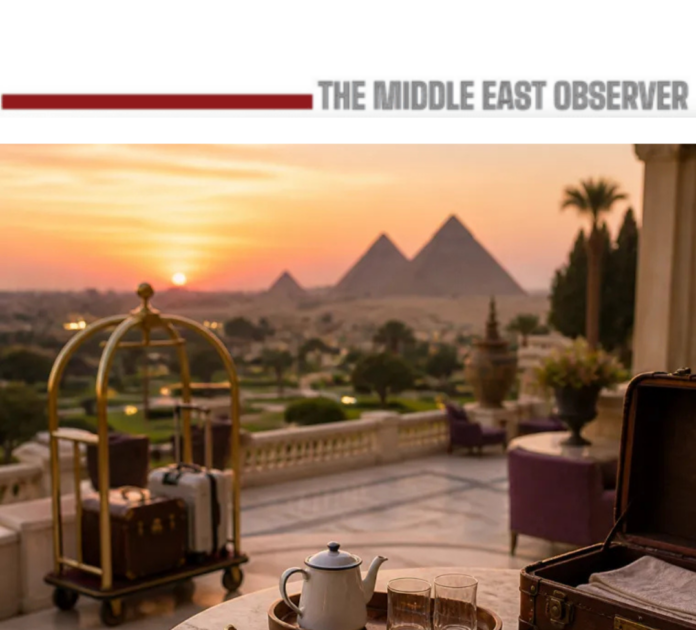
Egypt combines ancient heritage, the Nile, Red Sea resorts, Mediterranean beaches and desert tourism within a single national market.
The country received about 19mn tourists in calendar 2025, up roughly 20% from 2024. Separately, official data for FY2024/25 show tourism revenues of $16.7bn and 179.3mn tourist nights, the latter up 16.4% year on year.
WTTC estimated that travel and tourism contributed EGP1.4tn to Egypt’s economy in 2024, equivalent to 8.5% of GDP. International visitor spending stood 36.1% above its 2019 level, while domestic visitor spending was 31.8% higher.
For Egypt, the potential productivity gain lies in converting a predominantly destination-based tourism model into a multi-destination economy.
The opportunity is not simply another hotel room, but connecting existing attractions into longer, higher-spending journeys. A visitor who combines Cairo and the Grand Egyptian Museum with Luxor, Aswan, the Red Sea or the Mediterranean coast generates demand across accommodation, transport, restaurants, guides, retail and entertainment.
The constraint is integration. Transport links, destination connectivity, digital booking and service standards will help determine whether Egypt’s individual attractions function as a coherent visitor economy.
Who captures the value?
The experience economy matters because tourism spending can spread far beyond hotels — but only if local businesses participate.
Restaurants, guides, cultural businesses, retailers, transport operators, entertainment companies and technology platforms can capture additional expenditure when visitors stay longer and do more.
Tourism therefore becomes an SME, employment and urban-development strategy as much as a hospitality strategy.
Saudi Arabia illustrates the potential. Employment in its tourism industries reached about 1.03mn in 2025, while Saudi women accounted for roughly 47% of Saudi employees in tourism-characteristic activities, compared with 5% in 2018.
For investors and policymakers, this shifts attention towards spending per visitor, average length of stay, repeat visitation and the share of expenditure captured outside accommodation. Together, these measures provide a fuller picture of tourism productivity than headline arrival numbers alone.
Resource intensity presents another constraint. Extreme heat, water scarcity and cooling requirements raise operating costs. For investors, energy efficiency, water management and climate resilience are questions of margins and asset economics, not simply sustainability.
The new tourism race
MENA’s first tourism race was largely about capacity: airports, airline routes, hotel rooms, resorts and visitor numbers.
The next is about productivity.
Saudi Arabia is testing whether enormous investment can create durable demand. Dubai must raise the productivity of an already mature visitor economy. Egypt’s opportunity is to connect an exceptional collection of existing assets into longer, higher-spending journeys.
Scale alone will not determine the next phase of the region’s tourism competition. The advantage will increasingly belong to destinations that convert each arrival into more nights, more experiences and more locally captured spending — without allowing the cost of sustaining that demand to erode returns.
The next benchmark for MENA tourism will therefore be not simply how many people arrive, but how much sustainable economic value remains after they do.
Related news:
IMF Signals Structural Economic Shift Across MENA
Egypt Targets AI and Cloud Investment with National Data Centre Strategy
Read also:
Wizz Air Opens 27 Weekly Poland Routes to Egypt’s Red Sea Resorts
When Electricity Becomes a Business: Who Will Control Egypt’s Next Power Market?