Small-cap stocks lead Sunday’s recovery after last week’s sell-off, but foreign investors remain net sellers and high interest rates continue to challenge equity valuations
CAIRO — Egyptian equities opened the week with a broad rebound on Sunday, as smaller stocks sharply outperformed blue chips following last week’s correction and S&P Dow Jones Indices’ decision to retain Egypt as an emerging market.
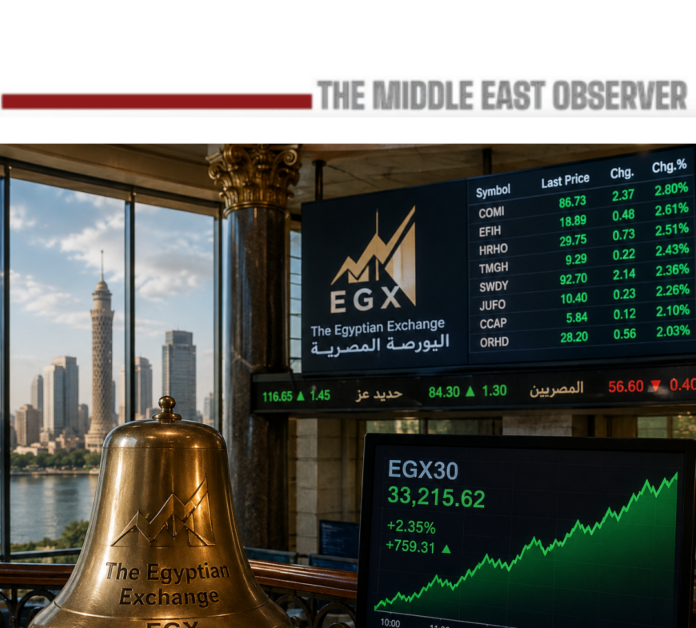
The benchmark EGX30 rose 1.12% to 55,350.36 points, extending Thursday’s modest recovery. The stronger move came below the headline index: the EGX70 Equal Weight surged 3.87% to 21,621.83, while the EGX100 climbed 3.18% to 27,911.41. Market capitalization increased by about EGP60bn to EGP4.279tn.
The breadth of Sunday’s advance was significant after the divergence that characterised the end of last week, when the EGX30 lost about 0.9% but the EGX70 fell roughly 3.6%.
The broader recovery provides evidence of renewed participation beyond heavyweight stocks, although one session is insufficient to establish a durable change in positioning.
Small Caps Reverse Last Week’s Weakness
The EGX30 began last week strongly before three consecutive declines pushed it to 54,512.65 on Wednesday. Thursday brought a modest recovery, but smaller stocks continued to fall.
Sunday reversed that divergence for the session.
The EGX70’s 3.87% rise was more than three times the EGX30’s gain, while the EGX100’s 3.18% advance showed that buying extended across a wider range of companies.
Commercial International Bank gained about 1.3% and Telecom Egypt rose 3.1%, helping lift the benchmark, according to Reuters. Regional markets were also generally firmer as higher oil prices supported sentiment.
The move repaired much of the previous week’s damage but did not establish a decisive breakout. The EGX30 remains around recent highs rather than clearly above them.
For investors, that distinction is more important than Sunday’s percentage gain alone: the market has recovered, but has yet to demonstrate another sustained leg higher.
S&P Removes a Classification Risk
Sunday was the first trading session after S&P Dow Jones Indices retained Egypt’s emerging-market classification, ending consultations over a possible move to frontier status.
The chronology makes the decision relevant to Sunday’s market backdrop, but there is insufficient evidence to attribute the rally to the announcement alone.
S&P’s decision preserves Egypt’s place in the broader emerging-market investment universe and avoids potential restrictions for funds whose mandates, benchmarks or risk limits distinguish between emerging and frontier markets.
Classification alone, however, does not create demand. Valuation, liquidity, currency risk and the ability to move capital efficiently will continue to determine allocations.
That distinction was visible in Sunday’s flows.
Foreign Investors Remain Net Sellers
Egyptian investors were net buyers by about EGP155mn, while Arab investors recorded net sales of approximately EGP82.6mn and non-Arab foreign investors sold a net EGP72.3mn.
The amounts were modest relative to some of the unusually large nationality flows recorded during the previous week, but their direction is instructive.
Sunday’s rally was domestically led rather than dependent on foreign buying.
It is therefore premature to interpret Egypt’s retention of emerging-market status as having triggered a new wave of international allocations. Evidence of that would require sustained foreign buying rather than a single session’s price reaction.
High Rates Raise the Equity Hurdle
The more immediate constraint remains monetary policy.
The Central Bank of Egypt kept its overnight deposit rate at 19% and lending rate at 20% on August 20. Headline inflation stood at 14.9% and core inflation at 14.7%, according to the CBE’s latest indicators.
Those rates matter directly to equity valuations.
High yields available on government debt and other fixed-income instruments increase the return investors require for assuming equity risk. That makes another broad expansion in valuation multiples harder to sustain unless companies can deliver corresponding earnings growth.
As the earlier EGX re-rating matures, the market is therefore likely to become more sensitive to cash generation, margins, leverage and earnings quality.
Last week’s widening gap between blue chips and smaller stocks, followed by Sunday’s sharp reversal, is consistent with a more volatile and discriminating market — although it remains too early to identify a lasting rotation.
Stronger Buffers, but Liquidity Remains the Test
Egypt’s improved external position provides a more supportive backdrop. Net international reserves reached a record $56.29bn at the end of July, strengthening the foreign-currency buffer and easing some concerns over FX availability that had previously weighed on international investors.
But stronger reserves do not by themselves deepen the equity market.
The longer-term challenge is therefore not simply retaining an emerging-market label but developing the characteristics that make the classification valuable.
Global institutions need sufficient free float, liquidity, market capitalisation and predictable access. The practical test is not merely whether they can buy Egyptian equities, but whether they can build and exit meaningful positions without moving prices excessively.
That remains a constraint in a market where institutional liquidity is concentrated among a relatively limited group of companies.
Telecom Egypt’s upgrade from the small-cap to mid-cap segment of FTSE Russell’s Global Equity Index Series, following an increase in its market capitalisation to about $3.9bn, provides one example of an Egyptian company reaching greater investable scale. The September review changes take effect on September 21.
Egypt needs a broader pool of companies meeting similar standards of capitalisation, liquidity, trading volume and free float if improved macroeconomic conditions are to translate into materially larger institutional allocations.
The Test Is Follow-Through
Sunday’s session was materially stronger than Thursday’s rebound.
The EGX30 gained 1.12%, while the EGX70 and EGX100 rose more than 3%, reversing much of the weakness beneath the benchmark. S&P’s decision simultaneously removed a potential institutional obstacle to holding Egyptian equities.
But the evidence stops short of confirming a new market leg.
Foreign investors remained modest net sellers, the EGX30 has not moved decisively beyond its recent highs, and domestic rates of 19-20% continue to offer formidable competition for capital.
The next test is whether the rebound can hold its recovered levels while smaller stocks retain participation and foreign flows become more constructive.
If breadth fades, Sunday’s move may prove largely a recovery from last week’s sell-off. If it persists alongside earnings growth and improving institutional flows, the case for a broader advance becomes stronger.
S&P has removed one source of uncertainty. The harder test is whether earnings, liquidity and foreign participation can sustain the rebound beyond a single broad session.
Related news:
Egypt’s Stock Market Ends Week in Green as EGX Nears International Standards & Norms
Saudi Arabia Approves Rules for Foreign Property Ownership
Read also:
Foreign Buying Helps EGX30 Recover as Small-Caps Extend Rally