Xi Jinping’s Cairo visit shifts factories, exports and technology towards the centre of bilateral ties as Egypt seeks greater domestic value from Chinese capital and Beijing builds a Suez-based production platform for markets across Africa, the Middle East and Europe.
CAIRO — Egypt and China are betting that factories, supply chains and wider market access can rebalance an economic relationship in which Cairo imported more than 12 times as much from Beijing as it exported in the first half of 2026.
Egypt sold $840.8 million of goods to China during the period but imported $10.4 billion, leaving a merchandise deficit of about $9.6 billion, according to CAPMAS.
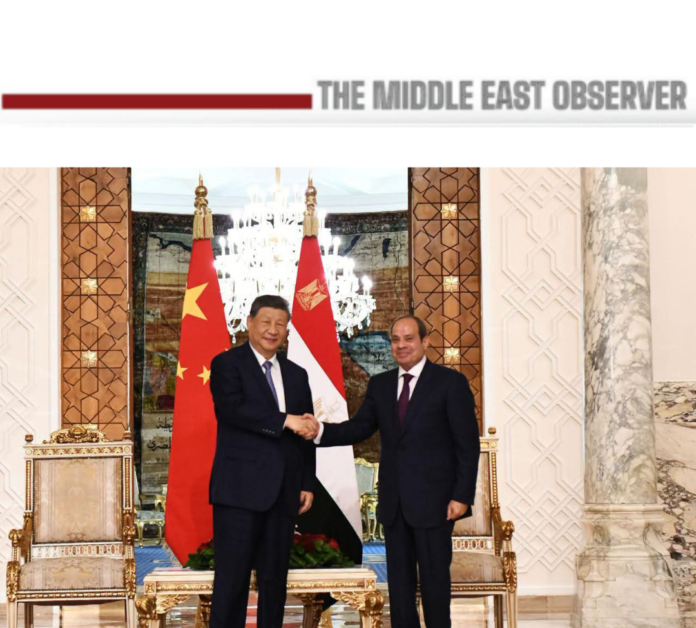
President Xi Jinping’s September 1-2 state visit — his first to Egypt in a decade — produced five publicly identified agreements and more than 20 additional cooperation documents spanning industry, technology, trade, science, education and transport.
The economic bargain is two-sided: Egypt wants Chinese investment to generate factories, exports, local suppliers and technology, while China gains a manufacturing and logistics base beside the Suez Canal with access to markets across three continents.
The objective is no longer simply more trade, but more production and value creation around it.
Five agreements set the framework
President Abdel Fattah El-Sisi and Xi oversaw agreements linking Egypt Vision 2030 with China’s Belt and Road Initiative, economic and technical cooperation, industrial and supply chains, information technology, and cooperation between the Suez Canal Economic Zone and China’s Ministry of Commerce.
China’s Foreign Ministry said more than 20 additional cooperation documents were signed in areas including the digital economy, science and technology, education and transport. Artificial intelligence, trade and industrial supply chains were also among the fields covered.
The wider bilateral agenda extends into electric vehicles, renewable-energy equipment, shipbuilding, desalination, cloud computing, data centres, semiconductors, cybersecurity and critical-mineral supply chains.
Most remain areas for future cooperation rather than committed investment projects. Their significance lies in the direction they set: away from a relationship dominated by Chinese exports, contracting and infrastructure finance and towards deeper industrial integration.
Suez becomes the production platform
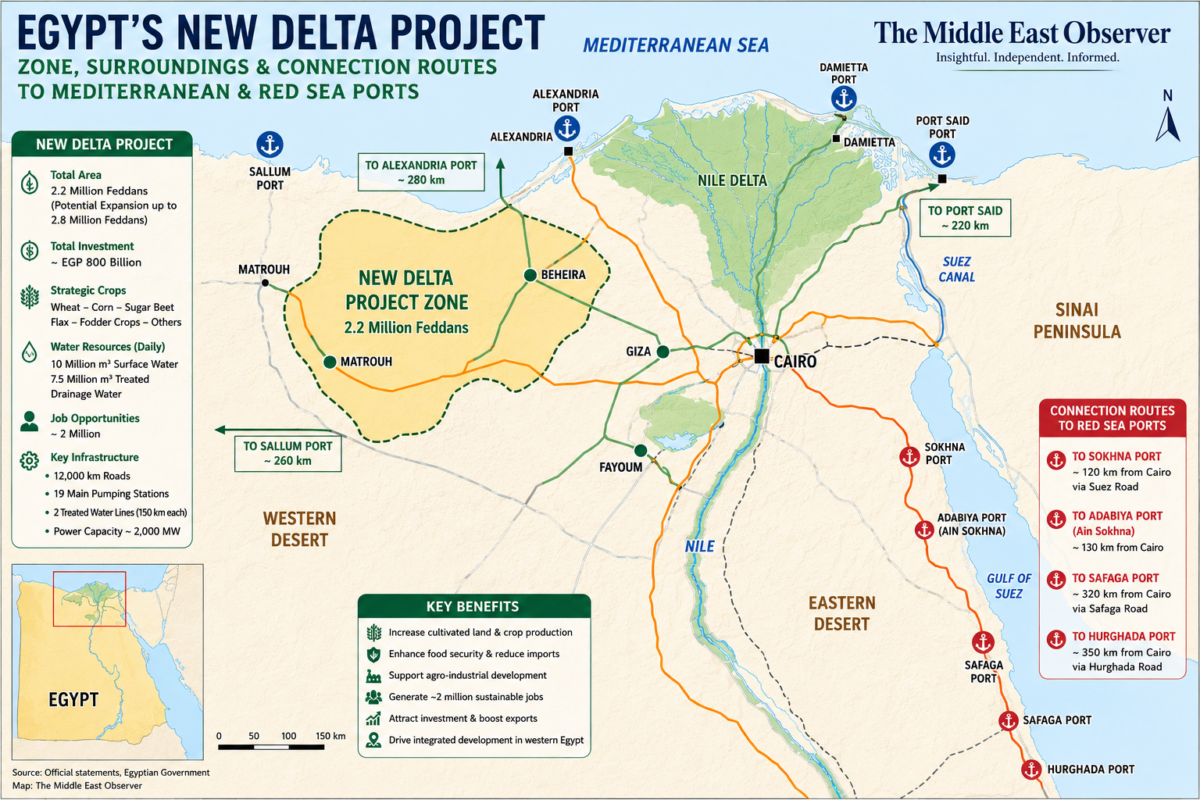
The clearest industrial outcome was agreement to launch a third phase of the China-Egypt TEDA Suez Economic and Trade Cooperation Zone, expanding activity in renewable energy, automotive manufacturing, textiles and chemical fibres.
For Egypt, TEDA offers an export-oriented industrial platform. For Chinese manufacturers, it combines a large domestic market with proximity to the Suez Canal and potential access to African, Arab and European markets where rules of origin are met.
Producing in Egypt also gives Chinese companies another manufacturing location as tariffs, industrial policy and supply-chain fragmentation reshape global trade.
Several agreements around Xi’s visit illustrate the model.
China’s ZC Rubber signed a letter of intent with the Suez Canal Economic Zone to study a tyre-manufacturing complex in Sokhna with estimated investment of about $500 million. The proposed plant would target roughly 95% of production for export.
That makes the project one of the clearest examples of the model Cairo is seeking: Chinese capital deployed in Egypt to manufacture mainly for third markets and generate foreign-currency earnings.
Chinese agricultural technology company FAMSUN separately signed an agreement with Cairo 3A and plans a further $100 million in Egyptian manufacturing and technology investment covering agricultural machinery, grain storage, feed and food processing.
Egypt’s Mansour Group and China’s Tianneng Battery Group also signed an MoU to explore battery and energy-storage manufacturing, including products for new-energy vehicles.
Together, the projects extend Chinese industrial activity beyond infrastructure into automotive supply chains, batteries, agricultural engineering and food processing.
Import substitution is only part of the gain
Not all localisation carries the same economic value.
Plants serving Egypt’s domestic market can substitute imports, create jobs and generate demand for local suppliers. Export-oriented factories can do all three while also bringing in foreign currency and connecting Egyptian production to regional supply chains.
But a factory located in Egypt is not necessarily a deep industrial gain if most machinery, components and technology remain imported.
The test for Cairo is whether localisation extends beyond final assembly into Egyptian components, engineering, skills and suppliers.
Otherwise, production may relocate to Egypt without a comparable shift in value added to Egyptian firms and workers.
That risk is particularly relevant because Chinese exports to Egypt are concentrated in industrial goods.
Electrical and mechanical machinery accounted for $4.1 billion of Egypt’s imports from China in the first half of 2026. Vehicles and related products reached $1.2 billion, while iron and steel products approached $931 million.
Egypt’s exports were much narrower. Fuels and mineral oils accounted for $494 million, followed by vegetables and fruit at $150.6 million and cotton and vegetable textile fibres at $76.4 million.
The policy challenge is therefore not simply to replace imported finished products with factories inside Egypt, but to ensure those factories gradually reduce dependence on imported industrial inputs as well.
China opens the other side of the trade equation
Cairo is simultaneously seeking greater access to the Chinese market.
Beijing began applying zero-tariff treatment to eligible Egyptian goods from May 1, 2026, as part of a wider extension of preferential access to African trading partners.
The two governments also agreed to promote more balanced bilateral trade, facilitate the entry of additional Egyptian products meeting Chinese requirements and continue consultations on an Early Harvest arrangement.
The strategy therefore has two tracks: more Chinese-backed production and exports from Egypt, and more Egyptian goods sold directly into China.
Zero tariffs remove one barrier. They do not create competitiveness.
Egyptian exporters still need to meet Chinese regulatory standards, build distribution networks, understand local demand and compete on price and scale.
The strongest opportunities are likely to emerge where Egypt can combine improved market access with established production advantages in agriculture, food processing, textiles and selected manufactured goods.
Technology raises the stakes
The partnership is also moving into higher-value sectors.
Artificial intelligence, cloud infrastructure, data centres, semiconductors and cybersecurity now sit alongside manufacturing and renewable energy in the bilateral agenda.
Digital infrastructure presents a different policy challenge from conventional factories. Investment decisions also involve data sovereignty, cybersecurity and technology standards.
Egypt therefore has an interest in attracting Chinese capacity while maintaining competition among Chinese, American, European and other suppliers.
That matters particularly because Egypt sits on major submarine-cable routes connecting Europe, Asia, Africa and the Middle East and is seeking to expand domestic cloud and computing capacity.
The financial architecture widens alongside trade
The industrial strategy is being supported by deeper financial links.
In June, the Central Bank of Egypt and the People’s Bank of China renewed their bilateral local-currency swap for three years and expanded it from RMB18 billion to RMB30 billion, equivalent to EGP203 billion under the agreement.
The September summit welcomed that expansion and called for greater use of pounds and yuan in bilateral trade and investment.
The facility gives the two countries greater scope to settle transactions without using the US dollar as an intermediary, potentially reducing dollar demand for part of Egypt’s large trade relationship with China while supporting Beijing’s push for wider international use of the renminbi.
The swap is a liquidity and settlement mechanism rather than direct investment. Its economic value will depend on how extensively businesses and financial institutions use local currencies in actual trade and investment transactions.
That distinction also applies more broadly to Chinese finance in Egypt.
Direct equity investment, concessional lending, contractor finance and commercial credit carry different implications for production, debt and the balance of payments. A $500 million factory investment, a $500 million concessional loan and $500 million of realised foreign direct investment are not economically equivalent.
The structure of Chinese capital therefore matters as much as its headline size.
China gains more than another export market
For Beijing, Egypt offers more than access to a population of over 100 million.
Manufacturing near the Suez Canal places Chinese companies closer to customers in Europe, Africa and the Middle East, diversifies production locations and can integrate them more deeply into regional supply chains.
It also embeds Chinese companies in sectors central to Egypt’s development strategy, from automotive manufacturing and renewable energy to food processing, transport and digital infrastructure.
For China, Egypt is becoming a production platform as well as a market.
For Egypt, China is becoming a source of industrial capacity as well as imports and infrastructure finance.
That reciprocity is the defining feature of the emerging architecture.
Strategic diversification supports the economic shift
The industrial expansion is unfolding alongside deeper political and security ties.
Cairo is diversifying its partnerships rather than replacing Washington with Beijing, maintaining substantial relations with the US and Europe while expanding cooperation with China and other powers.
China offers Egypt another source of capital, technology, financing and strategic options. Beijing gains a major Arab and African partner controlling one of the world’s principal trade corridors.
The political package also included Chinese recognition of Egypt’s water-security interests on the Nile, while Cairo reiterated the One-China principle. The two sides also strengthened coordination on Gaza, Sudan and Red Sea security.
These ties reinforce the economic relationship without turning it into an exclusive alignment.
Factories will determine the summit’s legacy
Xi’s visit has laid out a model for a more balanced economic relationship.
Five headline agreements, more than 20 additional cooperation documents, a third TEDA expansion and private-sector agreements across tyres, batteries and agricultural technology have moved manufacturing and supply chains closer to the centre of bilateral ties.
But the summit’s economic legacy will be determined less by the number or stated value of agreements than by what happens inside the factories: how much Egypt supplies, how much it exports and how much technology it absorbs.
If Chinese capital turns Egypt into an export platform, the bilateral deficit may remain large without continuing to define the relationship.
If factories remain heavily dependent on Chinese machinery and components, Cairo risks replacing imported finished goods with imported industrial inputs.
The summit has established the architecture for a more balanced partnership. Whether it delivers one will depend on how much production and value are created in Egypt — rather than simply routed through it.
Related News:
Egypt–Japan Align on Industrial Investment Opportunities
Egypt Posts Lowest Trade Deficit in a Decade as Exports Surge
Red also:
How MENA Can Turn Trade Corridors Into the Industrial Platform Connecting Global Blocs