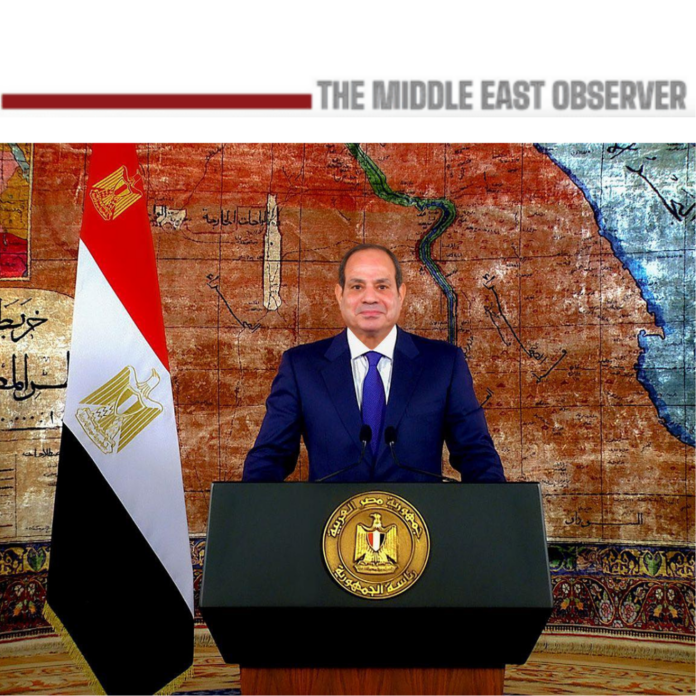
President Abdel Fattah El-Sisi has reaffirmed that his presidency will end in 2030, proposed a new system for preparing Egypt’s future leaders and sought parliamentary authorisation to defend Saudi Arabia if requested, placing political succession, institutional reform and regional security at the centre of his address on Saturday.
In a historical Speech at the Egyptian Military Academy’s graduation ceremony at the New Administrative Capital on 17 October, El-Sisi ruled out further constitutional amendments to extend his presidency, describing the end of his current term as a settled matter.
The declaration follows constitutional amendments approved in 2019 extending presidential terms from four to six years and permitted his re-election in December 2023, establishing 2030 as the scheduled end of his current mandate.
El-Sisi subsequently outlined plans to expand the Military Academy’s civilian training responsibilities through a 30-month programme exceeding 7,500 hours, designed to prepare candidates for senior positions across government, parliament and the presidency.
The proposed initiative would target doctorate holders from recognised Egyptian and foreign universities, generally aged 40–50, with cohorts potentially reaching 1,000 participants. Experienced government officials could qualify for exemptions, while the Armed Forces would finance the programme.
A committee involving parliamentary leaders, ministers and political figures would establish merit-based selection criteria and draft the necessary legislation.
ElSisi cited that experience to emphasise institutional resilience, national security and the importance of regional partnerships.
Turning to regional security, El-Sisi declared Egypt’s readiness to defend Saudi Arabia against external threats if Riyadh requested assistance, amid continuing Houthi attacks and escalation of fighting in Yemen.
He stressed that Egypt was not seeking military confrontation but would act to protect Saudi security and sovereignty, subject to parliamentary approval. The House of Representatives subsequently scheduled an emergency session for Sunday, 18 October, at 1 p.m. Cairo time.
The declaration follows El-Sisi’s discussions with Saudi Crown Prince Mohammed bin Salman in September and renewed diplomatic coordination over Red Sea security.
El-Sisi also recalled the economic disruption following Egypt’s 2011 uprising, attributing losses of approximately $450 billion to years of political instability, strikes and interrupted economic activity. He said the Armed Forces had provided EGP 80 billion to support the economy during the crisis and acknowledged the financial and energy assistance extended by Gulf countries, particularly Saudi Arabia, the UAE and Kuwait, after 2013.
The address established two immediate priorities on different timetables: parliamentary consideration of possible Saudi defence assistance and legislation defining how Egypt will prepare future national leaders before the scheduled 2030 presidential transition.
The significance of El-Sisi’s address extends beyond its immediate announcements. By reaffirming 2030 as the definitive end of his presidency, proposing a structured programme to prepare future national leaders and seeking parliamentary authorisation for potential defence assistance to Saudi Arabia, the president addressed longstanding questions surrounding political succession, the Armed Forces’ institutional role and constitutional accountability.
His commitment to a defined presidential timetable directly challenges speculation circulating on social media about further extensions of his tenure, while the proposed leadership programme signals an effort to establish a sustainable pipeline of qualified officials capable of assuming national responsibilities. Equally significant, referring the Saudi defence question to Parliament underscores the constitutional procedures governing military commitments, consistent with Egypt’s stated commitment to regional stability and peace.
Together, these initiatives outline a framework for political transition, institutional continuity and responsible regional engagement. Their lasting significance will depend on translating presidential commitments into transparent legislation, effective leadership development and constitutional safeguards that strengthen state institutions while preserving civilian governance and political participation.
Related news:
Empowering Egyptian Students: A Revolutionary Scholarship Initiative
Meta Appoints Dina Habib as President in Strategic Leadership Shift
Read also:
IMF Signals Structural Economic Shift Across MENA
El-Sisi Reviews Inflation, Reserves and Exchange-Rate Stability Amid Regional Pressures